
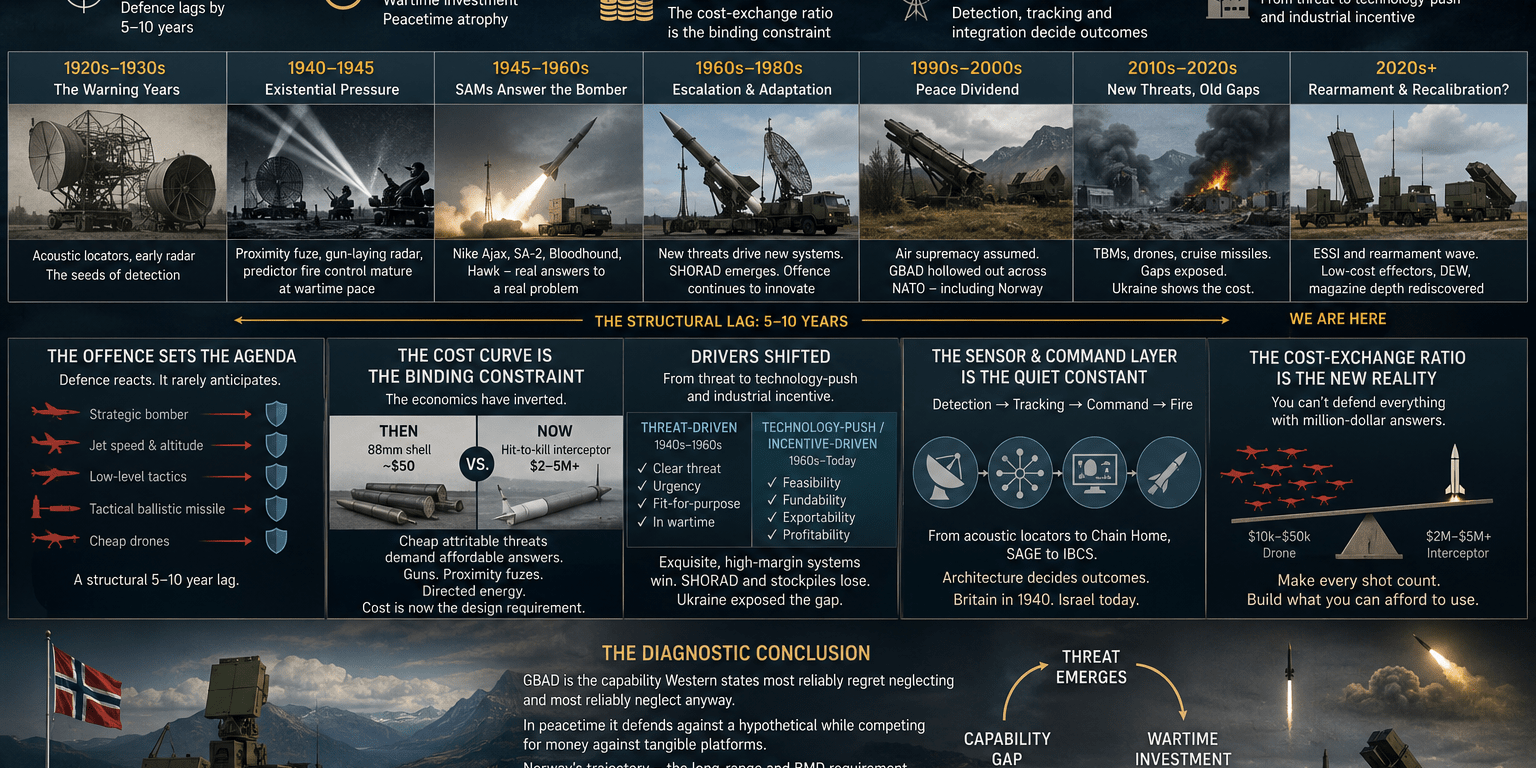
A century of Western ground-based air and missile defences shows a discipline that is structurally reactive, cyclically neglected, and now economically — not technically — constrained.
The offence has set the agenda in every era, with the defence lagging by five to ten years; investment has come in wartime bursts followed by peacetime atrophy; and the true long pole has been the sensor and command layer, not the interceptor. Threat-driven development dominated through the early Cold War, but from the 1960s onward technology-push and industrial incentive increasingly shaped what was built — favouring exquisite, high-margin systems while SHORAD, magazine depth, and munitions stockpiles were neglected. Ukraine has exposed the cost of exactly those choices, and the binding constraint on Western air defence today is the cost-exchange ratio, a problem the industry only began treating as a design requirement in the last two to three years.
With that stated, the supporting analysis:
Development comes in wartime bursts. The proximity fuze, gun-laying radar, and predictor fire control matured under existential pressure between 1940 and 1945 at a pace peacetime budgets have never replicated. The SAM era was forced by the nuclear-armed strategic bomber — Nike Ajax, SA-2, Bloodhound, Hawk were real answers to a real problem, and the timelines showed it. The 1990s and 2000s show the reverse: assumed permanent air supremacy hollowed out GBAD across nearly every NATO army, including Norway’s. The West builds air defence when frightened and dismantles it when not. ESSI and the current rearmament wave are the latest oscillation of that cycle, not a departure from it.
The offence sets the agenda. In a hundred years there is scarcely a case of defensive capability genuinely anticipating a threat. Radar answered the bomber; SAMs answered jet-age speed and altitude; SHORAD answered the low-level tactics that SAMs themselves forced; PAC-2/PAC-3 answered the tactical ballistic missile after the 1991 Scud campaigns exposed the gap. The low-cost interceptor cluster launched at Farnborough this month answers the Shahed-class drone four years after Ukraine demonstrated the problem at scale. That five-to-ten-year lag is structural, and worth internalising when reading any manufacturer’s roadmap. In-depth analysis.
The cost curve is now the binding constraint. A wartime 88mm shell cost pocket change; a modern hit-to-kill interceptor costs millions. For seventy years this was tolerable because targets were themselves expensive and scarce. The cheap attritable drone inverted the equation, and the industry is now scrambling back down its own cost curve — rediscovering guns (Gepard’s second career in Ukraine being the emblematic case), cheap proximity-fuzed effectors, and directed energy. The technically hardest problem, hitting the target, was largely solved decades ago; the economically hardest problem, hitting it affordably, is only now being treated as the design requirement rather than a footnote. In-depth analysis.
Drivers shifted from threat to technology-push and industrial incentive. Wartime and early Cold War programmes were overwhelmingly threat-driven. From the 1960s onward the record shows something else creeping in: the Nixon-era ABM debates were as much about feasibility and fundability as need; SDI is the clearest case of technological ambition outrunning both the threat assessment and the physics; and in the post-Cold War export market, systems were visibly marketed into requirements rather than derived from them. Industry preferred exquisite, high-margin solutions because that is where the profit sits — while unglamorous SHORAD and stockpile depth were consistently deprioritised. Ukraine has revealed precisely which neglected categories mattered. In-depth analysis.
The sensor and command layer is the quiet constant. From acoustic locators to Chain Home to SAGE to today’s IBCS-style integration efforts, air defence history is substantially a history of detection, tracking, and fire coordination. Nations that invested in the network layer — Britain in 1940, Israel today — have consistently outperformed nations that bought launchers without architecture. In-depth analysis.
The diagnostic conclusion: GBAD is the capability Western states most reliably regret neglecting and most reliably neglect anyway, because in peacetime it defends against a hypothetical while competing for money against tangible platforms. Norway’s own trajectory — the long-range and BMD requirement deferred to 2033 under Prop. 68 S — sits squarely within the hundred-year pattern, not outside it. Whether the current rearmament cycle breaks the pattern or repeats it will only be knowable in retrospect. In-depth analysis.
AI-assisted article.

