
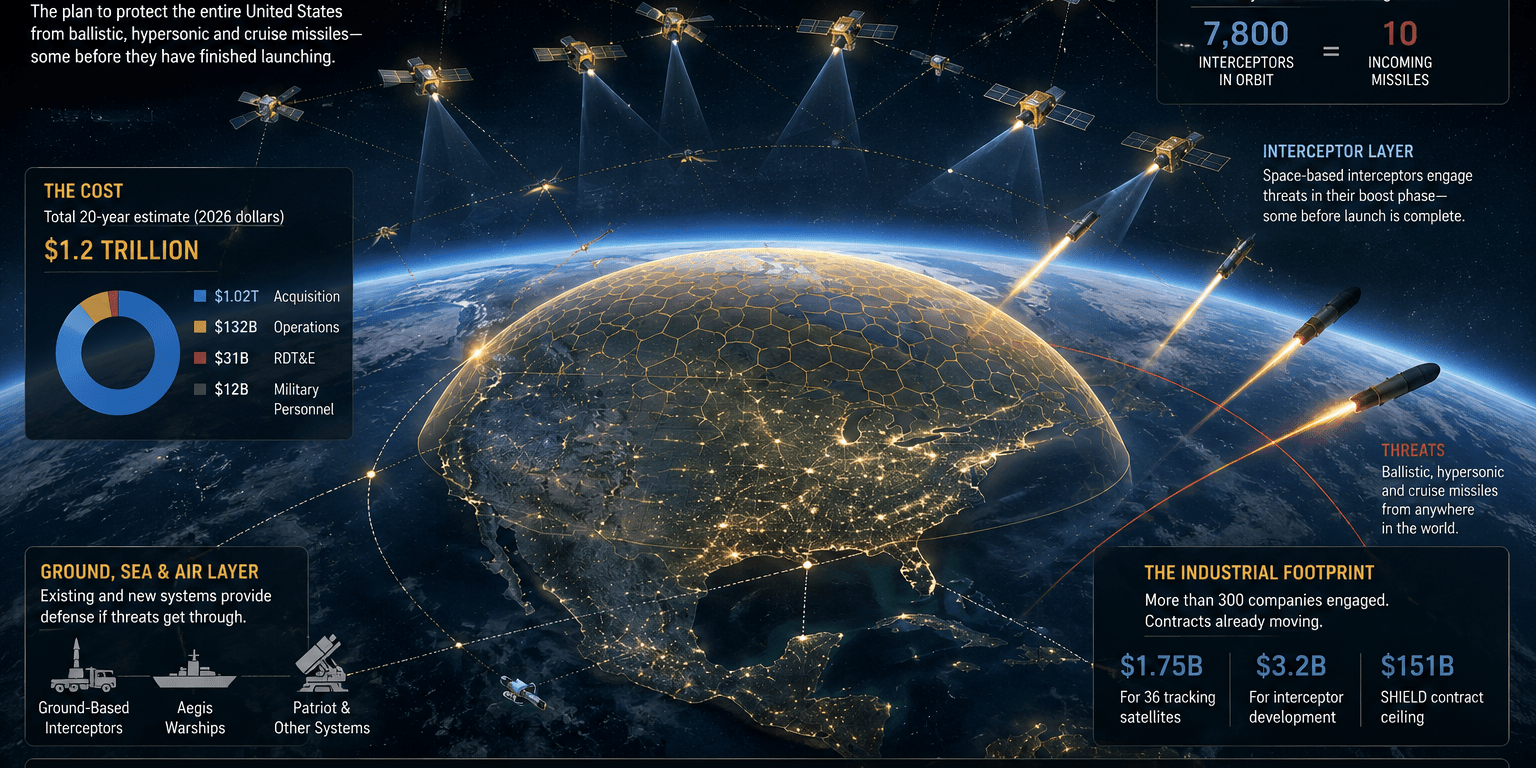
An analysis of the largest air and missile defence undertaking ever attempted, read through the discipline this site applies to every system: what the interceptors cost, who builds them, and what the arithmetic permits
Two statements were made in July 2026, ten days apart, by people at opposite ends of the air defence market. Neither referenced the other. Together they define where the entire field now stands.
The first came at Farnborough on 20 July, where — as we analysed at the time — three manufacturers launched low-cost interceptors within hours of each other, publicly conceding that the unit price of the round, not its performance, is the binding constraint on Western air defence. The second came in Washington on 17 July, when the Senate confirmed Space Force General Michael A. Guetlein to run Golden Dome — the plan to place a missile shield over the entire United States — clearing the way for a program that could ultimately cost well over $175 billion, spanning the Space Force, the Missile Defense Agency, the Army, the Navy and the Air Force, and promising something no country has ever managed: to shoot down ballistic, hypersonic and cruise missiles aimed at the homeland, some before they have finished launching.
One end of the market is racing toward the cheapest possible interceptor. The other end is proposing the most expensive interceptor architecture ever conceived. What makes July 2026 remarkable is that both ends have now said, on the record, that they are constrained by the same thing. The general running Golden Dome has described his hardest problem in words that could have been lifted from this site’s cost database: space-based interception, he argues, is not a physics problem but “an economics, scalability problem,” adding that a capability that cannot be delivered affordably and at scale makes no sense to pursue, because the nation cannot be bankrupted for it.
This article examines Golden Dome the way this site examines every system: through the contracts, the cost decomposition, and the exchange arithmetic. It is written for a European readership, because — as we will argue — the program is not an American domestic story. It is a demand shock in the home market of the supplier that most of Europe queues behind.
What Golden Dome is, by document rather than by slogan
The program’s paper trail is short and steep. President Trump issued Executive Order 14186, “The Iron Dome for America,” on 27 January 2025 — seven days into his second term — and soon renamed it Golden Dome, partly to distinguish it from Israel’s Iron Dome, which has far more limited capabilities. He approved a Pentagon plan at the end of May 2025, pinning the cost at around $175 billion, with a layered concept: satellites in orbit to detect and track a launch within seconds; a mix of ground-, sea- and space-based interceptors; and an AI-enabled command network fast enough to tie it together.
The conceptual lineage is older than the press coverage suggests. Reagan’s 1983 Strategic Defense Initiative included the Brilliant Pebbles proposal — thousands of small autonomous satellites orbiting Earth to detect and intercept missiles in space — and Golden Dome builds on that research toward what would be the first-ever fielded space-based interceptors. The idea has been priced before, and shelved before. What is new is the political commitment, the money beginning to move, and the industrial method.
That method is unusually opaque. In 2025 the Pentagon issued a gag order forbidding military officials from discussing the technical specifics of Golden Dome’s architecture, and Guetlein revealed in late 2025 that he had held one-on-one talks with more than 300 private companies to shape it. Guetlein has defended the secrecy on the grounds that the intelligence threat is high. For analysts, this means the honest data is not the architecture — which is classified — but the contracts, which are public. And the contracts are instructive.
The sensing layer is being bought now, at pace. On 14 July, the Space Development Agency announced agreements worth a combined $1.75 billion with L3Harris Technologies and Sierra Space for 36 missile-tracking satellites — 18 each — growing the Tranche 3 tracking constellation, with all 36 expected to be launch-ready by the end of 2028. A roughly $2 billion missile-tracking ship program adds a maritime sensing element. The interceptor layer, by contrast, is being explored rather than bought: the Space Force has awarded 20 contracts worth up to $3.2 billion to 12 companies to develop space-based interceptor capabilities, which it expects to begin integrating with Golden Dome in 2028. And the contracting superstructure is enormous relative to the money actually committed: the Missile Defense Agency’s SHIELD contract vehicle carries a total ceiling of $151 billion across all awardees, while only $23 billion has been allocated to the program so far.
Read together, the contracts describe a program that is certain about sensing, uncertain about intercepting, and structured to keep every option open. That is not a criticism. It is precisely what one would expect from a program whose central question is unresolved — and the central question was put on the table, in public, by the Congressional Budget Office in May.
The arithmetic: 7,800 satellites to stop ten missiles
CBO’s May 2026 report estimated the twenty-year cost of developing, deploying and operating the system described in the executive order at $1.2 trillion in 2026 dollars — roughly twice its estimate from the year before — with just over $1 trillion of that for acquisition. The headline number travelled around the world. The decomposition behind it matters more, because it locates exactly where the money is and why.
The problem is orbital mechanics meeting reaction time. To destroy a missile in boost phase, an interceptor satellite must already be close enough to the launch site to engage within roughly three to five minutes for an ICBM. Satellites in low Earth orbit move continuously and cannot hold position over a point on the ground, so thousands of interceptors are needed to guarantee that enough are always near potential launch areas. CBO estimates about 7,800 interceptor satellites would be required simply to engage a salvo of ten nearly simultaneous ICBM launches — and maintaining that capability over two decades would require about 30,000 satellites in total. Each satellite is estimated at $22 million with a five-year service life, meaning the initial constellation must be followed by at least 1,600 replacement satellites every year; the space-based component alone would cost $723 billion to acquire and deploy, against about $139 billion for the ground- and sea-based systems.
Note what the driver is not. Even under aggressive assumptions about future launch economics, including heavy-lift systems such as Starship, CBO concludes launch expense is not the principal obstacle — the scale of the constellation and the perpetual replenishment are. This is worth dwelling on, because it means the cost problem is structural rather than technological. Cheaper rockets do not fix it. The constellation is large because the Earth rotates and orbits precess; the replenishment is perpetual because atmospheric drag limits the service life of low-orbit systems to roughly five years. The interceptor magazine, in other words, evaporates on a schedule — whether or not a single missile is ever fired at the United States. Readers of our Patriot cost analyses will recognise the pattern in extreme form: the magazine, not the fire unit, dominates lifecycle cost. Golden Dome’s orbital magazine is one that must be repurchased in its entirety every five years.
The remaining layers are, by comparison, conventional and comprehensible. CBO’s architecture includes three fields of interceptor silos — the existing Ground-Based Interceptor field at Fort Greely, Alaska, plus two new Next-Generation Interceptor fields likely in the northeastern and southern United States, at about $15 billion each to build and $410 million annually to operate — and a space tracking constellation of 108 low-orbit and 27 medium-orbit satellites at around $69 billion.
And then there is the sentence that should anchor every serious discussion of the program. CBO explicitly stated that even the notional system it modeled could still be overwhelmed by a large-scale attack from China or Russia — and that removing the space-based interceptors from the architecture would lower the twenty-year estimate from $1.2 trillion to about $448 billion.
Ten missiles is the design case. 7,800 satellites is the price of it. The attacker’s cost of an eleventh missile is measured in tens of millions; the defender’s cost of covering it is measured in constellation fractions. This is the cost-exchange problem this site has documented from the Shahed upward, restated at the strategic ceiling.
The program chief agrees with the diagnosis
What separates Golden Dome from its ancestor programs is not the physics. It is that the man running it talks like a cost analyst.
Guetlein has told Congress that space-based interceptors are not guaranteed to be part of Golden Dome’s architecture, and that if the technology is not both affordable and scalable, the Pentagon will not pursue it. He has said CBO’s estimate does not meet the program’s affordability targets, and that he is pushing industry to offer” interceptors at lower price points — noting that the homeland problem and the regional-defence problem call for different architectures. His formulation of the core issue — an economics and scalability problem rather than a physics problem, bounded by the principle that one cannot bankrupt the nation — was delivered alongside the observation that CBO never consulted his office about the actual architecture under development.
Set that against Farnborough. In our analysis of the low-cost interceptor cluster, we quoted the Destinus chief executive arguing that using expensive missiles against cheap threats is arithmetic that eventually stops working, and that no economically viable architecture can engage every incoming round. Guetlein is making the same argument from the opposite end of the threat spectrum — where the incoming round is an ICBM and the interceptor is a satellite. The most heavily funded air defence official on Earth and the manufacturers of the cheapest interceptors in Europe have converged on the identical proposition: intercept performance is available; intercept economics is the frontier.
This convergence has a practical implication for how the program should be read. Golden Dome is frequently described as a decision that has been made. The contract record and the director’s testimony describe something else: a sensing architecture being built with real urgency, wrapped around an interceptor question that remains genuinely open, with the answer explicitly conditioned on whether industry can break the cost curve that CBO has quantified. The program, in effect, contains its own referendum on the central thesis of the past three years of air defence experience — and its director has stated the terms of that referendum in public.
The fiscal context sharpens the terms. Defense Secretary Hegseth has told lawmakers the Pentagon needs close to $90 billion in supplemental funding, with $37.5 billion tied directly to operations from the Iran conflict. The same interceptor stockpiles whose depletion we documented in our March analysis of the post-Epic Fury environment are being rebuilt from the same budget that must eventually fund the constellation. Money is fungible; production capacity, as we turn to next, is not.
Why this matters in Oslo, Warsaw, Seoul and Ottawa
The globally relevant fact about Golden Dome is not its ambition. It is its position in the supply chain.
The United States is the home market of the industrial base that produces PAC-3, THAAD, the SM family, GMD and NGI — the systems that anchor allied missile defence from Poland to Japan, and the systems for which allied customers already wait in Foreign Military Sales queues measured in years. Golden Dome is, whatever else it becomes, the largest new demand signal ever injected into that base. The Atlantic Council’s assessment states the consequence plainly: if Golden Dome achieves its goals, it will shift resources toward space-based missile defence and could disrupt the current market, which consists mainly of ground- and naval-based sensors and interceptors. No US ally or partner in Europe, the Middle East or Asia has a space industry that could credibly invest in the new domain — so strategic cooperation on Golden Dome likely means allies procuring future US systems, with added incentives for co-production.
Three distinct mechanisms deserve separation, because they are usually blurred together.
The first is absorption. Engineering talent, production slots, prime-contractor management attention and sub-tier supplier capacity are finite. A program with a $151 billion contract ceiling competes for those resources against every FMS case in the queue — including the European orders this site tracks. Whether Golden Dome crowds out allied deliveries or, through volume, eventually expands the shared base is the single most consequential open question for European procurement planners, and it is currently unanswerable, because the architecture is classified and the interceptor decision unmade.
The second is consultation, or its absence. The January 2025 executive order required an Allied and Theater Missile Defense Review to be completed by 15 May of that year — yet many key allies and partners appear not to have been consulted, and analysts have argued that a US wish to leverage allied industrial bases would be well served by giving those allies a heads up. Russia and China, meanwhile, have messaged aggressively that Golden Dome is destabilising and arms-race-inducing, or alternatively that the United States is incapable of building it. Chinese analytical writing points to a deficient US industrial base and the Next Generation Interceptor program’s difficulties, predicts Sentinel-style cost overruns against high US debt levels, questions whether the program survives beyond the current administration, and speculates that America First burden-sharing pressure could generate exactly the allied friction that undermines the cooperation the program requires. Adversary analysis is self-interested, but the specific failure modes it lists — industrial capacity, integration, political continuity — are the same ones a friendly analyst would list.
The third is precedent, and here Canada is the case study every ally should read. The Pentagon linked Prime Minister Carney’s ambivalence over the Golden Dome proposals to its decision to pause the US-Canada Permanent Joint Board on Defence — a seventy-year-old institution suspended, at least in part, over a missile defence disagreement. Canadian analysts have mapped the deeper institutional risk: if the United States constructs Golden Dome largely outside the NORAD command structure, Ottawa could find itself providing surveillance and base access while engagement authority migrates toward unilateral US command pathways — retaining symbolic partnership while losing actual decision-making authority. Canada has been here before, having explored joining US ballistic missile defence in 2004 and formally declined in February 2005 over sovereignty, strategic stability and space concerns. The Canadian dilemma — participate on terms set elsewhere, or abstain and accept a defended neighbour’s decisions — is a preview of the choice that will eventually reach every US ally under a missile threat, in one currency or another.
For the European frameworks this site follows — ESSI, EDIP, the Anti-Ballistic Missile Coalition — Golden Dome functions as a boundary condition. It fixes, for the next decade, where the deepest pool of missile defence capital and engineering effort in the world will be spent: on the American homeland. Europe’s decision space is what remains. That is not an argument for or against any European choice. It is the planning fact against which every European choice will be made.
Provisional conclusions
Golden Dome should be read, at this stage, as three programs wearing one name. The first — proliferated space sensing — is real, contracted, and moving on schedule; it will exist regardless of what else happens, and it will benefit allied warning indirectly. The second — expanded ground-based homeland defence, the silo fields and NGI — is conventional, expensive and comprehensible; CBO prices it in the low hundreds of billions, and it extends an existing capability rather than inventing one. The third — the orbital interceptor constellation — is the program’s identity, its dominant cost, and its unmade decision. On CBO’s arithmetic it is 60 percent of the money; on the director’s own testimony it is contingent on a cost breakthrough that industry has not yet demonstrated.
Our assessment discipline requires the same caution here that we apply to concept-stage interceptors at trade shows, and the caution cuts identically: announced systems have a documented tendency to converge upward in price, and no figure in this article should be treated as settled until contracts convert it. The difference is scale. When a European SHORAD round misses its price target, a procurement plan slips. If the constellation misses its price target, the outcome shapes the strategic balance, the space environment, allied command relationships and a trillion dollars of opportunity cost.
And beneath all of it sits the exchange ratio, which no architecture escapes. Ten simultaneous ICBMs is the design case that yields 7,800 satellites. The marginal cost of the attacker’s eleventh missile is a rounding error against the defender’s constellation; CBO itself concludes the modeled system could be overwhelmed by a large-scale peer attack. This site asked, in an earlier analysis, what “enough air defence” could structurally mean, and answered that the attacker’s choice of time, place and axis makes the question unanswerable by volume alone. Golden Dome is the largest test of that proposition ever funded. Its director, to his credit, appears to understand this better than many of the program’s advocates — which is why his economics-not-physics formulation may prove the most consequential sentence spoken about air defence in 2026.
The referendum has dates. Interceptor integration is expected to begin in 2028; the replenishment mathematics begin the moment the first tranche flies; and the budget requests between now and then will show whether the constellation survives contact with appropriators. We will track the program as we track every system in the cost database: by what is signed, not what is announced.
AI-assisted article.

