
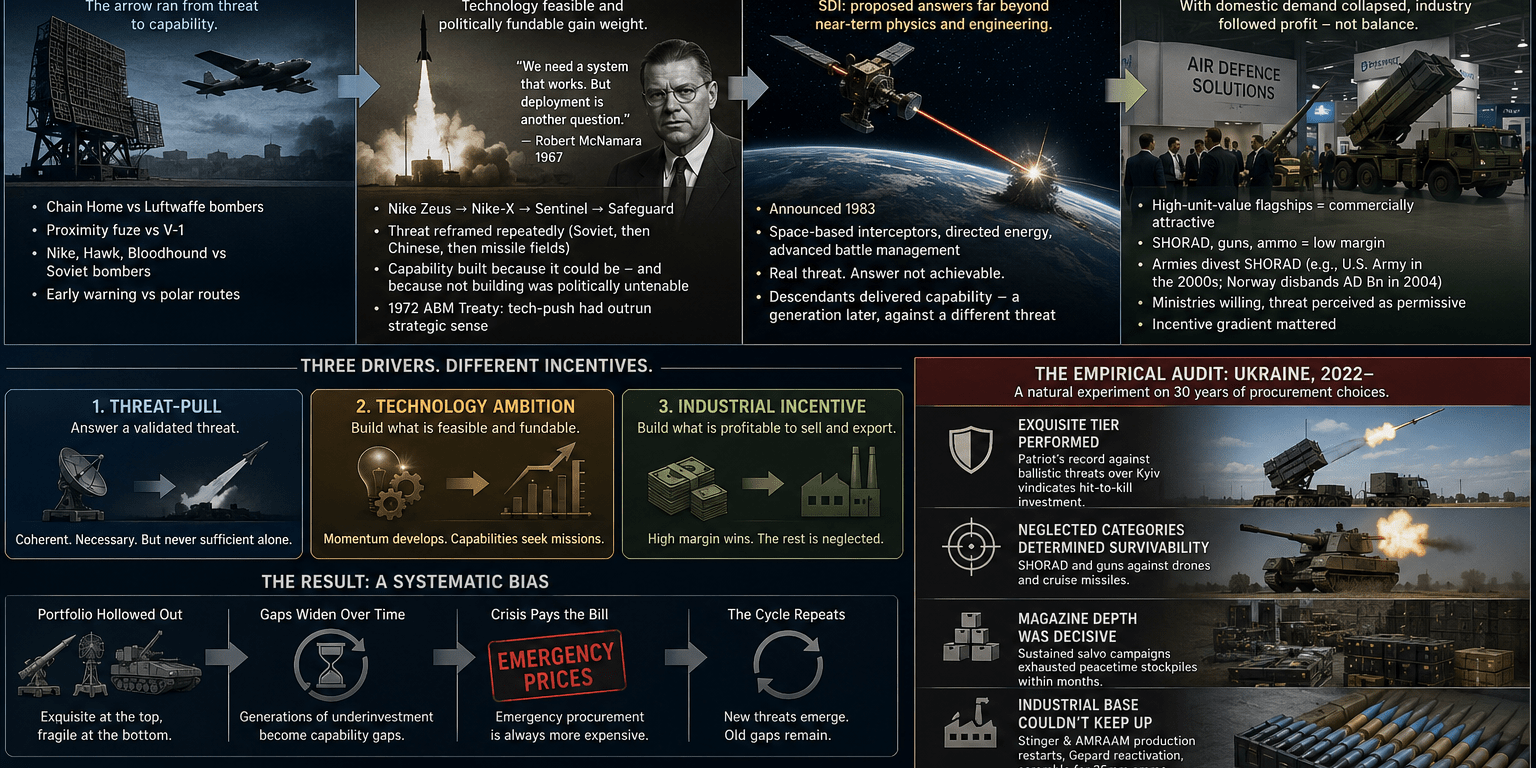
Wartime and early Cold War air defence programmes were overwhelmingly driven by validated threats. From the 1960s onward, the record shows two other drivers gaining weight: technological ambition — what was feasible and fundable — and industrial incentive — what was profitable to build and export. The result was a systematic bias toward exquisite, high-margin systems and a systematic neglect of unglamorous SHORAD and stockpile depth. Ukraine has revealed, empirically, which of those neglected categories mattered.
Distinguishing the drivers of a defence programme is inherently difficult, because every programme is publicly justified by threat. No system has ever been announced as an answer to industrial capacity seeking a market. The analytical task is therefore to read the record for cases where the stated threat and the built capability diverge — and across a century, such cases cluster distinctly in time.
They do not cluster in the first half of the record. The programmes of 1935 to 1960 track their threats with almost mechanical fidelity. Chain Home tracked the Luftwaffe’s bomber expansion; the proximity fuze tracked the V-1; Nike, Hawk, and Bloodhound tracked the Soviet strategic bomber force; the early warning networks tracked the polar attack routes. Development timelines, basing decisions, and even the technical parameters of these systems map directly onto contemporaneous intelligence assessments. Whatever else may be said of the era, the arrow ran from threat to capability.
The 1960s American ballistic missile defence debate is where the record first shows the arrow bending. The progression from Nike Zeus through Nike-X to Sentinel and finally Safeguard was shaped as much by what was technically demonstrable and politically fundable as by a stable threat assessment. The threat itself was interrogated and reframed repeatedly — Soviet ICBMs, then Chinese ICBMs, then protection of missile fields rather than cities — while the technology programmes rolled forward with considerable momentum of their own. McNamara’s own public ambivalence, announcing Sentinel while arguing against the strategic logic of deployment, captured the dynamic: the capability was being built partly because it could be, and because not building it was politically untenable, rather than because the threat analysis demanded it in the form built. The 1972 ABM Treaty was, among other things, a mutual recognition that the technology-push dynamic had outrun strategic sense on both sides.
The Strategic Defense Initiative is the clearest case in the century. Announced in 1983, SDI proposed a comprehensive shield against a massed Soviet ICBM strike using technologies — space-based kinetic interceptors, directed-energy weapons, the associated battle management — that did not exist and, in several cases, contradicted near-term physics and engineering reality. The threat was real; the proposed answer bore little relationship to what was achievable within any relevant timeframe. Whatever second-order strategic effects one attributes to the programme, as an air and missile defence development effort it stands as the paradigm of technological ambition outrunning both the threat assessment and the physics. Its descendants — the sensor architectures, the hit-to-kill lineage — delivered real capability, but a generation later and against a different threat than the one that justified the original funding.
The post-Cold War export market introduced the third driver in its purest form. With domestic procurement collapsing after 1991, Western air defence industry survived substantially on export, and the export market has its own logic: flagship systems with high unit values, long support tails, and prestige value for the purchasing government are commercially attractive; cheap effectors, gun systems, and ammunition stockpiles are commercially marginal. The observable result, documented across this site’s comparative procurement coverage, is a generation of Western inventories rich in exquisite upper-tier capability and hollow below it. The United States Army divested essentially its entire manoeuvre SHORAD capability in the 2000s; most European armies did the same or nearly so — Norway’s Army lost its organic air defence with the disbandment of the air defence battalion in 2004, a case examined below and in our earlier root-cause analysis of the Norwegian long-range procurement delay. It would overstate the case to attribute the SHORAD collapse to industry preference alone; the permissive threat assessment of the era was genuine, and ministries made these choices willingly. But the incentive gradient mattered: no major Western prime spent the 2000s lobbying governments to buy more gun ammunition, and the systems that were marketed hard into export requirements were, consistently, the high-margin tier.
The empirical audit arrived in February 2022. Ukraine’s air defence war has functioned as a natural experiment on three decades of Western procurement choices, and the results are uncomfortable in a specific, patterned way. The exquisite tier has performed — Patriot’s record against ballistic threats over Kyiv vindicates the hit-to-kill investment. But the categories that determined day-to-day survivability were precisely the neglected ones: SHORAD and gun systems against drones, magazine depth against sustained salvo campaigns, and munitions production capacity against consumption rates that exhausted peacetime stockpiles within months. The Stinger and AMRAAM production restarts, the emergency Gepard reactivation, and the scramble for 35mm ammunition are all, in effect, invoices for the incentive structure of the preceding thirty years — now being paid at emergency prices.
The pattern has a contemporary application. The current European rearmament wave — ESSI, EDIP, the Anti-Ballistic Missile Coalition endorsing new low-cost interceptor production that this site covered in July — is publicly framed as pure threat response, and much of it is. But the structural drivers identified above have not disappeared; if anything, a rapidly expanding budget environment amplifies them. The analytical discipline this record recommends is not cynicism but decomposition: for each announced programme, ask which portion answers a validated threat, which portion answers what industry is currently positioned to sell, and which portion answers what is politically fundable this cycle. The three overlap; they are never identical. Where they diverge is where the next generation’s gaps are being written — and, on the century’s evidence, where the next war’s emergency procurement will be found.
AI-assisted article.

