
Why lasers are the most-discussed answer to the drone problem, why the physics favors ships over vehicles, and why Norway would face a double disadvantage in adopting them
Premises
This article examines the state of directed-energy weapons — high-energy lasers in particular — as a candidate solution to the short-range air defense problem this site analyzed in its previous piece. It updates the site’s March 2025 survey of European laser programmes, which is now substantially out of date: since then, the world’s first laser air-defense system has entered operational service, one major army has cancelled two ground-based laser programmes, and Europe’s naval laser efforts have moved from demonstrator to production contract.
The analysis presents data, not recommendations. It proceeds from a single organizing claim that the reader can test against the evidence: lasers are frequently presented as the escape hatch from the cost asymmetry that defines drone warfare — near-zero cost per shot, unlimited magazine — but the escape hatch is not yet open for the tier and the conditions where Norway would need it. Front-line applications and strategic ballistic-missile defense lie outside the scope; the focus is the same as before — protection of infrastructure and maneuver forces against drones, rockets, and mortars.
A laser solves magazine depth. It does not, yet, solve engagement rate — and saturation is an engagement-rate problem.
Part 1: What Changed — The Technology Crossed a Threshold
The March 2025 survey treated operational laser air defense as imminent but unproven. That is no longer the correct framing. In late December 2025, Rafael delivered the first operational 100-kilowatt Iron Beam system to the Israeli Defense Forces — the transition, in the manufacturer’s own terms, from testing to serial production, and the first time a directed-energy weapon of this class has entered regular service with any military. The system reaches out to roughly 7–10 kilometers, requires two to five seconds of beam dwell to destroy a target, and is integrated as the innermost layer of Israel’s multi-tier shield, beneath Iron Dome, David’s Sling, and Arrow.
Two developments since confirm the threshold has been crossed rather than merely approached. Israel has publicly discussed early combat use against rockets and drones from Lebanon in the spring of 2026, and in July the Defense Ministry announced tests pairing Iron Beam with an upgraded Iron Dome — a laser and a missile system cueing from the same battle-management picture and choosing, per threat, which effector is cheaper to expend. That pairing is the operational concept the entire field has been working toward: the laser handles what it can, the missile handles what the laser cannot, and the expensive interceptor is conserved for the threats that justify it.
So the headline is real: laser air defense works. The rest of this article is about the conditions under which it works, and the ones under which it does not.
Part 2: The Physics Chose Ships
The most revealing pattern in current procurement is which platforms are advancing and which are being abandoned — because the split is not driven by budgets or doctrine. It is driven by two physical requirements a high-energy laser cannot escape: the electrical power to generate the beam, and a place to dump the enormous waste heat that generation produces.
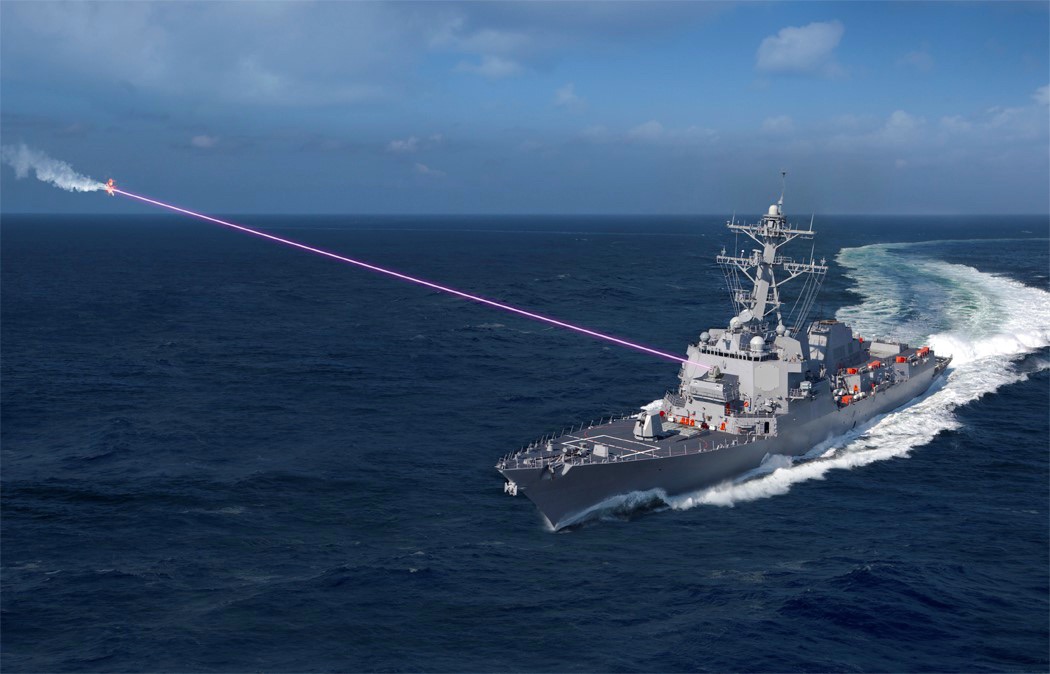
Ships supply both effortlessly. A warship has megawatts of generating capacity and an unlimited heat sink surrounding the hull. It is no accident that Europe’s serious laser programmes are naval. The United Kingdom has contracted MBDA to deliver DragonFire — a 50-kilowatt-class system — to Royal Navy Type 45 destroyers from 2027, five years earlier than originally planned, after successful firing trials in the Hebrides. Germany’s Rheinmetall and MBDA Deutschland, building on a demonstrator that fired more than a thousand shots from the frigate Sachsen across a year and 28,000 nautical miles of real-world conditions, are forming a joint venture to field a naval laser expected operational around 2029. The US Navy’s HELIOS is already at sea.
The land side tells the opposite story, and it is told most bluntly by the army with the deepest laser experience on earth. The US Army cancelled its Directed Energy Maneuver-Short Range Air Defense programme — a 50-kilowatt laser on a Stryker chassis, precisely the gun-SHORAD-replacement concept a drone-saturated battlefield seems to demand. Four prototypes went to the Middle East for soldier assessment; the feedback was not positive. The Army’s acquisition head described the core problem in terms that should be read carefully by anyone treating lasers as a near-term ground solution: a 50-kilowatt power level proved challenging to incorporate into a vehicle that has to move constantly — the heat dissipation, the electronics, the wear of a tactical environment versus a fixed site. A Congressional Research Service review found that results from the lab and the test range were very different from the tactical environment. The Army has since also stepped back from its 300-kilowatt IFPC-HEL effort, reducing it to a single prototype that will not become a programme of record, folding the work instead into a joint Army-Navy counter-cruise-missile laser programme.
The lesson is not that ground-based lasers are impossible. It is that the tier where the drone threat is most acute — mobile, dispersed, protecting maneuvering forces — is precisely the tier where laser physics is hardest, and that the most experienced operator in the world has now twice declined to field a vehicle-mounted laser SHORAD. Europe is accelerating on ships. On land, it is largely still testing.
Part 3: The Cost-Per-Shot Trap
Every laser headline leads with the same number. DragonFire is marketed at roughly £10 per shot. Iron Beam is quoted at $2 to $5. Against a Tamir interceptor at around $50,000, or a PAC-3 at several million, the figure looks like the end of the cost-asymmetry problem this site has documented since the January database.
The number is true and also misleading, in two distinct ways that matter for procurement.
First, it is a marginal cost — the electricity for one shot — and it excludes everything that makes the shot possible. The laser director, the power generation, the thermal management, the tracking radar, the beam control, the crew: a full Iron Beam battery is estimated in open sources at somewhere between $100 million and $200 million, and each laser director unit alone at tens of millions. The per-shot figure is real for the marginal engagement, but the capability is not cheap; it front-loads its cost into the system rather than spreading it across the magazine. Comparing $3 of electricity against $50,000 of missile answers a question — magazine cost — that is not the same as the question of whether the system is affordable to field at the density required.
Second, and more fundamentally: a laser solves the wrong half of the saturation problem. Missiles have shallow magazines and high engagement rates — a battery can put many interceptors in the air near-simultaneously, then runs dry. A laser has an infinite magazine and a low engagement rate — it engages one target at a time, holds the beam on it for two to five seconds, slews, and engages the next. Against a trickle of threats, the infinite magazine is decisive. Against twenty Shaheds arriving together, sequential three-second engagements are not a saturation defense; they are a queue. This is the precise inverse of the gun profile — high rate, cheap rounds, shallow-ish magazine — which is why the countries buying lasers (the UK, Germany) are the same countries running gun-SHORAD programmes. The two effectors cover each other’s weaknesses. Neither substitutes for the other, and a laser bought as a saturation answer will disappoint in exactly the scenario that motivated the purchase.
The cost-per-shot figure answers a magazine question. Saturation is a rate question. A laser’s infinite magazine does not help when twenty threats arrive in the time it takes to burn through three.
Part 4: The Weather Problem — and Why It Is Norway’s Problem Specifically
There is a further constraint that receives little attention in the cost-per-shot coverage, and it happens to be the one most relevant to Norwegian conditions.
A laser delivers energy as a concentrated beam of light, and light degrades as it passes through the atmosphere. Humidity, precipitation, fog, and airborne aerosols scatter and absorb the beam, reducing the energy that arrives on target and lengthening the dwell time needed to destroy it — which, in turn, further reduces the already-limited engagement rate. Norway’s own defense research establishment has been unusually candid about this. FFI is running atmospheric-propagation research at Kjeller under a heading that states the problem plainly: laser weapons need weather forecasting. At an FFI seminar in the spring of 2026, researchers noted that neutralizing small drones is a matter of seconds under good conditions, that stopping missiles with lasers is much harder, and that field power supply is resolved through local energy storage and generators — an implicit acknowledgment of the generation-and-cooling burden that grounded the US vehicle programme.
The significance for Norway is direct. A 100-kilowatt system that reaches 10 kilometers over the clear, dry air of the Negev does not deliver the same performance over the coast of Nordland in November. Norwegian operating conditions — maritime humidity, frequent precipitation, long periods of low cloud and fog — sit close to the worst case for beam propagation, and an adversary chooses the weather in which to attack. This does not make lasers useless in Norway; it makes their performance envelope narrower and more conditional than the marketing figures, derived largely from Middle Eastern and range conditions, would suggest. A capability that degrades precisely when concealment favors the attacker is a capability that must be planned around, not planned upon.
Part 5: The Double Disadvantage
The previous article identified five mechanisms that cause the lower tier to lose Norway’s priority battle systematically. Two of them apply to lasers with particular force, and they point the same direction.
The first is the tier problem. Lasers, where they are maturing fastest, are maturing as a naval and fixed-site capability — the innermost layer of a shield, cueing off an existing missile system’s radar and battle management. That is the upper-tier-adjacent end of the architecture, not the mobile, dispersed lower tier where Norway’s gap is widest. A laser bought today would most plausibly protect a fixed high-value site, not the maneuvering brigade or the scattered infrastructure that the SHORAD analysis identified as uncovered.
The second is the industry problem, and here the disadvantage is structural. The countries fielding lasers are fielding national or near-national capability: the UK through MBDA UK and QinetiQ, Germany through Rheinmetall and MBDA Deutschland, Italy through Leonardo, Israel through Rafael and Elbit. Norway has FFI research — genuine and internationally aware — but no domestic laser weapon product. Kongsberg’s portfolio is missiles and command-and-control; Nammo’s is propulsion and ammunition. Neither is a laser house. Norway would therefore enter directed energy as a pure buyer, without the industrial-return argument that has repeatedly accelerated Norwegian procurement of systems where Kongsberg holds a stake — and, conversely, without the industrial base whose absence has repeatedly slowed decisions in categories Norwegian industry does not build.
This is the double disadvantage. In the framework the previous article set out, lasers land on the wrong side of both the visibility-and-tier mechanism and the industrial mechanism. Where NASAMS benefits from both — high-profile system, Kongsberg-built — a laser benefits from neither. The same two forces that pushed gun-SHORAD down every Norwegian budget cycle would push directed energy down as well, and for the same reasons.
Part 6: Observations, Not Recommendations
Five observations can be stated without leaving the descriptive.
First, the technology has crossed a real threshold: operational laser air defense now exists, works, and has been used, primarily in the Israeli case and primarily against the lower-tier threat set of rockets, mortars, and drones.
Second, the platform split is being decided by physics rather than preference: naval and fixed-site laser programmes are advancing toward fielding across Europe, while the most experienced army in the field has twice declined to field a vehicle-mounted laser for the mobile lower tier.
Third, the cost-per-shot figure describes marginal magazine economics and does not describe either the system’s acquisition cost or its behavior under saturation, where its low engagement rate is a genuine limitation rather than a marketing footnote.
Fourth, laser performance is conditional on atmospheric conditions in a way that bears directly and unfavorably on Norwegian coastal operating environments — a point FFI itself has documented.
Fifth, Norway would approach directed energy from the wrong side of both the tier logic and the industrial logic that govern its air-defense decisions, making it, on current evidence, among the least likely categories to be adopted quickly regardless of its eventual merit.
None of this settles whether Norway should invest in directed energy, and when. What the evidence indicates is narrower: the frequently invoked image of the laser as a near-term escape from the drone cost trap does not survive contact with the tier, the engagement physics, the weather, and the industrial structure that would actually govern a Norwegian decision. The escape hatch is real. It is simply not yet open where Norway stands, and the mechanisms that would keep it shut are the same ones this site has been documenting all along.
Sources include Rafael and Israeli Ministry of Defense statements on Iron Beam’s December 2025 delivery and subsequent testing; Defense News, Breaking Defense, and Congressional Research Service reporting on the US Army’s DE M-SHORAD and IFPC-HEL decisions; MBDA and UK MoD statements on the DragonFire production contract; Rheinmetall and MBDA Deutschland statements on the German naval laser joint venture; and FFI’s 2026 published work on laser atmospheric propagation and directed-energy air defense. System cost figures are open-source estimates and vary by configuration; per-shot figures are marginal energy costs quoted by manufacturers. This article builds on this site’s March 2025 European laser survey and its preceding analysis of the SHORAD/VSHORAD gap.
Image: Artist’s rendering of Lockheed Martin’s HELIOS system. Courtesy Lockheed Martin.
This article was produced with AI assistance.

