
An analysis of the July 13 Paris declaration, the Freya project at its center, and the position of founding members that have yet to make national BMD decisions
Introduction
On July 13, 2026, on the sidelines of the Coalition of the Willing summit in Paris, ten countries — Denmark, France, Germany, Italy, the Netherlands, Norway, Spain, Sweden, Ukraine and the United Kingdom — announced the establishment of an Anti-Ballistic Missile Coalition, described in the joint declaration published by the Élysée Palace as purely defensive in nature. The stated aim, per the French presidency’s press release, is to build a shared anti-ballistic missile capacity for Europe, and President Zelensky confirmed that the coalition will support Ukraine’s Freya air defense project — developed by the Ukrainian company Fire Point and intended as a lower-cost alternative to the U.S.-made Patriot against Russian ballistic missiles.
This is the third multilateral framework in three years to promise Europe a path toward ballistic missile defense, after the European Sky Shield Initiative (ESSI) and the air defense components of the European Defence Industry Programme (EDIP). Each has a different lead nation, a different funding logic, and a different relationship to actual hardware. Understanding what the new coalition adds — and what it structurally cannot provide — requires separating three things that the announcement compresses into one: a political declaration, an industrial development project, and a defense capability.
This analysis examines each in turn, then turns to a question the declaration leaves open: what membership means for founding states — Norway among them — that have signed onto a collective anti-ballistic architecture while their own national ballistic missile defense requirements remain undecided.
Europe now has three overlapping frameworks that touch ballistic missile defense — led by Berlin, Brussels, and Paris respectively — and still not one binding procurement decision in several of the member states that signed all three.
What was actually announced
The declaration itself is deliberately architectural rather than contractual. According to the published text and accompanying statements, it frames the effort as a collective response to the growing ballistic missile threat, endorses a Flagship Project to accelerate development of an anti-ballistic capability, and calls for an integrated missile defence architecture developed through collective effort, technological openness and trusted industrial cooperation. Reported mechanisms include joint operational requirements, technical working groups, governance structures, and development roadmaps. The coalition remains open to other nations that share its principles.
Three features distinguish it from prior initiatives. First, Ukraine is included as a full participant, not merely a recipient of aid — with its combat experience explicitly cited in the declaration as a coalition asset. Second, the industrial center of gravity is Ukrainian: the Flagship Project is Freya, led by a private Kyiv firm rather than a European prime. Third, the industrial breadth on display was unusual. According to President Zelensky’s account of the opening meeting, it was attended by representatives of Fire Point, Thales, Hensoldt, Diehl Defence, Saab, Kongsberg Defence & Aerospace, Weibel, Leonardo, MBDA, Eurosam, Safran, and Destinus — a list that spans companies normally found on opposite sides of Europe’s air defense procurement competitions.
That last point deserves emphasis. MBDA/Eurosam (SAMP/T), Diehl (IRIS-T), and Kongsberg (NASAMS) are competitors in nearly every European tender this site tracks. Their reported joint presence at a founding meeting signals that the coalition is being positioned as pre-competitive: a components-and-architecture layer beneath the national procurement fights, not a replacement for them.
Freya: the system at the center
The technical concept has been public since Fire Point presented it in May 2025, with detail added through 2026 in company presentations and Ukrainian and international trade reporting. What follows relies primarily on Fire Point’s own claims, reported by outlets including Ukrainska Pravda, Militarnyi, Defense Express and RBC-Ukraine; independent verification of most specifications is not yet possible, and readers should treat the figures accordingly.
Freya is described as an open-architecture “system of systems” designed to integrate with existing NATO-standard radars, command posts, and data links rather than function as a standalone national system. Integration is planned via Link-16, and the component options reportedly under evaluation read like a catalogue of the European market: Hensoldt’s TRML-4D and Thales’ Ground Master 400 for early warning, Leonardo’s Kronos for tracking and target designation, and Kongsberg fire-distribution technology for command and control.
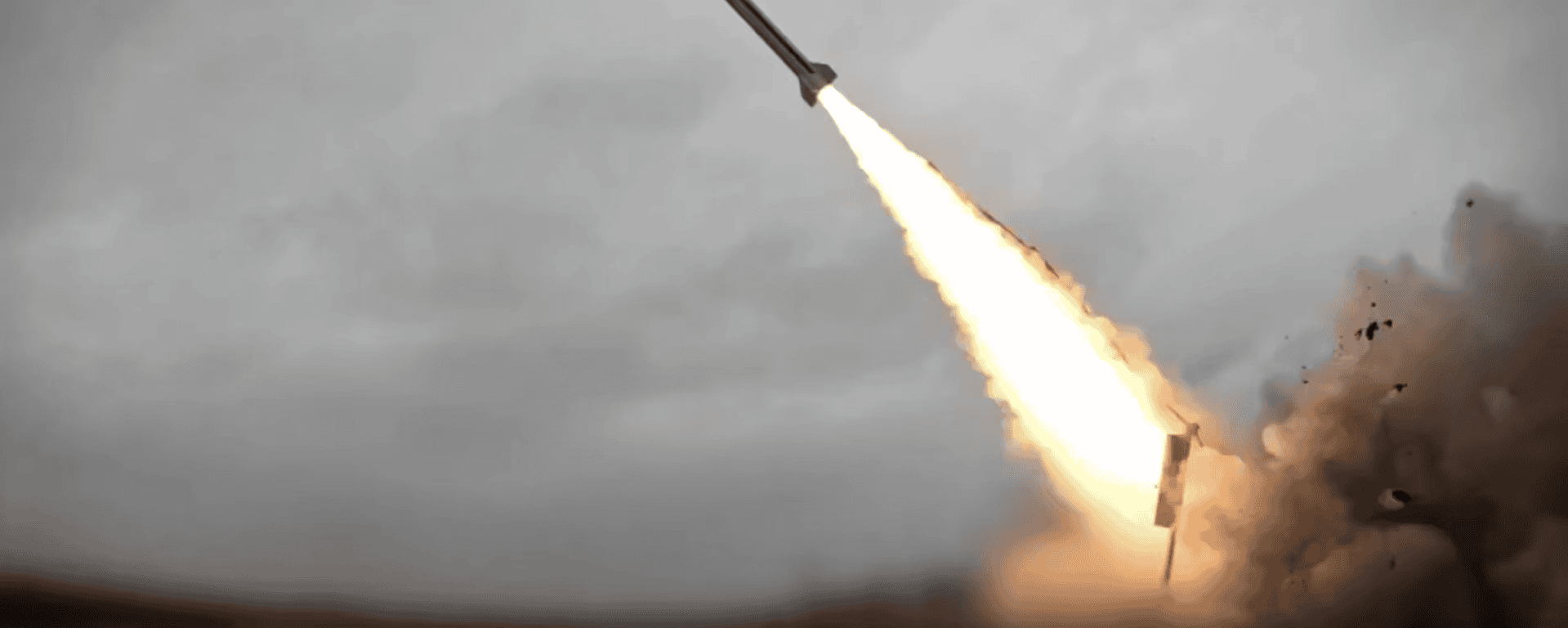
The interceptor carries Fire Point’s designation FP-7.x, an extension of the company’s existing FP-7 missile. Trade reporting and independent analysis — including a technical assessment by missile researcher Fabian Hoffmann — describe it as derived from the Soviet-era 48N6 missile family used in the S-300/S-400 series, rebuilt in composite materials; Fire Point has not published a full design lineage, so the derivation should be read as reported rather than confirmed. Per the company’s published figures, the missile is 7.25 meters long, reaches 1,500–2,000 m/s, has a stated range of up to 200 km and a warhead of up to 150 kg. Primary guidance is stated to be an imaging infrared seeker, with a semi-active alternative from Diehl reportedly under evaluation. The company has also said the system will be assembled from off-the-shelf hardware and open-source software — an unusual claim for a strategic air defense system, and one worth flagging precisely because it is central to the cost argument.
One characteristic is worth dwelling on because it defines the engagement concept. An Iskander-M arrives at roughly 2,100 m/s in its terminal phase; the FP-7.x’s claimed top speed is slightly below that. It cannot win a chase — it must reach the intercept point first and wait. This is a legitimate engagement geometry (terminal BMD intercepts are generally lead intercepts, not stern chases), but it places heavy demands on the sensor and battle-management chain: cueing must be early and track quality high, because the interceptor has little kinematic margin to correct for late or degraded data. The system’s performance ceiling is therefore set less by the missile than by the radar network and C2 layer around it — which is precisely the part being assembled from multinational off-the-shelf components.
The headline number is cost. Fire Point’s stated target is roughly $700,000 per interceptor, which the company contrasts with a figure of about $3.8 million for a Patriot PAC-3 missile; U.S. trade reporting citing the Army’s FY2027 budget request puts PAC-3 MSE unit costs higher still, at approximately $5.3 million. Hoffmann’s analysis suggests the economics could hold even under pessimistic assumptions: by his modelling, at an inflated unit price of $1.5 million and an intercept probability of only 30 percent, a salvo of Fire Point interceptors achieving 90 percent cumulative kill probability would still cost around 72 percent of the equivalent PAC-3 MSE salvo. That is his calculation, not an official figure — but the direction of the argument survives considerable degradation of the input assumptions.
The timeline claims are more strained. Zelensky told the Paris meeting he hopes to see Freya working within a year; Fire Point itself has said it does not expect to intercept a ballistic missile until the end of 2027. The company has stated that serial production of the interceptor is slated to begin in August 2026, with possible service entry in 2027. A one-year gap between political ambition and developer expectation, announced on day one, is worth noting — not as a prediction of failure, but as a baseline against which the coalition’s roadmaps can later be measured.
The stress test that explains the timing
Why this coalition, and why now? The answer is visible in the interceptor consumption picture that has accumulated since 2024 and sharpened this year.
Ukrainian reporting puts the country’s intercept rate against Russian ballistic missiles at roughly four in ten. Patriot remains the most combat-proven Western system against Russian ballistic missiles — SAMP/T has reportedly achieved ballistic intercepts as well, but at far smaller scale — and Ukrainian Air Force statements cited in Ukrainian media describe an expenditure of around 60 Patriot interceptors a month on what has been called a “starvation ration.” Lockheed Martin is the prime manufacturer of PAC-3, with a reported 2025 production rate in the low hundreds of interceptors per year — one widely cited figure is 620 annually — feeding every Patriot operator on earth. Meanwhile, the second front of consumption — the Middle East — has drawn on the same production line. U.S. trade reporting describes American PAC-3 stockpiles as having fallen substantially below the levels the Pentagon considers necessary, depleted across two active conflicts: Ukraine, and the intense clash with Iran that began in early 2026. Exact inventory figures are classified and published estimates vary; what is not in dispute is that replacement at current production rates is measured in years, against expenditure measured in weeks.
This is the production-gap thesis this site has documented since the January cost database and its March update: Western interceptor output is structurally misaligned with wartime consumption, and every stockpile in the Western world now competes for the same constrained production slots. Seen through that lens, the Anti-Ballistic Missile Coalition is less a technology bet than a capacity bet. The $700,000 figure matters not because it is cheap in absolute terms but because a composite airframe built on a reported derivative design, using catalogue radars and commodity software, can plausibly be produced in volumes and timescales that exquisite Western interceptors cannot.
The coalition is not primarily a bet that Freya will outperform Patriot. It is a bet that Europe can produce something adequate in quantities that Patriot’s supply chain will never deliver.
Whether that bet pays off depends on questions the declaration does not answer: where production lines will physically sit, who funds them, how intellectual property is shared across ten states and a private Ukrainian firm, and — as Ukrainian coverage has already highlighted — governance. A selling point emphasized in Ukrainian reporting is that no foreign government can switch the system off — a pointed contrast with the export-control and sustainment dependencies attached to American systems, and a preview of the sovereignty arguments that will shape European procurement debates for the rest of the decade.
Three frameworks, one continent
The coalition does not arrive in an empty landscape. Since 2022, Europe has produced three multilateral constructions that touch ballistic missile defense, and they differ in kind, not just in emphasis.
The European Sky Shield Initiative, launched under German leadership in 2022, is a joint procurement framework: coordinated national purchases of existing, proven systems — IRIS-T SLM, Patriot, Arrow 3 — funded from national budgets, with deliveries already ongoing. Its logic is speed through the market: buy what exists now, including American and Israeli hardware.
EDIP, the EU’s defense industry programme adopted through the Union’s legislative process and now being implemented, is not a procurement vehicle at all. It is an industrial funding instrument — EU budget co-financing aimed at production capacity, supply chains, and the defense-industrial base, with Ukraine as beneficiary and partner. As this site argued when Norway committed its membership contribution in May: EDIP enables acquisition programmes; it is not one.
The Anti-Ballistic Missile Coalition is the third type: a joint development effort. France convenes it politically; Ukraine leads it industrially; its hardware focus is a system that does not yet exist. Its funding logic is unresolved, its Ukraine role is the deepest of the three — full member and lead developer — and its claimed delivery horizon of 2027 is unproven.
The overlaps are substantial and, in places, awkward. ESSI’s German-led logic — buy proven systems now — sits in unresolved tension with the new coalition’s French-inflected logic of building European (and now Ukrainian) capability instead. Germany has signed both declarations. So have Denmark, Sweden, and Norway. The polite reading is layering: ESSI covers the near term, the coalition the long term, EDIP the industrial base beneath both. The less polite reading is that Europe is accumulating frameworks faster than it is accumulating interceptors, and that framework membership has become a low-cost way to demonstrate momentum while deferring expensive national decisions.
The distinction this site drew in May applies here, with one addition — a development coalition is not an acquisition programme either. Nothing in the July 13 declaration, as published, obligates any member to buy Freya, fund a battery, or station one on its territory.
The founding member without the capability
Which brings us to the structural observation this site is positioned to make.
Norway signed the Paris declaration as a founding member. Norway has also — as documented in this site’s coverage of the revised Long-Term Defence Plan presented in March 2026 — deferred the acquisition start for long-range air defense with anti-ballistic capability to 2033, extending a requirement first formalized in the 2016 planning framework into a delay approaching two decades. Norway is now a member of ESSI, a contributor to EDIP, and a founder of the Anti-Ballistic Missile Coalition. It participates, in other words, in every multilateral framework Europe has created for ballistic missile defense, while remaining without a national ballistic missile defense decision, budget line with near-term effect, or fielding timeline inside the 2020s.
Norway is not alone in this position — several signatories are in analogous situations — but the Norwegian case is unusually clean because the national requirement is explicit, longstanding, and formally postponed in the same four-month window in which two of the three framework memberships were signed.
There is also a specific industrial thread. Ukrainian reporting on the Freya programme names Norway among the countries involved alongside Germany and France, and Kongsberg fire-distribution technology — the C2 heart of NASAMS — has been reported among the components under evaluation, with Kongsberg listed among the companies present at the founding meeting. If Freya matures, Norwegian industry may sit inside the architecture of a European BMD system years before the Norwegian state operates any BMD system of its own. Readers of this site’s earlier root-cause analysis will recognize the pattern: industrial participation and national capability are separate tracks in Norwegian defense policy, and the first has consistently outrun the second.
Three distinct things could follow from coalition membership for a state in this position, and the declaration is compatible with all of them. These are analytical scenarios, not predictions.
Acceleration. Coalition-developed capability, if it materializes at the claimed cost points, could lower the budgetary threshold that has repeatedly stalled national BMD decisions — turning a multi-billion-euro exquisite-system choice into a more incremental one.
Substitution. Membership could function as the answer — “we contribute to the shared European shield” — allowing national requirements to remain formally open indefinitely. The mechanism would be familiar: collective frameworks absorbing the political demand for action that national procurement fails to satisfy.
Irrelevance. If Freya underdelivers — and a sub-$1 million interceptor against Iskander-class threats, fielded within eighteen months by a company that has never built an air defense system, is an aggressive claim by any historical standard — the coalition joins the long list of European defense initiatives that produced working groups rather than working systems.
Which of the three obtains will not be visible in declarations. It will be visible in budgets, test results, and production contracts, beginning with whether serial production actually starts on the company’s stated August 2026 schedule and whether an FP-7.x kills a ballistic target under realistic conditions before the end of 2027.
What to watch
Five indicators will show whether the Anti-Ballistic Missile Coalition becomes hardware or remains architecture. First, a funded production commitment — any member state placing a firm order or financing a production line, as opposed to endorsing a roadmap. Second, a live intercept of a representative ballistic target, with independent confirmation of the engagement conditions. Third, governance resolution — who holds design authority, export authority, and the ability to release (or withhold) the system in crisis. Fourth, ESSI interaction — whether dual members begin sequencing the frameworks explicitly, or whether the two continue as parallel, uncoordinated tracks. And fifth, national decisions in member states with open BMD requirements — whether framework membership precedes, accompanies, or replaces them.
The July 13 declaration is genuinely significant: it is the first time Europe has organized a multilateral ballistic missile defense effort around a Ukrainian design, priced for wartime consumption rather than peacetime deterrence, with the continent’s rival primes reportedly seated at the same table. That is new. What is not new is the gap between a signed declaration and a fielded battery — a gap this site has measured, in the Norwegian case, at eighteen years and counting. The coalition will be judged against the same clock.
Sources for factual claims include the joint declaration published by the Élysée Palace (13 July 2026); reporting by the Kyiv Independent, Euronews, Al Jazeera and Defense News on the coalition launch; Fire Point company statements as reported by Ukrainska Pravda, Militarnyi, Defense Express, RBC-Ukraine and Euromaidan Press; and technical analysis by Fabian Hoffmann (Missile Matters). Specifications and cost figures attributed to Fire Point are the company’s own claims and have not been independently verified.
Image: Ukrainian FP-7 ballistic missile. Freeze frame from Fire Point video
This article was produced with AI assistance.

