
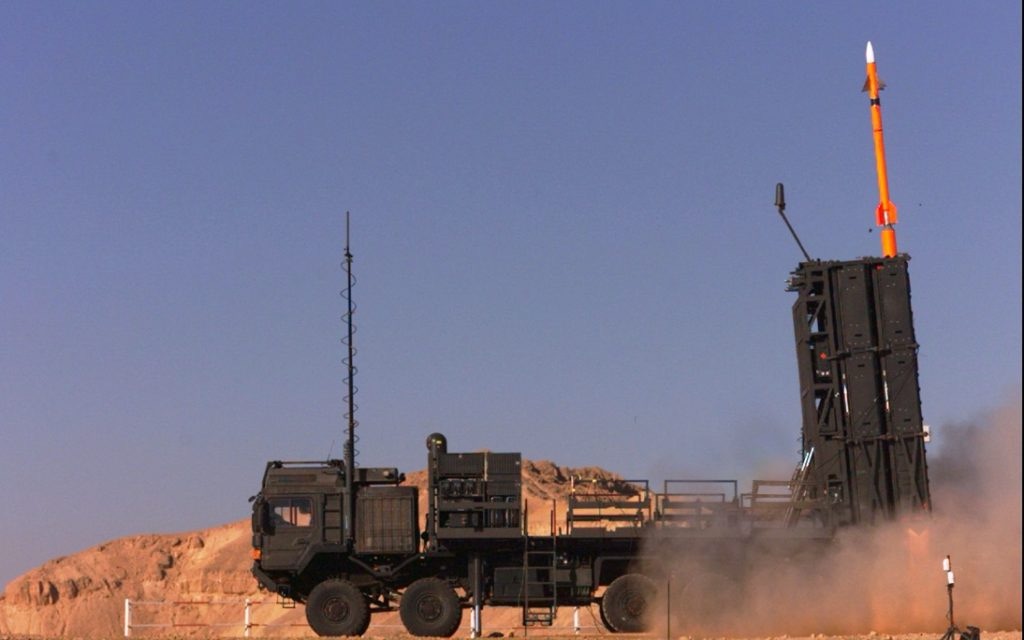
How a mid-sized NATO state built a short-range layer first, and what happened when it reached for the next one
Czech air defence reached international headlines on 14 July 2026, when Foreign Minister Petr Macinka, standing beside Israeli Foreign Minister Gideon Sa’ar in Tel Aviv, said Prague was in talks with Israeli firms about air defence systems. The Czechs, he said, were looking at Spyder, Arrow and other systems, adding that these systems are technologically at the top. Within days the story had been amplified across the international press, and at least one outlet reported that Czechia was close to concluding negotiations for David’s Sling and Arrow, with talks in their final stages.
The Czech-language record does not support that reading. What Macinka said, according to the Czech News Agency report carried by e15, was that Czechia continues to negotiate with Israel about SPYDER — that this was one reason a Defence Ministry representative accompanied him on the visit — and that particularly after the NATO summit in Ankara, it is important to try to meet the capability targets set by NATO military planning, one of which is Czech air defence. Ekonomický deník reported the same Ankara framing. “Arrow and other systems” was a response to a journalist’s question, not a programme announcement.
The distinction matters, because the actual Czech story is more instructive than the reported one. Czechia has spent five years building a short-range and medium-range air defence layer from a standing start, has largely completed it, and is now confronting the question of what comes next — with a stated ambition, an approved concept, and no visible means of paying for it.
The SPYDER programme: what was bought
The foundation is documented in unusual detail by Czech official sources.
On 5 October 2021, Deputy Minister for Armaments and Acquisitions Lubor Koudelka and Israeli MoD Director General Amir Eshel signed an intergovernmental contract for the SPYDER system from Rafael, valued at CZK 13.7 billion including VAT. The contract covers four batteries, each with its own 3D radar, command and fire control system, and four launchers, together with short- and medium-range missiles using infrared or radar guidance. Czech experts had evaluated several options before concluding in summer 2020 that SPYDER offered the best parameters — a decision taken before the Russian invasion of Ukraine, not in response to it.
The system replaces the 2K12 KUB, introduced into Soviet service in 1967 and used by Czech forces since the 1970s. Colonel Jaroslav Daverný, then head of ground-based air defence, described KUB as technically and morally obsolete, with problems in ammunition and repeatedly extended missile service life. The user is the 25th Anti-Aircraft Missile Regiment at Strakonice, specifically its 251st Anti-Aircraft Missile Battalion, which held four KUB batteries. The withdrawn KUB will be retained for training.
Each battery comprises a radar, four launchers, a loading vehicle and command and fire control systems, all mounted on Tatra 815-7 8×8 chassis standard in the Czech Army, with operating and maintenance equipment and spares included.
The munitions choice is the most analytically interesting element. Czechia procured all available missile types: the short-range Python-5, the radar-guided I-Derby, and the long-range I-Derby variant reaching up to 80 km. A separate order for I-Derby LR missiles followed in 2023, with ammunition deliveries expected to continue until at least 2027 subject to further options. Colonel Daverný emphasised that Czech forces would have every missile type in the manufacturer’s portfolio. Defence Industry Europe reported the I-Derby ER contract as giving the capability to intercept aircraft, helicopters, unmanned aerial vehicles and cruise missiles at ranges up to 80 km and altitudes of 20 km.
Janes, reporting from IDET 2025, quoted Daverný describing a system that can fire within minutes of arriving and leave just as quickly, used against combat aircraft, class 2 and 3 unmanned aerial vehicles, and cruise missiles — with a range of 25 to 80 km depending on missile type and the ability to fire salvos, against KUB’s single missile at 21 km maximum.
Industrial participation
Czech domestic industry content is substantial, though the figures cited by different official bodies do not agree.
The Armaments and Acquisitions Section of the Ministry of Defence puts the Czech industry share at 38 percent, with RETIA, part of the CSG holding, as Rafael’s main partner, and TATRA TRUCKS, ELDIS Pardubice, Ray Service and the state Military Research Institute participating in system integration. The Military Technical Institute is the principal MoD-side partner, and Czech industry is also engaged in life-cycle support. The Czech Army’s own release, by contrast, states domestic industry share at more than 30 percent, with the system manufactured in parallel in the Czech Republic and abroad.
We note the discrepancy without resolving it; both are official Czech sources published within the same programme.
There is a further integration benefit. The EL/M-2084 radar used by SPYDER at the 25th Regiment is the same type as the Czech MADR 3D radars, and CZ Defence reports that RETIA has drawn directly on its MADR project experience for the SPYDER deliveries. The same radar family is a key component of Iron Dome and David’s Sling in Israeli service and is used by Canada in a weapon-locating configuration.
Delivery status
The first battery successfully completed an operational test at the end of August 2025, verifying functionality from radar target detection and data transfer to the firing computer, through the fire order, to a simulated launch and hit assessment. The test methodology was designed by soldiers of the 25th Regiment as future users, with ELTA, RETIA and the Military Technical Institute participating alongside Israeli and Czech ministry representatives.
Czech Radio reported in January 2026 that troop trials were under way and that soldiers should receive all four batteries during 2026, each battery consisting of nine vehicles with differing roles. By May 2026, Prime Minister Andrej Babiš stated that two batteries had been delivered, with two more to come. e15 reported in March 2026 that the first of four systems had entered service.
Radio Prague International, reporting from RETIA’s Pardubice facility, quoted CEO Jan Mikulecký describing the final integration phase before military tests, and Colonel Daverný noting that full crew training would take 18 months. Army Recognition reports full operational deployment expected by 2028.
The programme is therefore roughly on its original schedule, five years after contract signature and six after the selection decision.
A capability decided in 2020 is in troop trials in 2026 and fully operational in 2028. That is the realistic tempo for a mid-sized European state introducing a new air defence system from a foreign supplier — not because anything went wrong, but because nothing did.
The concept: total ambition
Having largely completed the lower layer, the Czech Ministry of Defence turned to the architecture above it.
The Concept for the Development of State Air Defence was approved in February 2026, according to the parliamentary record of 16 April 2026. Defence Minister Jaromír Zůna told the Chamber of Deputies that the concept prioritises protection of the territory of the Czech Republic, its airspace, critical infrastructure and population, and plans a multi-layered air defence with modern command systems, sensors and effectors. He noted that implementing sophisticated systems takes four to six years.
Zůna has framed air defence as long underestimated, recalling that his parting words to the incoming defence minister were that air defence was the real priority and nobody was talking about it.
The scope of the ambition was stated plainly by his officials. Luděk Teger, head of ground-based air defence in the MoD force development section, said the ambition is to cover all layers of air defence from very short range up to the lower layer of missile defence. Zůna described this as a very costly matter, in the order of hundreds of billions of crowns to 2035 and beyond.
Alongside this sit several concrete follow-on projects. The parliamentary record lists SPYDER as a medium-range system with the possibility of long range when equipped with new missiles; the start of implementation of counter-unmanned systems development in 2026; and preparation for acquisition of a SPYDER All-in-One system, including preliminary market consultations, contract, and creation of a new air force development programme. Czech Television reported the army is also examining systems against drones and ballistic missiles, for protection of its own units, key sites and the whole territory.
Babiš stated in May 2026 that beyond the two batteries already delivered and two more expected, the government wants to buy four additional SPYDER systems. Aktuálně.cz reported in March 2025 that MoD spokesman David Šíma described preliminary talks with Israel on further batteries as a natural step arising from the European security situation, and calculated that on the 2021 contract basis each additional battery would cost at least CZK 3.4 billion.
The latent upper tier deserves particular attention. Rafael’s DERBY-LR, based on the I-Derby ER with a booster that more than doubles engagement range from 40 to 80 km, intercepts at 50,000 to 60,000 feet, and the associated SPYDER upgrade adds capability against tactical ballistic missiles. Czechia’s route toward a limited ballistic defence capability may therefore run through the system it already operates rather than through a new acquisition — an option available only because the lower layer was bought first, and bought with the full munitions portfolio.
The budget: the concept has no funding path
Here the Czech case becomes genuinely instructive, because the gap between the approved concept and the available money is both large and publicly acknowledged.
Zůna presented the 2026 figures to the Chamber of Deputies ahead of a no-confidence vote: a Defence Ministry budget chapter of CZK 154 billion, or CZK 184 billion including defence-related spending in other ministries, which he put at 2.1 percent of GDP on the April 2025 forecast and 2.06 percent on the updated January 2026 forecast, with CZK 56 billion for investment. He stated the budget required no project cancellations, with financing for two acquisitions shifted to 2027, and identified 2027 to 2029 as the key period for meeting military ambitions.
NATO’s own assessment gave a different figure. Zůna said in April that Czech defence spending would reach 1.78 percent of GDP by NATO assessment in 2026, and that he had planned to request an increase to two percent — CZK 190 billion — for the following year. Before the Ankara summit on 7 July 2026, Babiš announced the government would raise the defence budget by CZK 36 billion next year to meet the two percent commitment for the first time, adding that the government wants to fulfil the new army concept covering air defence, counter-drone defence and long-standing NATO brigade commitments.
The dispute over whether Czechia met two percent has been politically contested between the current government and its predecessor, with Zůna noting that NATO was assessing the 2022–2025 planning cycle and that 2026 would be assessed in 2028.
Against a concept costed in the hundreds of billions, the constraint is not subtle. Josef Flek (STAN), chair of the parliamentary defence committee, said SPYDER All-in-One was precisely one of the systems that had been cut, put the cost of genuine layered protection at CZK 400 to 600 billion, and concluded that two percent will not be enough. An internal General Staff calculation prepared for the government put the cost of strengthening air and counter-drone defence in the higher tens of billions of crowns.
The coalition’s own arithmetic points the same way. When Zůna cautiously mentioned annual budget growth to approach NATO’s requested 3.5 percent of GDP, SPD leader Tomio Okamura responded immediately that there is no money for defence spending above two percent in 2027 and 2028. Finance Minister Alena Schillerová has likewise declined to promise significant increases. The Finance Ministry told Echo24 in July 2026 that the state budget remains in preparation, that increases must be assessed against all state priorities, and that with mandatory and statutory spending forming the bulk of outlays, the room for reallocation is limited.
Echo24 also noted that government parties had previously argued there was no point increasing defence spending if there was nothing to spend it on. Babiš, for his part, has said that once the ministry audit is complete the government will again invest massively in things that make sense — a remark e15 read as referring to air defence, under the headline “Leaky as Emmental.”
What the case shows
Three observations follow from the Czech record, none of which require a verdict on Czech policy.
Sequencing produces optionality. By buying the lower layer first, and by buying the complete munitions portfolio rather than the minimum viable configuration, Czechia acquired a system whose reach can be extended through munitions rather than through new platforms. The official description of SPYDER as medium-range with long-range potential given new missiles describes a growth path that exists only because the initial decision was taken and executed. Whether that path is pursued is a separate question; that it is available is a consequence of having bought something.
Industrial participation is achievable at moderate scale. A 38 percent domestic share on a CZK 13.7 billion contract, with a named prime partner and life-cycle involvement, was negotiated by a state with no prior relationship to the supplier and no comparable indigenous system. The radar commonality with the existing MADR programme, and RETIA’s ability to carry experience from one to the other, suggests the industrial return compounds where sensor families are shared.
An approved concept is not a funded programme. This is the most transferable finding. Czechia has a formally approved State Air Defence Concept, a defence minister who identifies air defence as the genuine priority, a stated ambition spanning every layer up to lower-tier missile defence, and a governing coalition in which a partner leader has publicly ruled out the spending required to deliver it. The committee chair’s figure of CZK 400 to 600 billion against CZK 56 billion of total investment spending in 2026 is not a gap that programme management closes.
The Czech position is thus a specific one: a state that has completed a layer, documented its next layers, costed them at least approximately, and arrived at the point where the remaining obstacle is purely fiscal and openly discussed in parliament. That is a more advanced position than it may appear from the international coverage of the July talks in Tel Aviv — and a more constrained one than the concept documents suggest.
Sources and caveats
Two items in this account warrant verification before being treated as settled. e15 reports that with twenty years of service support Czechia will pay over CZK 37 billion for the SPYDER systems — a figure that would nearly triple the headline contract value and which we have not corroborated elsewhere. And the status of the additional four batteries remains unclear: Babiš stated in May 2026 that the government wants to buy them, while the Ministry of Defence characterised discussions as preliminary in March 2025. We have found no signed contract.
Primary and official Czech sources used: the Armaments and Acquisitions Section of the Ministry of Defence; the Czech Army (acr.mo.gov.cz); the 25th Anti-Aircraft Missile Regiment; and the stenographic record of the Chamber of Deputies, 15th session, 16 April 2026. Czech media: e15, Ekonomický deník, Aktuálně.cz, Echo24, iROZHLAS/Czech Radio, Czech Television (ČT24), České noviny/ČTK, CZ Defence, Czech Air Force. International trade and defence press: Janes, Defence Industry Europe, Army Recognition, Defense Update, Radio Prague International. Israeli and international press for the July 2026 Tel Aviv statements: The Times of Israel, The Jerusalem Post. The claim that negotiations on David’s Sling and Arrow are in their final stages appears in EUalive, republishing a Polish partner outlet; we have found no Czech-language corroboration and do not treat it as established.
Image: Courtesy Rafael
This article was produced with AI assistance.

