
The conflict has become the most significant live test of directed-energy air defense in history — and the results are complicated.
The promise has been on defense ministry briefing slides for thirty years: a laser weapon that fires at the speed of light, costs almost nothing per shot, and carries an effectively unlimited magazine. In the spring of 2026, for the first time, that promise is being tested under real conditions — by real operators, under real threat, with real consequences if the beam misses.
Three distinct directed-energy systems are now present in the theater of the Iran conflict. One has confirmed intercepts. One is deployed but not confirmed as employed. One has been quietly struggling in the field since before the shooting started. Together, they offer a more nuanced picture than either the enthusiasts or the skeptics have been arguing.
Iron Beam: The First Combat Laser
The most significant development came early in the conflict. Footage circulating from Israel’s northern border showed what appeared to be the Iron Beam laser intercepting a drone launched from Lebanon — Hezbollah’s opening move after Iran’s Supreme Leader was killed in Operation Epic Fury. If confirmed, it marks the first operational combat use of a ground-based directed-energy air defense system anywhere in the world.
This was not entirely unexpected. Israel’s Ministry of Defense had declared Iron Beam operational in late 2025, following a delivery to the Israeli Air Force’s air defense array in December. The system — developed by Rafael Advanced Defense Systems over roughly three decades — had already logged intercepts during the drone and missile attacks of 2025. The current conflict simply represents a significant escalation of that operational exposure.
The system’s value proposition is straightforward. A Shahed-136 drone costs Iran somewhere between $10,000 and $50,000 to manufacture. An Iron Dome interceptor costs approximately $50,000. An Iron Beam shot costs, in the words of Rafael’s CEO, effectively nothing — the electricity to run the beam director. Against the sheer volume of one-way attack drones Iran has been launching, the cost arithmetic is not academic.
Iron Beam is not, however, a universal solution. Its effective engagement range sits at roughly ten kilometers — meaning it only comes into play in the final minutes of a Shahed’s flight path. It is vulnerable to atmospheric conditions: dust, fog, and sand degrade the beam’s coherence. It is a single-target system — one beam, one target, one engagement at a time — which creates a sequencing problem against saturation attacks. And it is mounted on the ground, constrained by terrain and line of sight in ways that a missile interceptor is not.
The Iron Beam’s debut nonetheless represents a genuine milestone. For the first time in combat history, a high-energy laser has destroyed an aerial threat in an active warzone. The question now being studied closely in defense ministries from Oslo to Canberra is what it can and cannot do at scale.
ODIN: The Navy’s Quiet Deployment
The second system is American and naval. When US Central Command released footage of Operation Epic Fury on 28 February 2026 — showing Arleigh Burke-class destroyers launching Tomahawk cruise missiles toward targets in Iran — close analysis of the imagery revealed something else. At least one destroyer in the carrier task group was fitted with the Optical Dazzling Interdictor, Navy, known as ODIN: a soft-kill laser system designed to dazzle and disable the sensors of hostile drones before they can fix a targeting solution on a ship.
The USS Spruance (DDG-111) was identified in the footage firing Tomahawks. The ODIN installation — recognizable by its distinctive mounting position replacing the Phalanx CIWS on the bow — appeared on at least one other destroyer in the formation. The US Navy has not confirmed any combat use of ODIN during the conflict. Its role may be entirely passive: a deterrent against the Iranian UAV surveillance missions that have repeatedly attempted to approach and photograph American warships in the region.
This matters strategically regardless of whether ODIN has fired a shot. Iran’s targeting doctrine relies heavily on UAV reconnaissance to cue its longer-range missile and drone strikes against naval targets. A destroyer that can silently blind an approaching surveillance drone — without firing a kinetic interceptor, without triggering an escalatory response — holds a significant operational advantage. ODIN’s presence in the task group suggests the US Navy has sufficient confidence in the system’s reliability and its integration into the fleet’s combat management architecture to deploy it to a high-threat environment.
DE M-SHORAD: The Struggling Prototype
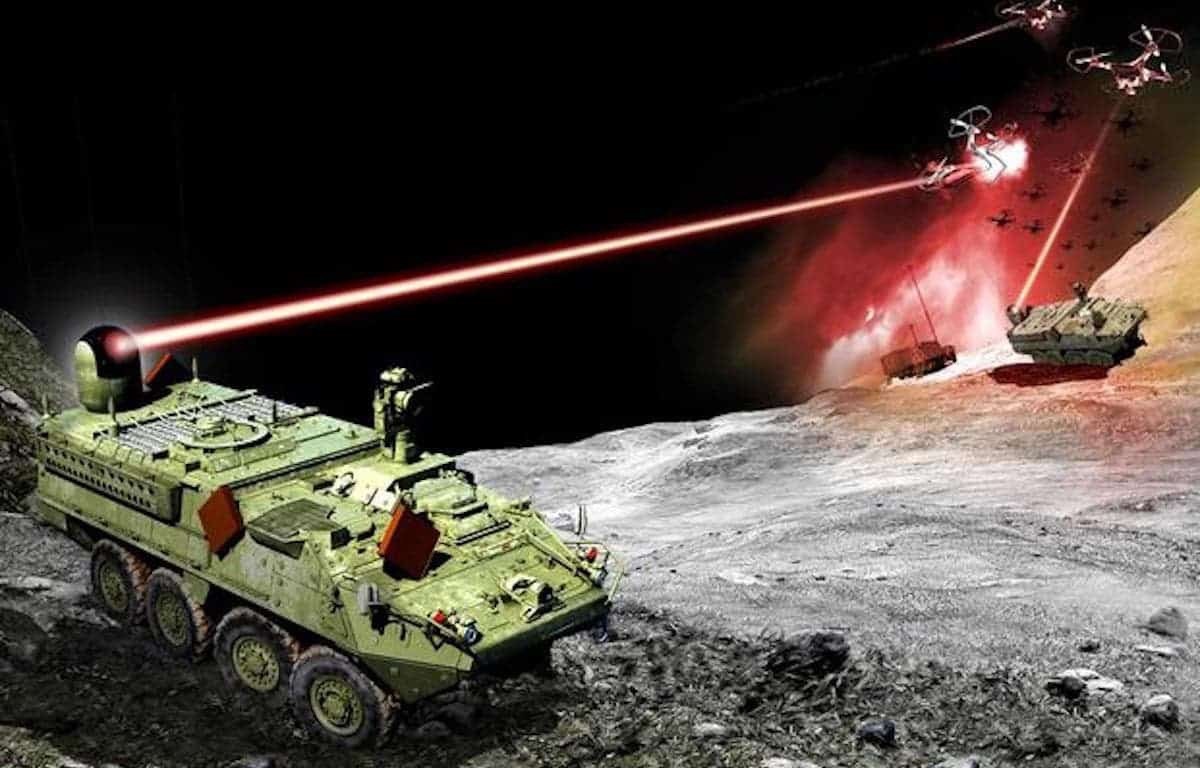
The third system tells a more cautionary story. The US Army’s Directed Energy Maneuver-Short Range Air Defense system — a 50-kilowatt laser mounted on a Stryker armored vehicle — had been deployed to CENTCOM even before the current conflict, as part of a real-world operational evaluation. Four prototype systems from the 4th Battalion, 60th Air Defense Artillery Regiment were in theater by early 2024.
The feedback from soldiers was, to use the Army’s own characterization, “not overwhelmingly positive.” The heat dissipation demands of a 50-kilowatt laser are severe, and managing them on a vehicle that moves constantly — over unpaved roads, in desert heat, with the vibration and dust typical of a tactical environment — has proven materially harder than in controlled test conditions. The Army acknowledged that results from the lab and test ranges diverged significantly from what soldiers encountered in the field.
There are no confirmed combat engagements for DE M-SHORAD in the current conflict. The system remains present in theater, and the Army is using the operational environment as a learning laboratory, feeding the results into the development of its next-generation Enduring High Energy Laser program scheduled for competition in fiscal 2026. The lesson being absorbed is not that directed energy doesn’t work — it is that vehicle-mounted, mobile laser systems face integration challenges that fixed-site or naval installations do not.
The Strategic Lesson
The conflict is clarifying what directed-energy air defense can and cannot do in 2026, and the picture is nuanced in ways that matter for long-term planning.
The cost argument for lasers has never been stronger. Iran is launching waves of Shahed drones — sometimes hundreds in a single night — precisely because it understands that each interceptor missile defending against a cheap drone represents a favorable exchange ratio for the attacker. At $4 million per Patriot interceptor and $4.3 million per SM-6, burning through stockpiles with $10,000 drones is a coherent attrition strategy. Lasers break that equation fundamentally. They do not run out of ammunition in the conventional sense. Their marginal cost per shot approaches the cost of electricity.
But the physical constraints are real and not easily engineered away. Lasers struggle in adverse weather. They are one-target-at-a-time systems in an era defined by saturation tactics. Their effective range — currently around ten kilometers for operational systems — limits them to terminal defense. And mobile, vehicle-mounted systems face heat management and reliability challenges that fixed installations do not.
The emerging doctrine, visible in all three deployments, is layered integration: lasers to handle the volume of cheap, low-end threats; electronic warfare against autonomous drones; kinetic interceptors reserved for the high-end threats — ballistic missiles, hypersonic weapons, cruise missiles — that require them. The laser does not replace the Patriot. It preserves the Patriot for the targets that only the Patriot can handle.
For a small nation like Norway — operating under budget constraints that make stockpile depth a permanent vulnerability — the implications deserve careful attention. The cost-per-shot argument and the deep-magazine logic of directed energy are directly relevant to the Norwegian threat environment, where Shahed-family drones and mass-attack tactics are now realistic planning scenarios. The technology is no longer science fiction. The Iran conflict has established that much definitively.
What it has not yet established is whether the technology is mature enough, integrated enough, and reliable enough to serve as a genuine layer in a national air defense architecture. The answer, based on what is being reported from the theater, is: for fixed or naval installations, increasingly yes. For mobile ground forces, not quite yet.
This article is part of an ongoing series at norskluftvern.com tracking the operational lessons of the Iran conflict for Norwegian air and missile defense planning.
AI-written article

