
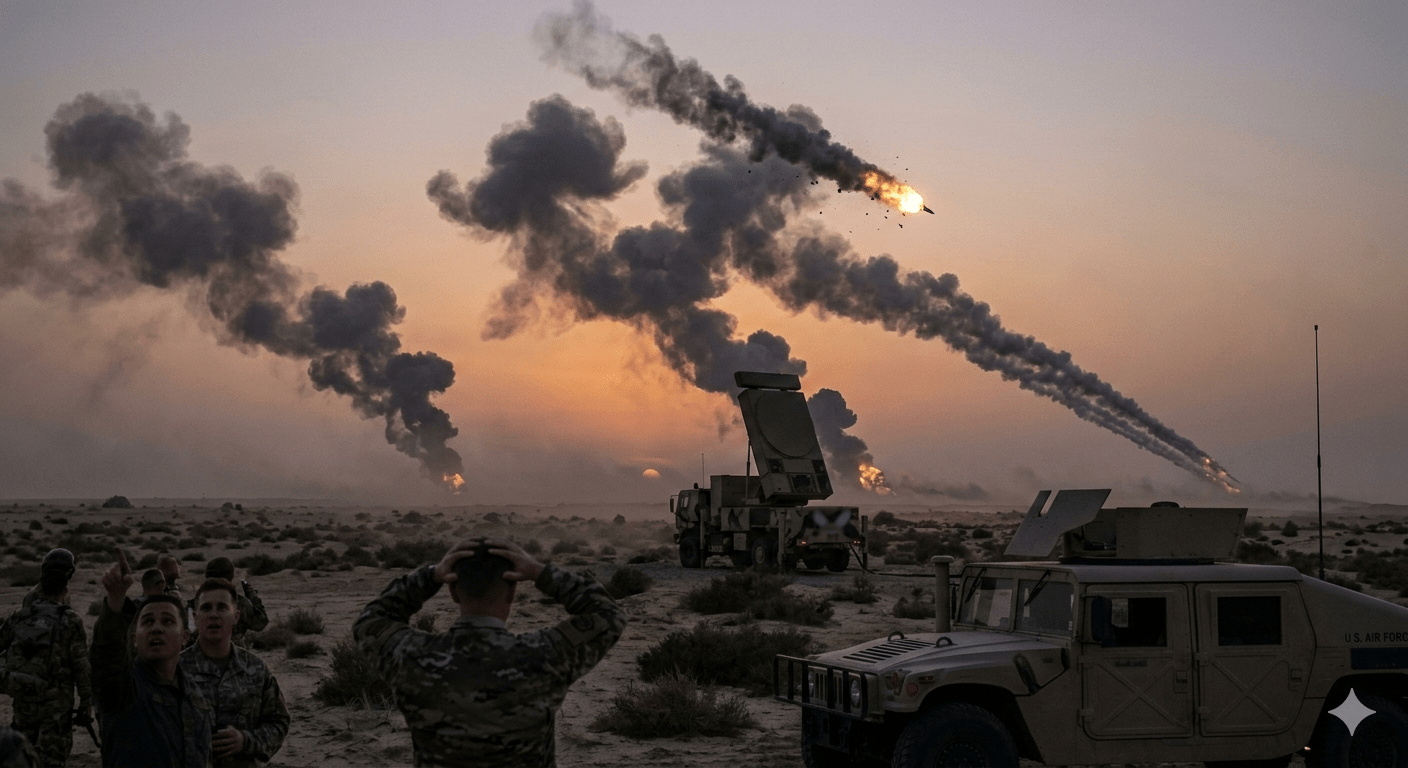
Three U.S. F-15E Strike Eagles destroyed by a coalition partner’s air defences over Kuwait on March 2, 2026. The incident is the most consequential fratricide event in a major U.S.-led air campaign since Iraq in 2003 — and a pattern that stretches back nearly four decades of American military operations in the Persian Gulf.
At 7:03 in the morning local time on March 2, 2026, three U.S. Air Force F-15E Strike Eagles fell from the sky over Al Jahra, Kuwait. Video captured on mobile phones showed one jet spiralling earthward, trailing flame, before the crew ejected into the smoke-filled dawn. Within hours, U.S. Central Command had confirmed the worst-kept secret of the morning: the aircraft had not been destroyed by Iranian missiles. They had been shot down by Kuwait.
The incident, described tersely by CENTCOM as an “apparent friendly fire” event during active combat operations, occurred on the fourth day of Operation Epic Fury — the joint U.S.-Israeli campaign against Iran that began on February 28 with the assassination of Supreme Leader Ali Khamenei and a wave of strikes across Tehran, Isfahan, Qom, Karaj, and Kermanshah. All six aircrew — three pilots and three weapons systems officers — ejected safely and were recovered in stable condition. Diplomatically, the incident was swiftly contained. Operationally, it has already become one of the most analytically significant fratricide events in modern warfare.
But it did not emerge from a vacuum. The Kuwait shootdown is the latest manifestation of a failure pattern that has repeated itself with remarkable consistency across nearly four decades of U.S. military operations in the Persian Gulf — from the Tanker War of 1987 through the invasion of Iraq in 2003 and into the Red Sea operations of 2024. Understanding the 2026 incident requires understanding what came before it.
The Battle Environment That Night
To understand what happened over Kuwait, one must first understand the airspace in which it happened. By the night of March 1–2, Iran had been conducting the most sustained multi-vector retaliatory campaign against U.S. and allied facilities in the Gulf since the 2003 Iraq War. Iranian strikes targeted military bases in Bahrain, Kuwait, Qatar, Jordan, Saudi Arabia, and the UAE simultaneously. The weapons mix was deliberate and eclectic: fast ballistic missiles, slow Shahed-series loitering munitions, cruise missiles, and conventional fixed-wing aircraft operating from Iranian territory.
Into this environment, U.S. Air Force F-15Es from the 4th Fighter Wing at Seymour-Johnson and the 48th Fighter Wing at RAF Lakenheath were flying active combat air patrol, engaging Iranian drones and ballistic missiles in the terminal phase. Their role — intercepting airborne threats below the engagement envelope of ground-based systems — placed them in the very altitude bands where Kuwait’s own air defence systems were operating.
The Kuwaiti air defence network is built around the same architecture that GCC countries have spent decades and hundreds of billions of dollars assembling: Patriot PAC-3 and PAC-3 MSE at the terminal layer, complemented by shorter-range systems for low-altitude threats. According to open-source analysis, the SHORAD systems involved appear to have been infrared-guided — a detail with critical technical implications.
“The sky was dirty. It was not a question of whether the IFF would be tested. It was a question of whether it would survive being tested.”
The F-15E Strike Eagle is not equipped with Missile Warning Sensors for infrared-guided threats. A radar-guided missile produces detectable emissions that the aircraft’s electronic warfare suite can identify. An infrared seeker hunting the heat bloom from a jet engine does not. The crew of those F-15Es, flying over what they understood to be friendly Kuwaiti territory in the pre-dawn darkness, would have had no warning before impact.
IFF: The Fragile Architecture of Trust
Identification Friend or Foe — IFF — is the foundational technology that is supposed to prevent exactly this kind of incident. The concept is straightforward: an aircraft carries a transponder that responds to an encrypted interrogation from a ground radar with a code that says “don’t shoot, I’m on your side.” When it works, IFF is close to failsafe. The problem is the conditions under which it is expected to work.
Several competing hypotheses have emerged in the days since the incident. CENTCOM’s investigation has reportedly been examining the possibility that Iranian electronic warfare systems jammed Kuwait’s IFF interrogators. Three Iranian jamming platforms were allegedly active at the time: the Cobra V8 near Bandar Abbas, Sayyad-4 radar units repurposed for interference, and the Avtobaza-M electronic intelligence system. The consensus among open-source analysts is that all three were likely too far from Kuwait to have jammed local IFF systems effectively.
A second, more troubling explanation centres on system integration failures. The Kuwaiti air defence architecture, like that of most GCC states, was built layer by layer through separate procurement programmes from multiple vendors. Patriot batteries, SHORAD systems, early warning radars, and datalink infrastructure are rarely engineered to share a unified operating picture. When the airspace becomes saturated with simultaneous ballistic missiles, cruise missiles, and friendly fighter aircraft, the deconfliction burden on individual battery operators becomes extreme.
The question is not whether operators had access to IFF data. The question is whether they had time to process it, confidence in it, and the command authority to act on it before the threat timeline expired. Analysts described operators who appeared to “fire at everything” in a period of maximum confusion — not as an aberration, but as a predictable consequence of a system architecture that places operators under impossible cognitive load during saturation attacks.
Four Decades of the Same Failure: A Persian Gulf Pattern
What makes the Kuwait shootdown particularly sobering is not its novelty. It is its familiarity. The specific failure modes on display over Al Jahra — IFF degradation, autonomous engagement under cognitive overload, coalition deconfliction breakdown — have appeared in every major U.S. air defence engagement in the Gulf region since 1987. The pattern is old. The lessons, apparently, have not been learned.
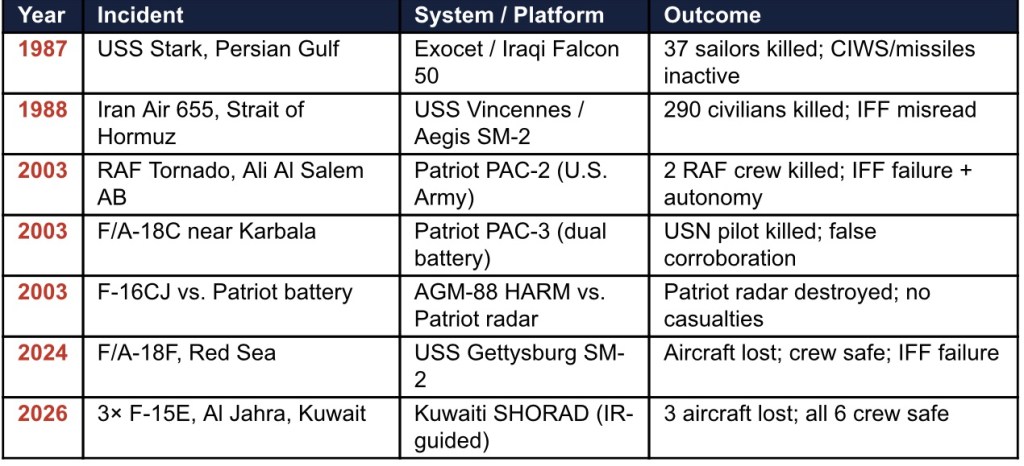
USS STARK, MAY 17, 1987. The pattern begins not with a friendly fire incident but with its mirror image: a failure to defend. During the Iran-Iraq Tanker War, an Iraqi jet operating covertly — later identified as a modified Falcon 50 business aircraft in civilian markings — fired two AM-39 Exocet anti-ship missiles at the U.S. frigate USS Stark as it patrolled off the Saudi coast. Thirty-seven sailors were killed. The ship never fired a weapon in response.
The operational failure was comprehensive: the Stark’s fire control STIR radar was in standby mode. The Phalanx close-in weapons system was not activated. The tactical action officer failed to track the approaching aircraft adequately, and critically, an AWACS aircraft in the area had designated the Iraqi jet as “friendly.” The pilot, flying a known civilian aircraft type on an approach that exploited the Stark’s weapons system blind spots, fired from within the ship’s engagement envelope without challenge. The incident introduced a theme that would recur for decades: in a complex, multi-party Gulf environment, the designation of “friendly” can be applied to an aircraft that is not.
USS VINCENNES, JULY 3, 1988. Thirteen months after the Stark, the Aegis system that was supposed to solve the Gulf’s identification problem produced the worst single air defence incident in U.S. naval history. USS Vincennes, a Ticonderoga-class cruiser fitted with the then-new Aegis Combat System, shot down Iran Air Flight 655 — a civilian Airbus A300 on a scheduled passenger flight to Dubai — killing all 290 people aboard.
The technical failure is instructive in its specificity. The Aegis system correctly detected the airliner’s Mode III civilian IFF transponder. It also detected a Mode II military IFF signal — almost certainly from an Iranian F-14 sitting on the ground at Bandar Abbas airport, which shared a runway with civilian traffic. The Vincennes’s anti-air warfare coordinator accepted the military correlation as valid, since Iranian military aircraft were known to transmit both codes simultaneously. The Aegis system’s own radar showed the aircraft climbing, not descending in an attack profile. That data was overridden by the operator’s threat assumption.
USS Sides, the nearest warship, correctly identified the contact as a civilian airliner. Its commanding officer, David Carlson, assumed that Vincennes — equipped with a more capable Aegis system — had superior information, and did not transmit his assessment. The correct answer was available in the same tactical picture. It was suppressed by deference to technology and by the aggressive command culture of a ship its own crew nicknamed “RoboCruiser.” The Navy attributed the incident to human error and stress. The Vincennes’s captain was awarded the Legion of Merit upon return.
“The correct assessment was available. It was suppressed by deference to technology — and the system’s own radar confirmed it. No one checked.”
PATRIOT vs. RAF TORNADO GR4, KUWAIT, MARCH 22, 2003. Here the geography becomes almost uncomfortable. The Tornado was returning to Ali Al Salem Air Base in Kuwait — the same base central to Epic Fury operations twenty-three years later — when a U.S. Army Patriot battery wrongly identified it as an Iraqi anti-radiation missile. The IFF system was interrogated; there was no adequate response. The Patriot engaged autonomously. Both crew members were killed instantly.
The UK Ministry of Defence investigation identified a cascade of contributing factors: threat classification criteria too broadly defined, rules of engagement that enabled autonomous engagement, firing doctrine that prioritised speed over verification, crew training focused on ballistic missile interception at the expense of air picture management, and IFF procedures that treated non-response as a hostile indicator rather than a classification failure. The Tornado’s IFF equipment had a serviceability issue. The aircraft was not transiting through the designated safe corridor. Any one of these failures alone might have been recovered; together they were fatal.
PATRIOT vs. U.S. NAVY F/A-18C, KARBALA, APRIL 2, 2003. Ten days later, the same failure repeated with a more insidious twist. Lieutenant Nathan White was returning from a successful bombing run near Karbala when he radioed that missiles were tracking him. He executed a high-G evasive turn. It was not enough. The impact was catastrophic. He was thirty years old.
What makes this incident the most analytically consequential of the 2003 series is its mechanism. One Patriot battery misclassified the F/A-18C’s radar return as an Iraqi ballistic missile and reported it to the Information Coordination Centre. A second, independent Patriot battery reached the same erroneous conclusion. Each reinforced the other’s assessment. The command centre, receiving corroborating reports from two independent sensors, became — in the words of the subsequent investigation — “increasingly confident” that it was tracking a hostile missile. Two Patriot interceptors were launched. No disciplinary action was taken.
The lesson of Karbala is not simply that Patriot misidentified an aircraft. It is that two independent systems agreeing on the same wrong answer generated certainty rather than triggering doubt. In complex multi-sensor architectures where operators are trained to value corroboration as confirmation, this is not an edge case. It is an inherent failure mode.
F-16CJ vs. PATRIOT BATTERY, IRAQ, MARCH 24, 2003. Two days after the Tornado shootdown, a U.S. F-16CJ found its own Patriot battery’s radar locking onto it. The pilot did what he had been trained to do: he fired an AGM-88 HARM anti-radiation missile in self-defence, destroying the Patriot’s radar antenna. No casualties resulted. The Patriot battery’s crew had left the system running in autonomous mode while they took cover from incoming fire.
The incident completed a grim trifecta in a single month of combat operations: a Patriot had killed an allied crew, nearly killed a friendly pilot, and now had its own radar destroyed by a friendly aircraft acting in legitimate self-defence. The 2003 Defense Science Board investigation was unambiguous in its assessment: Patriot systems had been given too much autonomy, and operators had been trained to trust the software over their own situational awareness. Its central recommendation — “every effort must be made to avoid autonomous fire units” — was published, disseminated, and, apparently, not adequately institutionalised.
Persian Gulf Fratricide / Misidentification: Selected Incidents 1987–2026
The Immediate Precedent: USS Gettysburg, December 2024
The Kuwait shootdown was not the first warning of what was coming in Operation Epic Fury. Fourteen months earlier, in the early hours of December 22, 2024, the guided-missile cruiser USS Gettysburg fired two SM-2 surface-to-air missiles at a pair of F/A-18F Super Hornets from the USS Harry S. Truman carrier strike group as they returned from strikes against Houthi targets in Yemen. One Super Hornet was hit; both crew ejected safely. The second aircraft narrowly escaped.
The 152-page investigation released in December 2025 is a document that should have been read very carefully by every air defence commander in the Middle East before Epic Fury began. Its findings describe a cascade of institutional and technical failures that are structurally identical to what appears to have happened over Kuwait.
Multiple watchstanders reported that the Gettysburg suffered frequent IFF malfunctions in the days surrounding the incident — stale IFF video, failure to display Mode 5 IFF data, IFF not correlating with the Cooperative Engagement Capability datalink. Critically, this information was not reported up the chain of command. The watchstanders on duty at the moment of engagement did not know their IFF system was not working. The two returning Super Hornets were tagged as “unknown” rather than “friendly” in the tactical display after a high-tempo mission cycle that had disrupted track management. When an “earlier than expected” Houthi missile and drone barrage added stress to the CIC team, the commanding officer made an engagement decision without the situational awareness to recognise he was targeting his own aircraft.
The investigation concluded that the incident was caused by “a lack of integrated training opportunities between USS Gettysburg and the Carrier Strike Group, lack of forceful backup, and lack of cohesion across the Carrier Strike Group.” The commanding officer was relieved. Fifteen retraining initiatives were implemented across the fleet. Fourteen months later, over Kuwait, three F-15Es were shot down in a strikingly similar combination of IFF unreliability, cognitive overload, and coalition deconfliction failure — with the added complication of a second nation’s air defence systems involved.
The Coordination Problem at Scale
Operation Epic Fury has assembled what is arguably the most complex coalition air defence architecture in history over a confined geographic area. U.S. Patriot and THAAD batteries operate alongside Israeli Arrow, David’s Sling, and Iron Dome systems. GCC states — Kuwait, Saudi Arabia, Bahrain, Qatar, the UAE — each operate their own layered architectures, interconnected to varying degrees with CENTCOM’s integrated air and missile defence network. Arleigh Burke-class destroyers equipped with Aegis provide additional coverage. Carrier air wings, land-based fighter aircraft, and multiple national systems are all operating simultaneously in overlapping engagement zones.
The coordination required to maintain a unified, real-time picture of every transponder across this architecture during a saturation attack is, in the clinical language of systems engineering, extremely demanding. In the language of the operators involved, it appears to have been impossible. The U.S., Israel, Kuwait, and Saudi Arabia were all engaging targets in the same narrow geographic corridors. Iranian threats ranged from hypersonic ballistic reentry vehicles to slow, heat-emitting Shahed drones. When a Kuwaiti SHORAD battery detected a fast-moving, heat-emitting target in a corridor filled with Iranian drones, the cognitive and procedural burden on its operators was immense.
A joint statement by the U.S., Bahrain, Jordan, Kuwait, Qatar, Saudi Arabia, and the UAE praised “effective air and missile defence cooperation” for preventing greater casualties. That statement was released hours before the Kuwait fratricide was confirmed. The gap between the political narrative of seamless coalition integration and the operational reality of three downed F-15Es is worth examining with care.
“The 2003 Defense Science Board said it plainly: avoid autonomous fire units. Twenty-three years later, the same failure reappears over the same Kuwaiti airbase.”
The Autonomy Problem: From Karbala to Kuwait
Running through every incident in this forty-year sequence is a common thread: the tension between the speed of modern air threats and the cognitive capacity of human operators. Ballistic missiles and fast jets leave engagement windows measured in seconds. The solution adopted across multiple generations of air defence systems — from Patriot to Aegis to modern SHORAD — has been to build automation deeply into the engagement chain, allowing systems to engage without requiring explicit human authorisation for each shot.
The logic is sound in isolation. A Patriot battery operating against a ballistic missile threat may have a single-digit number of seconds to engage. Requiring an operator to physically authorise each launch is not operationally viable at that timescale. But when the same autonomous logic is applied in a complex, multi-domain environment where the distinction between friend and foe is not clear-cut, the results are predictable. The 1994 Black Hawk shootdown over Iraq. The 2003 Tornado. The 2003 Karbala F/A-18. The 2024 Gettysburg incident. And now, apparently, Kuwait.
The Defense Science Board in 2003 identified excessive autonomy as a primary factor and recommended that operators be more actively involved in engagement decisions. Two decades of incremental Patriot upgrades, Link 16 datalink integration, and combined arms training exercises followed. The 2024 Gettysburg incident demonstrated that IFF failures on a U.S. Aegis system were not being reported up the chain of command. The 2026 Kuwait incident suggests that the fundamental tension between engagement speed and positive identification has still not been resolved in coalition operations — and may not be resolvable by technology alone.
Interceptor Stockpile Depletion: The Deeper Pressure
The fratricide incidents in Epic Fury cannot be fully understood without the context of interceptor stockpile depletion. During the Twelve-Day War of June 2025, Israel’s layered air defence network conducted the most intensive interception operations of the modern era. The stockpiles of ground-based interceptors were significantly drawn down. As Operation Epic Fury began on February 28, 2026, those deficits had been only partially restored.
This creates a secondary dynamic rarely discussed in fratricide analysis: when interceptor stocks are under pressure, the institutional incentive — conscious or not — is to maximise probability of kill per launch. This may paradoxically compress the time available for positive identification. A battery commander under pressure to conserve missiles may become more aggressive in engagement decisions precisely when the cognitive environment least supports careful target discrimination. The forty-year history reviewed here suggests that the environments most likely to produce fratricide — high-tempo, saturated, multi-platform, multinational operations — are also the environments most likely to produce interceptor stockpile pressure.
The Nordic Dimension: What Kuwait Tells Us About Our Own Vulnerabilities
For readers of this blog, the Kuwait incident is not a distant case study. It is a direct analogue to the coordination challenges that would confront any multi-national air defence architecture on NATO’s northern flank.
Norway’s air defence posture rests primarily on NASAMS, which provides medium-range coverage against aircraft, cruise missiles, and drone threats. Within NATO’s integrated air and missile defence framework, Norway operates in coordination with allied assets: AWACS aircraft, Aegis-equipped allied vessels in the Norwegian Sea, allied air policing rotations, and the F-35 fleet providing both offensive and defensive capabilities. In a high-intensity conflict scenario, Norwegian NASAMS batteries would be operating in the same airspace as allied fighter aircraft, potentially under exactly the same saturation pressure that Kuwaiti operators faced on March 1.
The structural vulnerabilities are not identical, but they rhyme. NASAMS uses radar-guided engagement — AIM-120 AMRAAM and AMRAAM-ER missiles use active radar homing in their terminal phase — which provides somewhat different IFF failure modes than the infrared-guided SHORAD systems implicated in Kuwait. But the fundamental problem of maintaining positive identification in a saturated, multi-domain battlespace under time pressure is universal. The F-15E crews over Kuwait were not flying carelessly. They were operating in an approved area with functioning IFF equipment, in coordination with allied forces. That was not enough.
There is a broader Nordic context. Sweden has adopted IRIS-T SLM and SLS as its primary air defence investment. Finland has selected David’s Sling. Denmark has committed to SAMP/T NG. Norway retains NASAMS. Each of these systems has its own IFF architecture, its own engagement doctrine, and its own operator training culture. In a conflict requiring coordinated Nordic or Nordic-NATO air defence, these nationally distinct systems would be required to operate in overlapping airspace. The forty-year Persian Gulf record is a reminder that this is genuinely difficult under real combat conditions, even between forces that train together regularly, operate common platforms, and share the same Link 16 datalinks.
The Absent Ballistic Missile Defence Layer
The Kuwait incident also illuminates indirectly a persistent gap in Norway’s air defence posture: the absence of any ballistic missile defence capability. The F-15Es over Kuwait were shot down not because ballistic missile defence failed, but because the pressure created by simultaneous ballistic missile, cruise missile, and drone threats created a cognitive and procedural environment in which positive identification became impossible.
Had the overall threat burden been lower — had Iran’s ballistic missiles been engaged at higher altitude before reaching the terminal engagement zone — the airspace deconfliction problem for low-altitude SHORAD systems would have been significantly reduced. Norway faces a credible Russian ballistic missile threat from systems deployed on the Kola Peninsula. The absence of a dedicated upper-tier intercept capability means that any future conflict would begin with Norwegian and allied air defence systems already operating under full ballistic missile pressure. The Kuwait incident suggests that this is not merely a question of whether incoming ballistic missiles can be intercepted. It is also a question of what that unmanaged threat burden does to the rest of the air defence system’s ability to function safely and effectively.
Lessons and Open Questions
CENTCOM’s investigation into the Kuwait fratricide is ongoing as of this article’s publication. The full technical and procedural findings will take months to emerge. But forty years of Gulf operations provide a framework for what the investigation is likely to find.
The incident was not primarily a technology failure, though technology played a role. It was a system-of-systems failure in which the complexity of the operating environment exceeded the capacity of the coordination architecture to manage it safely. That architecture — built from separately procured national systems, linked by datalinks of varying fidelity, operated by personnel with different training cultures and rules of engagement — performed reasonably well against Iranian threats. It performed catastrophically against its own aircraft.
The specific technical questions the investigation must answer include: whether Kuwaiti SHORAD systems had access to real-time Link 16 data identifying the F-15Es as friendly; whether that data was being displayed in a usable format at battery level; whether rules of engagement for autonomous SHORAD engagement had been appropriately restricted given the presence of friendly aircraft in the same airspace; and whether Iran’s electronic warfare efforts, however distant, degraded any element of the IFF chain.
The broader questions are harder. How do you maintain positive identification requirements in an environment where the engagement timeline for infrared-guided SHORAD systems may be shorter than the time required to confirm IFF data? How do you reconcile the need for autonomous engagement authority at battery level — which saves reaction time — with the fratricide risk that autonomous authority creates in a complex coalition environment? And how do you build the kind of integrated air operations culture, with shared procedures, shared situational awareness, and shared command authority, that genuine multi-national air defence requires?
The Persian Gulf’s forty-year history provides one clear answer to the last question: it is not built through procurement. Buying compatible systems and connecting them with datalinks is necessary but insufficient. The Gettysburg had Link 16. The Kuwaiti batteries had IFF interrogators. The Tornado had an identification beacon. None of it was enough, because the human dimension — training, doctrine, command relationships, and the cognitive management of ambiguity under fire — was not adequately addressed.
Conclusion
Three F-15Es and ninety-three million dollars of aircraft destroyed by a coalition partner’s air defences. Six aviators lucky to be alive. One investigation ongoing. The Kuwait fratricide is already being absorbed into the routine language of military incident management — “apparent friendly fire,” “under investigation,” “partnership remains strong.” That language of institutional containment is understandable. It is also dangerous, if it allows the deeper systemic lessons to be deferred rather than confronted.
The conflict over Iran has provided the most operationally intense test of coalition air defence integration since the Gulf War. The results have been broadly impressive: Iranian missile and drone salvoes have been substantially defeated across the region by a coordinated multi-layer architecture that would have seemed impossible a decade ago. But the Kuwait incident is the latest entry in a forty-year record that says something uncomfortable about the gap between the performance of air defence systems against advertised threats and their performance in the complex, ambiguous, high-pressure environment of actual coalition warfare.
In 1988, the Vincennes’s Aegis system correctly identified Iran Air 655 as a civilian airliner and was overridden by human assumption. In 2003, Patriot autonomy killed an RAF crew over the same Kuwaiti airbase now at the centre of Epic Fury. In 2024, an Aegis cruiser’s IFF system was broken and nobody told the commanding officer. In 2026, three F-15Es were destroyed by an ally in an environment that exceeded the capacity of any individual operator to manage safely.
The lesson is not that air defence systems are unreliable. The lesson is that coalition air defence, under saturation attack, with diverse systems, diverse training cultures, and incomplete interoperability, is harder than any procurement programme or exercise schedule has yet been able to adequately address. Kuwait has shown us, again, what happens when that difficulty is underestimated.
For Norway, watching this conflict with the professional attention it deserves, this is not an academic observation. It is a planning requirement.
Sources: U.S. Central Command; Air & Space Forces Magazine; The Aviationist; The War Zone; Stars and Stripes; Military Times; Asia Times; We Are The Mighty; House of Commons Library; Council on Foreign Relations; Britannica; Wikipedia (2026 Iran conflict, Twelve-Day War, USS Stark incident, Iran Air Flight 655, MIM-104 Patriot); USNI News; U.S. Naval Institute Proceedings; Defense Science Board Task Force on Patriot System Performance (2004); U.S. Navy Truman Carrier Strike Group Investigation Report (December 2025); Naval History and Heritage Command H-Gram 020; Government Executive; SpaceNews; Arms Control Association.
AI-written article

