
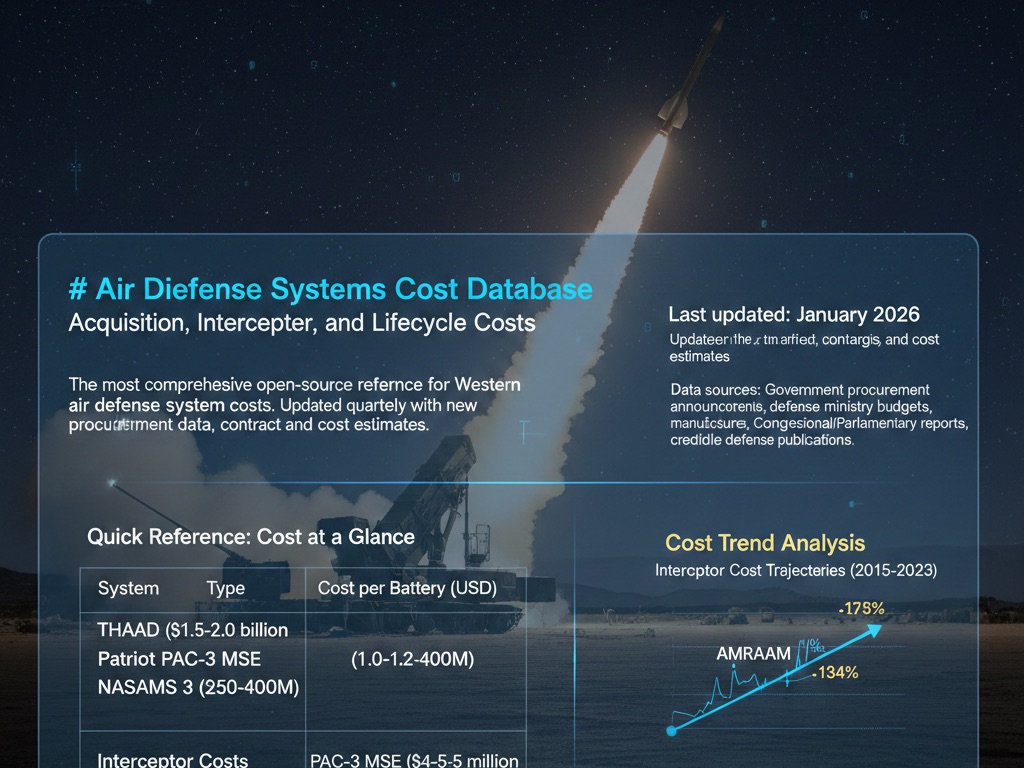
This database was published in January 2026. In the six weeks since, two sequential real-world stress tests have fundamentally changed the context in which these cost figures should be read — and in some cases changed the figures themselves.
The first is the June 2025 twelve-day Israel-Iran war (Operation Rising Lion), which this database was already written in the aftermath of. The second, and far more consequential, is Operation Epic Fury: the joint US-Israel military campaign against Iran launched on February 28, 2026, which is ongoing as of the date of this update. Together, these two events have compressed what were previously theoretical planning concerns about interceptor burn rates and stockpile depth into an active crisis — one that multiple senior US defense analysts are now describing openly as a “full-blown crisis” in interceptor availability.
This update note should be read alongside the original database. Where figures are revised or contextually changed, this note takes precedence.
The two-conflict context
The June 2025 war established the basic empirical baseline: approximately 100–150 THAAD interceptors and 80 SM-3s were fired over twelve days in defense of Israel, consuming roughly 14–25% of the entire US THAAD stockpile. Annual THAAD production at the time was 11–12 missiles. The strategic math was already alarming before 2026.
Operation Epic Fury, now in its sixth day, has compounded this materially. The first 100 hours of operations are estimated to have cost US forces approximately $5.82 billion in total, with CSIS estimating a daily replenishment cost of around $758 million per day for expended munitions alone. Defensive interceptor expenditure in the opening phase is estimated by the Payne Institute at roughly 40 THAAD missiles, 90 Patriot PAC-2/PAC-3 missiles, and 180 SM-2/SM-3/SM-6 naval interceptors — fired against Iran’s retaliatory salvos targeting US bases, Gulf state infrastructure, and Israel simultaneously.
Iran has reportedly fired over 500 ballistic missiles and nearly 2,000 drones since February 28. Critically, approximately 60% of Iranian launches have been directed at US targets in the region rather than Israel — distributing the defensive burden across Gulf state Patriot batteries, US naval Aegis systems, and THAAD assets that were already depleted from 2025.
What has changed since January 2026
THAAD: from “limited production volume” to active crisis
The database’s THAAD cost section noted “limited production volume” as a cost driver and flagged that the US stockpile was “fewer than 10 batteries sold.” That language needs to be understood now against a two-conflict consumption reality.
Going into Operation Epic Fury, the US THAAD stockpile had already been reduced by an estimated 14–25% from the June 2025 war. The ongoing conflict is adding further draws from a stockpile that is not being replenished at anything close to consumption pace. The Defense Department signed a contract with Lockheed Martin in January 2026 that aims to quadruple annual THAAD production from 96 to 400 missiles — but this is a multi-year ramp, not an immediate surge. THAAD delivery timelines mean new missiles procured now will not arrive in volume until 2027–2028 at the earliest. Analysts across CSIS, the Stimson Center, and JINSA now converge on a restocking timeline of three to eight years for the 2025 expenditure alone, before accounting for ongoing 2026 consumption.
The $12–15 million per interceptor cost figure in the database remains accurate. What has changed is the strategic weight behind it: each THAAD missile fired is now a genuinely scarce strategic asset being consumed faster than it can be replaced. Secretary of State Rubio stated publicly this week that Iran “is producing, by some estimates, over 100 of these missiles a month. Compare that to the six or seven interceptors that can be built a month.” That ratio — approximately 15:1 in Iran’s favor on production — is the defining constraint of the current operational environment.
For the database’s cost-driver section on THAAD, the “limited production volume” note should now be read as: the US is currently consuming THAAD interceptors at a rate that structurally cannot be sustained beyond weeks without strategic consequences for deterrence in other theaters, particularly the Indo-Pacific.
Patriot PAC-3 MSE: the more available but also depleting tier
The database lists PAC-3 MSE at $4–5.5 million per interceptor, with production of around 500–650 missiles annually. The DoD’s January 2026 contract with Lockheed Martin targets increasing this to 2,000 per year over seven years — suggesting PAC-3 MSE is recognized as the most scalable tier of the stack.
The current conflict is drawing heavily on Patriot stocks across multiple theaters simultaneously: defending Israeli cities, protecting US bases in Qatar (Al Udeid), Jordan (Muwaffaq Salti), Bahrain, and defending Gulf state civilian and energy infrastructure. The UAE’s THAAD-equipped batteries are also actively firing. Gulf states cannot domestically produce replacements and are consuming US-origin interceptors at a rate that will require replenishment from the same supply chain now under maximum strain.
The PAC-3 MSE cost figures in the database remain current. The context has changed: Patriot is now the workhorse of a multi-theater defensive campaign while simultaneously being the tier most likely to be scaled up. Any European nation considering Patriot procurement — including Norway — should factor both the increased demand signal and the prospective production ramp into their delivery timeline expectations.
SM-3: the naval tier under sustained pressure
The database’s SM-3 section was primarily framed around Aegis Ashore installation costs. The ongoing conflict has shifted the operational emphasis back to sea-based SM-3, with Arleigh Burke-class destroyers actively firing both Tomahawks offensively and SM-3/SM-6 defensively. The 12-day war consumed approximately 80 SM-3s; Operation Epic Fury has added an estimated 180 SM-2/SM-3/SM-6 naval interceptor launches in the first 100 hours.
The SM-3 Block IIA cost ($28–36 million) and the note about a procurement deficit extending to 2031 remain valid — and the 2031 timeline is now being challenged further by 2026 consumption. FPRI analysis from late 2025 noted that the 12-day war expenditure already exceeded the largest single annual SM-3 IIA delivery volume. Two months later that baseline has been surpassed again.
Hardware losses: a category the database did not address
The database covers interceptor and system acquisition costs, but not combat attrition of major systems. Operation Epic Fury has introduced this as a relevant variable. Iran struck and destroyed at least one AN/FPS-132 early warning radar at Al Udeid Air Base in Qatar (valued at approximately $1.1 billion) and at least one AN/TPY-2 radar component in the UAE ($500 million each). The AN/TPY-2 is the radar backbone of the THAAD system; its loss degrades both detection capability and the effective value of remaining THAAD interceptors in that theater.
This is not a cost figure this database tracks, but planners should note that a full THAAD battery engagement in a contested environment now includes meaningful risk of losing the $400–500 million radar component — a cost that should sit alongside the per-interceptor figures when assessing total operational exposure.
Iron Beam: combat debut confirmed
The database listed directed-energy systems under “Development / Limited fielding.” Since publication, Iron Beam has entered limited operational use. In the current conflict, it is being used against short-range rockets and drones from Hezbollah in Lebanon and Iranian Shahed-136 attacks. The per-engagement cost (effectively electricity cost, estimated at approximately $2 per shot) is confirmed as operational in limited conditions, though weather sensitivity and sustained-fire capacity constraints remain real.
This does not change near-term procurement calculus, but it does confirm the economic logic described in the database’s directed-energy section: a system engaging drones at $2 per shot against $20,000 Shaheds changes the math dramatically compared to Tamir ($50,000) or AMRAAM ($1–1.5 million) against the same target.
Shahed-136 and the drone economics problem
The database’s cost-asymmetry framing throughout has been validated at scale. Iran has launched approximately 2,000 drones since February 28. The UAE Ministry of Defense reported 941 detected drones in the first days, of which 65 penetrated Gulf defenses — damaging ports, airports, hotels, and data centers. The cost exchange is deeply unfavorable: Shahed-136 production cost is approximately $20,000; the cheapest interceptors routinely used against it (Tamir, IRIS-T SLS) run $40,000–$275,000; high-end interceptors misused against drones represent million-dollar engagements against $20,000 targets.
The database’s directed-energy and counter-drone sections should be read with this in mind. Qatar is reportedly using fighter jets for drone interception — a more sustainable option than missiles, consistent with lessons from Ukraine. The Pentagon and regional governments are also in reported negotiations to purchase cheaper Ukrainian-developed interceptors designed specifically for Shahed-class threats.
Production ramp: significant but slow
The January 2026 DoD-Lockheed Martin contracts represent the most significant production commitment in years: System Previous annual production Target production Timeline THAAD ~12/year ~400/year Multi-year ramp PAC-3 MSE ~500–650/year ~2,000/year 7-year program
These are real commitments that will matter by 2028–2030. They do not address the current conflict or the 2027 delivery gap that multiple analysts have identified. The database’s production capacity table — estimating 10–15 days of high-intensity combat supportable on annual PAC-3 MSE production — remains valid; the caveat is that the ramp, if sustained, will eventually change that figure materially.
Implications for Norwegian and Nordic planning
The original database was already flagging several Norway-specific considerations. Operation Epic Fury intensifies each of them.
The THAAD backstop assumption is no longer tenable. The US is now drawing down THAAD in two sequential conflicts from a stockpile that takes years to replenish. NATO Article 5 obligations do not come with a THAAD guarantee, and the Indo-Pacific demand signal is growing in parallel. Norwegian defense planning that relies on US upper-tier coverage as a given should be revised.
Delivery timelines for Patriot are now under pressure from two directions. Norway formally requested Patriot pricing in late 2024. Any contract signed now will compete for production capacity against US military replenishment demand, Gulf state orders (Saudi Arabia, Qatar), Ukrainian demand, and the existing European order queue. The 2–3 year delivery estimates that were reasonable in 2024 may be longer today.
Interceptor stockpile depth must be a primary procurement criterion, not a secondary one. The database’s lifecycle cost scenarios budgeted interceptor costs as a minority of 20-year total ownership cost. The current operational evidence suggests that in any credible high-intensity contingency, interceptor consumption rates would front-load those costs dramatically. Acquisition decisions made now should specify minimum interceptor holdings — not just system counts — as a threshold requirement.
The directed-energy inflection point has moved closer. Iron Beam’s combat performance against drone swarms is operationally validated as of March 2026. For a country like Norway facing plausible drone and short-range missile threats in any Baltic/Arctic contingency, the economics of directed-energy SHORAD have shifted from theoretical to demonstrated within the planning horizon of current procurement decisions.
Revised data points
Entry January 2026 figure March 2026 revision THAAD interceptor cost $12–15M Unchanged; but strategic scarcity premium now applies THAAD “limited production” note Pricing footnote Active strategic constraint; 3–8 year restocking timeline for 2025 consumption, extended by ongoing 2026 draws PAC-3 MSE production capacity 500–650/year Ramp to 2,000/year announced; 7-year timeline; no near-term relief SM-3 stockpile note Recovery deficit to 2031 Extended by 2026 consumption; timeline under further pressure Iron Beam status Development / limited fielding Limited operational use confirmed (drones/rockets, Lebanon front, March 2026) Directed-energy per-shot cost ~$2 (estimated) Operationally consistent with estimates; confirmed against Shahed-class threats AN/TPY-2 radar (THAAD component) $400–500M acquisition Add: combat attrition risk confirmed; at least one destroyed in Operation Epic Fury
A note on uncertainty
This update is written on March 6, 2026 — day six of an ongoing conflict whose trajectory remains unclear. Iranian missile and drone launch rates have reportedly decreased 83–90% since day one, suggesting US offensive operations against launch sites and production facilities are having effect. Whether that reflects degraded Iranian capability or deliberate conservation ahead of a sustained campaign is not yet known. Cost and consumption figures cited here are estimates from open-source analysis; actual DoD figures remain classified.
Readers should treat this update as a directional revision, not a definitive restatement. A formal quarterly update will be published once the operational picture stabilizes.
This update note reflects open-source information available through March 6, 2026. The underlying database will be formally revised in the Q2 2026 quarterly update. Corrections and sourced updates are welcome.
AI-assisted article

