
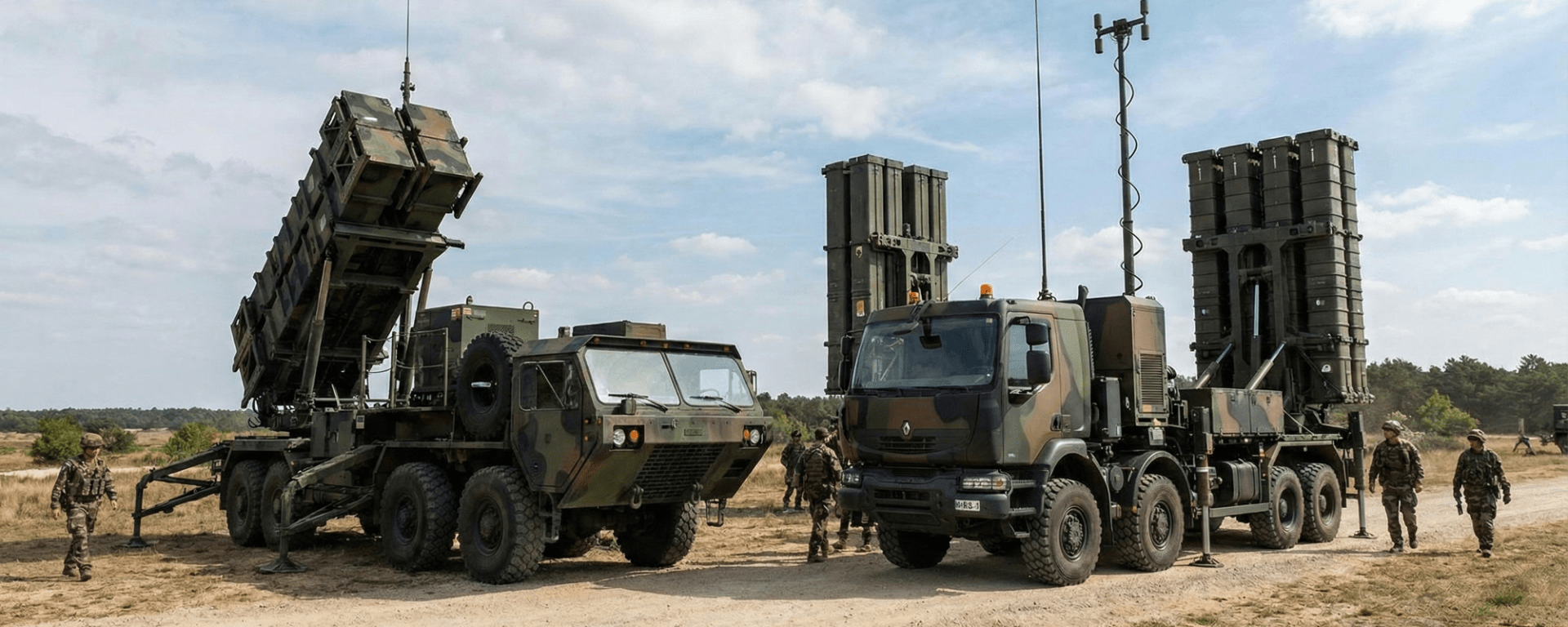
Denmark’s September 2025 selection of SAMP/T NG over Patriot possibly sent shockwaves through European defense circles, signaling that delivery timelines and European sovereignty now rival raw combat performance in procurement decisions. For Norway, which is still weighing its long-range air defense options, this Franco-Italian versus American rivalry has become the defining strategic choice of the decade. The systems represent fundamentally different visions: Patriot offers battle-proven performance and deep NATO integration, while SAMP/T NG promises European industrial autonomy and freedom from ITAR restrictions. With wait times for new Patriot batteries stretching to seven years and SAMP/T production ramping up dramatically, the calculus is shifting.
Technical specifications reveal distinct design philosophies
The two systems approach air and missile defense through fundamentally different engineering philosophies that trace back to their origins—Patriot as an evolution of 1980s American technology continuously upgraded through combat experience, and SAMP/T as a ground-up European design from the 1990s emphasizing naval commonality and European component sovereignty.
SAMP/T NG centers on the Aster 30 Block 1 NT missile, a significant upgrade featuring a new Ka-band active radar seeker replacing the previous Ku-band system. This delivers extended target acquisition range, higher angular resolution for tracking low radar cross-section targets, and improved resistance to electronic countermeasures. The missile reaches speeds of Mach 4.5, engages air-breathing targets beyond 150 km, and intercepts aircraft at altitudes up to 25 km. Critically, the B1NT extends ballistic missile defense capability from 600 km-class short-range missiles to 1,500 km-class medium-range ballistic missiles—including those with separable warheads and terminal maneuvering.
The Ground Fire 300 radar represents a generational leap over the original Arabel. Using gallium nitride (GaN) active electronically scanned array technology, it achieves 400 km detection range while simultaneously tracking over 1,000 targets— compared to Arabel’s ~130 targets and 80-100 km range. Factory acceptance tests completed in March 2025, with first deliveries to the French Air and Space Force scheduled for 2026. Italy has opted for the Leonardo Kronos Grand Mobile HP (C-band, 300+ km range) as an alternative sensor.
Patriot’s modernization centers on the Lower Tier Air and Missile Defense Sensor (LTAMDS)—a true 360-degree radar using three GaN AESA arrays, eliminating the legacy system’s notorious rear blind spot. A single secondary LTAMDS array delivers more capability than the entire current Patriot radar. The system achieved Milestone C approval for low-rate initial production in early 2025, with 94 radars planned and full-rate production anticipated by 2028.
The PAC-3 MSE interceptor provides Patriot’s primary anti-ballistic capability through hit-to-kill technology. With range exceeding 60 km and intercept altitude of 20-40 km against ballistic missiles, it uses 180 miniature attitude control motors for extreme terminal maneuverability. The June 2025 flight test validated upgraded seeker algorithms enhancing target discrimination in complex electronic warfare environments. Specification Aster 30 Block 1 NT PAC-3 MSE Maximum range (aerodynamic) >150 km ~160 km (GEM-T) Maximum range (ballistic) TBM up to 1,500 km class MRBM proven Kill mechanism Blast-fragmentation with proximity fuse Hit-to-kill kinetic Speed Mach 4.5 Mach 5+ Radar detection range 400 km (GF 300) ~300+ km (LTAMDS) Targets tracked 1,000+ Enhanced over legacy
Ukraine combat data reshapes performance assessments
The Ukraine conflict has provided unprecedented real-world validation—and revealed surprising limitations—for both systems. Patriot’s combat debut against Russian missiles initially appeared triumphant, but 2025 data complicated the narrative significantly.
Patriot achieved history’s first confirmed hypersonic intercept in May 2023, destroying a Russian Kh-47M2 Kinzhal over Kyiv at approximately 10 km altitude. Ukrainian operators noted the Kinzhal traveled at only Mach 3.6—roughly one-third of Russia’s claimed maximum speed—suggesting the “hypersonic” threat may be more manageable than feared. Following Patriot deployment, Ukrainian Air Force Colonel Serhii Yaremenko reported all 20+ Kinzhals fired at Kyiv were successfully intercepted. In May-June 2023, Ukraine’s two Patriot batteries shot down all 34 ballistic missiles targeting the capital.
However, a critical development emerged in late 2025: interception rates reportedly plummeted from 37% in August to just 6% in September after Russia upgraded Iskander and Kinzhal missiles with terminal-phase maneuvering capabilities. This dramatic decline—reported by the Financial Times citing US Defense Intelligence Agency assessments—allowed Russia to damage key military installations, four drone production facilities, and critical infrastructure.
SAMP/T has shown promising performance against these evolved threats. French Army assessments indicate Ukrainian SAMP/T systems began outperforming Patriot specifically against the modified Iskander flight profiles. In March 2025, Ukrainian forces claimed a SAMP/T battery shot down a Russian Sukhoi aircraft at approximately 90 miles—demonstrating the system’s versatility against both ballistic and aerodynamic targets. France and Italy have donated 2-3 SAMP/T batteries to Ukraine, though ammunition shortages reportedly brought systems “to the verge of being unusable” by March 2025.
Patriot’s earlier combat record in Saudi Arabia drew mixed reviews. US officials claimed ~90% success rates against Houthi missiles, but independent analysts questioned these figures. The September 2019 Abqaiq-Khurais attack saw six Patriot battalions fail to protect Saudi oil facilities—though the systems were positioned against the southern Houthi threat rather than the direct Iranian attack vector that materialized. MIT physicist Theodore Postol has consistently questioned Patriot effectiveness claims, noting that 1991 Gulf War assertions of 70% success were later revised to potentially 0-9%.
Cost analysis favors the European solution
Procurement costs reveal substantial differences, though comparing systems requires careful attention to what’s included in contract values—training, sustainment packages, and spare parts can double headline figures.
SAMP/T NG system costs range from €140-154 million per unit based on recent OCCAR contracts—the July 2023 order for five Italian Air Force systems at approximately €700 million, and France’s September 2024 contract for seven additional systems at an estimated €500 million. The Aster 30 Block 1 NT missile costs approximately $2-3.1 million per unit, derived from the January 2023 France-Italy contract for 700 Aster missiles at $2 billion total.
Patriot battery costs significantly exceed SAMP/T equivalents. Hardware alone runs approximately $400 million per battery according to CSIS and Congressional Research Service figures. Complete batteries with missiles reach $1.1 billion, while export packages including training, spares, and support commonly exceed $2-2.5 billion per system. PAC-3 MSE missiles cost $4.1-7 million each— roughly double Aster pricing. The LTAMDS radar adds $125-130 million per unit, expected to decrease toward the legacy AN/MPQ-65’s $110-115 million as production scales.
Lifecycle costs amplify these differences. The GAO estimates annual Patriot battery operations and maintenance at approximately $12 million, including $3 million for radar tube replacements, $2 million for vehicle overhaul, $4 million for missile recertification, and $3 million for software sustainment. SAMP/T’s lower crew requirements—14-20 personnel versus ~90 for Patriot— deliver additional sustainment savings.
Recent European contracts illustrate the market dynamics:
- Poland (Wisła): $4.75 billion Phase 1 for 4 radars, 16 launchers, 219 PAC-3 MSE; Phase 2 adding 12 LTAMDS for $2.09 billion
- Germany: $5.5 billion NATO consortium deal for 1,000 PAC-2 GEM-T missiles (with Netherlands, Spain, Romania)
- Switzerland: ~$2.1 billion for 5 Patriot fire units (deliveries delayed indefinitely due to Ukraine prioritization)
- Denmark: ~$9.1 billion total package for 8 medium/long-range systems including 2 SAMP/T NG
- Spain: $1.7 billion for 4 Patriot fire units (December 2025)
Production bottlenecks create strategic delivery gaps
The most consequential factor driving current procurement decisions may be delivery timelines—and here SAMP/T holds a decisive advantage.
NATO Admiral Pierre Vandier warned in August 2025 that new Patriot battery deliveries could take approximately seven years, meaning orders placed today wouldn’t arrive until 2032. Raytheon has set a goal of shrinking timelines to 30 months, but current realities remain sobering. The June 2024 Biden administration decision to temporarily halt Patriot and NASAMS deliveries to all countries except Ukraine and Taiwan—continuing through FY2025—has exacerbated the backlog. Switzerland’s 2022 Patriot order, originally scheduled for 2027-2028 delivery, has been delayed indefinitely.
MBDA has dramatically accelerated Aster production, achieving a 500% increase from 2022 baselines. Lead times have fallen from 42 months to 30 months, with an 18-month target by 2026. The company invested €2.4 billion in production capacity expansion for 2025-2029 and recruited 2,500 employees in 2024 alone. Annual Aster production is rising from approximately 80-100 units in 2025 toward 300+ missiles per year by 2028.
Current production rate comparison: System 2024 Output 2027 Target Key Constraint PAC-3 MSE 500+ missiles 650 missiles Boeing seeker availability PAC-2 GEM-T 240 missiles 420 missiles New European facility (2026) Aster (all variants) 80-100 missiles 300+ missiles Lead time reduction ongoing Patriot batteries ~12/year ~12/year Global demand exceeds supply
Denmark explicitly cited delivery timelines in selecting SAMP/T NG. Lieutenant General Per Pugholm Olsen stated directly that Patriot “delivery timelines are longer”—a determinative factor for a nation that had no operational ground-based surface-to-air missile systems prior to 2025.
European autonomy emerges as decisive procurement factor
The SAMP/T versus Patriot decision increasingly reflects broader debates about European strategic independence from American defense technology—and the practical implications of ITAR (International Traffic in Arms Regulations) restrictions.
SAMP/T represents the only non-US long-range air defense system contributing to NATO’s ballistic missile defense architecture. This delivers concrete benefits: no ITAR restrictions limiting deployment decisions, full European sovereignty over exports, and freedom from potential US “use restrictions” that could constrain European military options. EU Commissioner Andrius Kubilius observed that “ITAR is becoming a problem for American producers… many European firms are pitching ‘no China, no Russia, no ITAR.’”
France has championed this position by notably refusing to join the European Sky Shield Initiative (ESSI), viewing the German-led program as funneling billions in European taxpayer funds to American and Israeli contractors while starving European champions like MBDA and Thales. The 24-member ESSI selected Patriot for long-range defense alongside Israeli Arrow 3 for exo-atmospheric intercepts—explicitly excluding SAMP/T.
Denmark’s SAMP/T selection represents a significant validation of the French position, particularly given the political context. Greenland tensions with the Trump administration may have influenced Copenhagen’s decision to pivot toward European systems. For defense planners, the precedent matters: a NATO ally chose SAMP/T specifically to “ensure interoperability with European and NATO armed forces” while maintaining full sovereignty over the capability.
Both systems maintain full NATO interoperability. SAMP/T achieved its first NATO-architecture firing in March 2013, successfully integrating with the Alliance’s Active Layered Theater Ballistic Missile Defense program via Link 16. SAMP/T NG can track up to 1,000 targets while operating seamlessly within NATO’s Integrated Air and Missile Defence architecture.
Nordic choices reveal fragmented regional approach
The Nordic countries have each charted independent paths on long-range air defense, creating a diverse but potentially suboptimal regional architecture—a situation Norway’s pending decision could either consolidate or further fragment.
Sweden chose Patriot in 2018, receiving four batteries of Configuration 3+ with 100 GEM-T and 200 PAC-3 MSE missiles for approximately $3.2 billion. Deliveries completed in December 2022— accelerated from the original 2023 timeline—with Full Operational Capability achieved by 2025. Raytheon’s promised industrial collaboration with Saab and faster delivery timelines drove the selection over SAMP/T.
Finland selected David’s Sling in April 2023—the day after joining NATO—becoming the Israeli-American system’s first export customer. The €316 million deal addresses Finland’s specific high-altitude capability gap, complementing 12 existing NASAMS batteries. With 1,340 km of Russian border to defend, Finland prioritized a system optimized for ballistic missile intercept at extreme altitudes (minimum 15,000 meters) using hit-to-kill technology.
Denmark’s September 2025 SAMP/T NG selection broke the American-system pattern, driven by delivery timelines, European autonomy considerations, and potentially transatlantic political tensions. Copenhagen’s ~$9.1 billion investment covers eight medium- and long-range systems in a multi-layered architecture also including NASAMS, IRIS-T SLM, and Skyranger 30.
Norway remains the critical undecided player. The 2025-2036 Long-Term Defence Plan allocates NOK 600 billion ($55 billion) over 12 years, explicitly identifying long-range air defense as one of the highest priorities. The plan calls for a system “to protect one geographical area against tactical ballistic missiles,” with investment funds postponed until after 2028. Chief of Defence General Eirik Kristoffersen acknowledged in April 2024: “I don’t have a clear answer today what sort of system we should buy… we need to compare all systems.”
Norway’s Defence Commission estimated that full layered coverage of Oslo, Bergen, and military airbases would cost approximately NOK 60 billion ($5.5 billion) with annual operating costs of NOK 4 billion. Bergen naval base alone requires an additional NOK 20 billion investment. Nordic Country Long-Range Selection Delivery Status Rationale Sweden Patriot (2018) FOC 2025 Speed; Saab partnership Finland David’s Sling (2023) Contracted High-altitude gap; first export Denmark SAMP/T NG (2025) On order Delivery timelines; European autonomy Norway TBD (post-2028) Under consideration NASAMS expansion prioritized
Implications for Norway’s forthcoming decision
Norway faces a uniquely consequential choice that will shape Nordic regional defense architecture for decades. Several factors warrant particular attention.
Delivery timeline realities favor SAMP/T. If Norway requires operational capability before 2032, SAMP/T’s dramatically shorter production queues make it the more practical choice. Patriot’s seven-year waitlist could leave critical infrastructure undefended during a period of elevated regional tension.
Both SAMP/T NG and Next-Generation Patriot represent world-class air and missile defense capabilities that would significantly enhance any operator’s defensive posture. The technical specifications are broadly comparable—differences in radar range, missile velocity, and kill mechanisms reflect design philosophy choices rather than clear superiority.
Combat performance data requires careful interpretation. Patriot’s initial Ukraine success impressed global observers, but the 2025 decline against upgraded Russian missiles—and French assessments that SAMP/T outperformed Patriot against these evolved threats—complicates the “combat-proven” argument. Both systems have demonstrated ballistic missile intercept capability; neither has been tested against peer-adversary saturation attacks.
Nordic interoperability presents competing considerations. Sweden’s Patriot and Finland’s David’s Sling create an American-Israeli system cluster, while Denmark’s SAMP/T represents the European alternative. Norway’s choice could either establish NASAMS-based integration as the common thread (preserving flexibility) or push toward one technology bloc. Kongsberg’s Full Spectrum Air Defence concept may offer a uniquely Norwegian integration path.
European industrial considerations carry political weight. Norway’s significant defense industrial base—particularly Kongsberg’s NASAMS partnership with Raytheon—creates complex incentive structures. SAMP/T selection would signal stronger European autonomy alignment; Patriot would reinforce transatlantic defense ties during a period of uncertain American commitment to European security.
Cost-per-intercept economics matter for sustained operations. Against drone threats proliferating from the Ukraine conflict, using $4-7 million PAC-3 MSE missiles against $20,000-50,000 targets creates 140-350:1 cost disadvantages. SAMP/T’s lower missile costs ($2-3 million) and NASAMS’ even cheaper AMRAAM-ER options suggest Norway needs a diverse missile portfolio regardless of long-range system selection.
Conclusion: Two capable systems, one strategic choice
The decisive factors have shifted from pure capability to availability, industrial sovereignty, and regional alignment. Denmark’s SAMP/T selection signals that European buyers increasingly value delivery timelines and freedom from ITAR restrictions alongside combat performance. France and Italy’s aggressive production expansion has transformed SAMP/T from a niche European option into a competitive global alternative.
For Norway specifically, the choice will ultimately reflect answers to strategic questions beyond system specifications: How urgently is capability needed? How important is European defense industrial autonomy? What regional architecture serves Nordic security best? The technical comparison provides essential foundation, but the decision is fundamentally about Norway’s vision for European defense in an uncertain transatlantic era.
The systems themselves will continue evolving—Patriot’s LTAMDS integration and IBCS connectivity, SAMP/T NG’s Ground Fire 300 radar and future Aster 30 Block 2 for IRBM-class threats. Norway’s post-2028 decision timeline allows observation of both systems’ development trajectories and, critically, their ongoing Ukraine combat performance as Russian countermeasures continue evolving. The choice that emerges will shape Nordic air defense architecture—and signal broader European strategic direction—for the next generation.

