
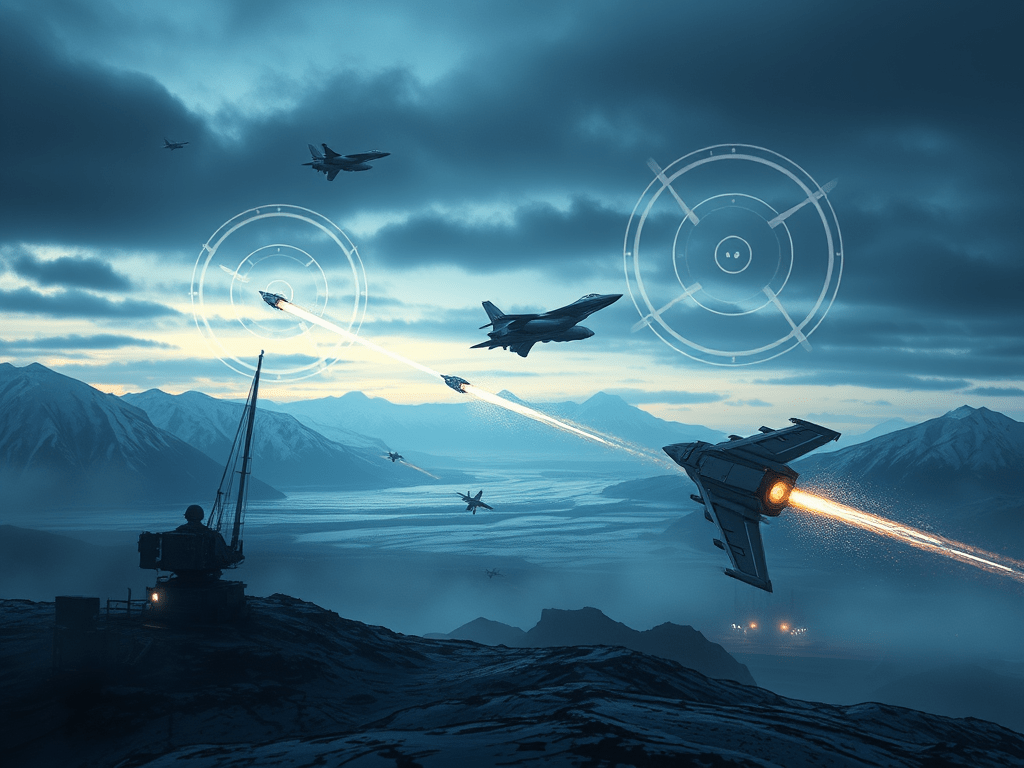
Defending the Nordic region today means mastering complexity
From slow, low drones hugging the terrain to ballistic missiles plunging back through the atmosphere at hypersonic speeds — and everything in between — the challenge is no longer a question of buying one “silver bullet” system. It’s about creating a network that produces a handful of crucial operational effects, every time, in any scenario.
From Points to the Whole Battlespace
Not long ago, Nordic air defence was built for point protection — defending an air base here, a port there, or a capital city from a handful of likely threats.
That era has passed.
Today, the threats are faster, more varied, and more likely to arrive in combinations designed to overwhelm defenders. The goal now should possibly be regional protection — a shield that covers the entire battlespace, adapts to changing attacks, and keeps working long after the first strike.
How the Target Environment Has Changed Since the Cold War
When the Cold War ended, many assumed the air defence mission could be relaxed. The target set for most Nordic defences was relatively simple:
- Manned aircraft delivering unguided or early-generation precision munitions.
- Limited numbers of ballistic missiles, mostly in the inventories of great powers.
- Predictable flight profiles, with threats generally detected well before they crossed borders.
The decades since have transformed that picture:
- Precision has proliferated – Guided munitions are now available to regional powers and even some non-state actors. Targets can be struck from greater ranges with less warning.
- Missile variety has exploded – Cruise missiles, short- and medium-range ballistic missiles, manoeuvrable re-entry vehicles, and hypersonic glide vehicles now blur the boundaries between categories.
- Small, cheap, and numerous threats – Commercial drones and loitering munitions can now be massed to saturate defences, support larger strikes, or conduct reconnaissance in real time.
- Combined-arms strike doctrine – Modern adversaries are more likely to mix ballistic missiles, cruise missiles, drones, and RAM fire in a single coordinated attack, creating dilemmas at every defensive layer.
- Reduced warning times – Faster missiles, terrain-following cruise systems, and low-observable designs shrink decision windows to seconds in some cases.
Implication: Modern Nordic air defence cannot rely on a single dominant threat model. The target environment is diverse, unpredictable, and deliberately designed to saturate and confuse defenders. That requires broad-spectrum sensors, multi-layer engagement capacity, and political/military frameworks for rapid cross-border cooperation.
The Expanding Threat Spectrum
Defending Nordic airspace in the 2020s means preparing for an entire spectrum of aerial and missile threats:
- Aerodynamic threats inside the atmosphere
- Manned aircraft delivering precision-guided munitions from stand-off ranges.
- Unmanned systems — from small quadcopters to long-endurance ISR drones.
- Cruise missiles skimming low to evade radar.
- Trans-atmospheric threats
- Ballistic missiles that leave the atmosphere before returning at extreme speed.
- Hypersonic weapons that blur the line, combining high speed with unpredictable flight paths.
- Indirect fire and saturation attacks
- Rockets, artillery, and mortars (RAM) used to overwhelm local defences or mask larger strikes.
- Swarming drones launched in large numbers to expose weak points.
Why Defending the Spectrum Is So Complex
Three realities make this problem harder than it might appear:
- Different physics, different timelines
An incoming cruise missile might give you minutes to respond. A ballistic missile in terminal phase? Seconds. Each layer needs different sensors and shooters. - Simultaneity is the norm
Expect small drones, cruise missiles, and ballistic threats arriving together, forcing choices about where to commit limited interceptors and attention. - Sensors must span ground, air, and space
Low flyers hide in terrain clutter; ballistic trajectories demand high-altitude or space-based tracking. Combining all of this into one picture — and keeping it live under attack — is a technical and organisational challenge.
The Effects That Matter Most
The Nordic region’s future defence shouldn’t be judged on the names of its systems, but on whether it can deliver these six operational effects in wartime:
- Early and Persistent Detection
- Seamless Engagement Across Layers
- High Burn-Through Capacity
- Rapid Local Response to Short-Notice Attacks
- Interoperability Across Borders
- Resilience Under Fire
Inside the Atmosphere: Aerodynamic Defence
Fighting aircraft, drones, and cruise missiles is an endurance game. Low-signature threats can appear late on radar, so defenders rely on dense sensor coverage, fast-tracking systems, and shooters positioned close to the assets they protect. Terrain, clutter, and weather all complicate the picture — making human skill and decision speed as important as technology.
Outside the Atmosphere: Missile Defence
Ballistic and hypersonic threats compress timelines brutally. Boost-phase detection relies on space or high-altitude sensors; midcourse tracking demands large radar or satellite coverage; terminal interception happens in seconds, often under heavy electronic and physical attack. This is where warning time becomes the decisive currency — the earlier a threat is seen, the more layers have a chance to engage.
Trade-Offs That Must Be Managed
- Coverage vs Cost – Wide-area sensors give early warning, but are expensive and potentially vulnerable.
- Automation vs Control – Faster reaction demands automation, but rules of engagement — especially across borders — slow it down.
- Stockpiles vs Selectivity – Low-cost munitions for swarms must be available in quantity so high-end interceptors are saved for major threats.
- Sovereignty vs Integration – Shared defence maximises effect but requires deep trust and legal agreements.
From Islands to a Networked Shield
Right now, Nordic defences are still pockets of protection. The next decade’s task is to connect them into one continuous shield:
- Shared air picture updated in real time.
- Common rules so the closest capable shooter always acts first.
- Redundant command and control so no single hit paralyzes the network.
A Strategic Imperative for the 2030s
By the mid-2030s, the Nordic air and missile defence enterprise should consider to be able to:
- Deter large-scale attacks by making them too complex and costly to succeed.
- Protect the movement of forces so reinforcements can flow freely.
- Safeguard critical infrastructure even under sustained attack.
- Enable offensive operations by securing the skies.
The bottom line
The systems will change. The names will change. But the effects demanded — early warning, layered engagement, sustained capacity, local rapid response, cross-border interoperability, and resilience — should stay constant.

