
How Four Nations Built the World’s Most Advanced Shield – And What It Reveals About Modern Alliance Strategy
The world’s most sophisticated missile defense systems tell a story that extends far beyond their technical specifications. THAAD, Arrow, PATRIOT, and SAMP/T represent four distinct approaches to the same existential challenge: how to defend against increasingly sophisticated missile threats while navigating the complex realities of alliance politics, industrial sovereignty, and strategic deterrence. Each system embodies its nation’s particular answer to questions of technological dependence, cost-effectiveness, and military partnership that will define 21st-century security.
Recent combat experience has transformed these systems from theoretical capabilities into battle-tested platforms. Ukraine’s successful use of PATRIOT against Russian hypersonic missiles, Israel’s Arrow intercepting Iranian ballistic barrages, and SAMP/T’s first fighter aircraft kill have provided unprecedented real-world validation. Yet the implications extend beyond battlefield effectiveness to fundamental questions about technological sovereignty, alliance burden-sharing, and the evolving nature of deterrence itself.
The American shield: THAAD’s global reach
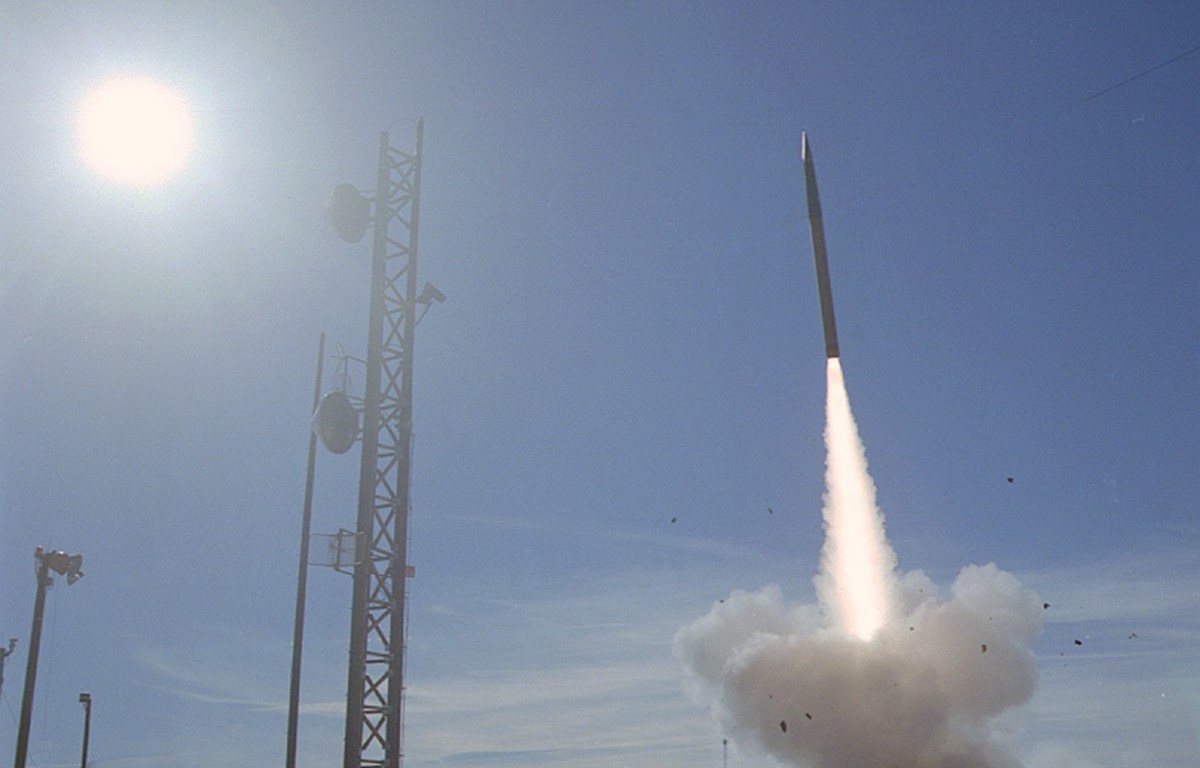
THAAD (Terminal High Altitude Area Defense) represents America’s most technically ambitious missile defense achievement, designed specifically for the unique challenge of both atmospheric and space-based intercepts. Developed by Lockheed Martin with its distinctive AN/TPY-2 radar, THAAD stands alone among these systems in its ability to intercept missiles both inside and outside Earth’s atmosphere— a capability that has proven decisive in recent deployments.
The system’s technical sophistication is matched by its strategic complexity. Each THAAD battery costs between $800 million and $1.8 billion, with individual interceptors priced at $13-15 million. This extraordinary expense reflects not just advanced technology but a specific strategic philosophy: high-cost, low-inventory systems designed to protect critical assets rather than provide area-wide coverage. THAAD’s 150-kilometer range and 150-kilometer altitude ceiling make it ideal for defending key installations, but insufficient for comprehensive territorial defense.
THAAD’s deployment pattern reveals American strategic priorities clearly. Seven operational batteries serve U.S. forces globally, with international deployments carefully calibrated to alliance relationships: South Korea’s controversial 2017 deployment strengthened deterrence against North Korea while straining relations with China; the UAE’s 2016 purchase represented the first international sale to a key Gulf partner; Israel’s recent deployment following Iranian attacks demonstrated extended deterrence in practice.
The system’s perfect operational record—16 successful intercepts in 16 production tests plus recent combat successes in Israel and the UAE— validates its technical approach while highlighting its strategic limitations. THAAD protects what America values most, but only what America can afford to protect.
Israel’s multi-layered masterpiece: The Arrow system
Israel’s Arrow system represents perhaps the most sophisticated integration of missile defense technology and strategic doctrine, born from the unique pressures of living under constant ballistic missile threat. The Arrow family—encompassing Arrow 2, Arrow 3, and the forthcoming Arrow 4—demonstrates how sustained threat exposure can drive technological innovation.
Arrow 2’s atmospheric intercepts and Arrow 3’s space-based kills create overlapping engagement envelopes that have proven decisive in recent conflicts. During Iran’s April and October 2024 attacks, Arrow systems “carried out the main part” of intercepting over 120 ballistic missiles in a single night— a combat validation unmatched by any other system. This performance justified nearly four decades of development investment, with total U.S.-Israeli spending reaching $2.4 billion.
The system’s technical evolution reflects Israeli strategic thinking. Arrow 2’s explosive warhead gives way to Arrow 3’s hit-to-kill technology, mirroring a broader shift from area denial to precise interception. The upcoming Arrow 4’s focus on hypersonic threats demonstrates Israel’s characteristic ability to anticipate and counter emerging dangers before they fully materialize.
Equally significant is Arrow’s emerging role as an export system. Germany’s €4 billion purchase—Israel’s largest defense export ever—validates both the system’s capabilities and its strategic value to allies. This success transforms Arrow from a purely defensive tool into a component of Israeli soft power, strengthening ties with European partners while generating revenue for continued development.
The proven workhorse: PATRIOT’s evolution
PATRIOT’s journey from Gulf War disappointment to Ukraine success story illustrates how sustained investment and operational learning can transform military capabilities. The system that initially struggled against Iraqi Scuds now successfully intercepts Russian hypersonic missiles, representing one of the most dramatic capability transformations in modern military history.
Technical evolution drives this success story. PAC-3 MSE interceptors with their dual-pulse motors and hit-to-kill technology represent a quantum leap from original PAC-2 variants. The new LTAMDS radar with its gallium nitride technology and 360-degree coverage addresses the system’s most significant historical limitation. Most importantly, the Integrated Battle Command System (IBCS) allows PATRIOT to operate as part of networked defense architectures rather than standalone batteries.
Combat validation has been decisive. Ukraine operations demonstrate PATRIOT’s effectiveness against the world’s most advanced missile arsenal: Kinzhal hypersonic missiles, Kh-22 supersonic cruise missiles, and even aircraft at ranges exceeding 100 kilometers. Saudi Arabia’s 150+ successful intercepts against Houthi missiles provide additional proof of concept across different threat types and operational environments.
Yet PATRIOT’s greatest strength may be its alliance architecture. Nineteen nations operate PATRIOT systems, creating the world’s most extensive missile defense network. This interoperability provides both military advantage and political cohesion, making PATRIOT not just a weapons system but a cornerstone of Western alliance structure. The $4.2 million per PAC-3 MSE interceptor cost seems reasonable when amortized across such an extensive user base.
Europe’s sovereign choice: SAMP/T’s strategic autonomy
SAMP/T represents Europe’s most ambitious attempt to achieve strategic autonomy in missile defense, embodying Franco-Italian determination to reduce dependence on American systems. The system’s technical capabilities—150-kilometer range, 360-degree radar coverage, and proven effectiveness against supersonic sea-skimming missiles—match or exceed American equivalents while maintaining European industrial control.
The strategic implications extend beyond technical performance. France and Italy’s rejection of Germany’s European Sky Shield Initiative in favor of SAMP/T expansion reveals fundamental disagreements about European defense strategy. While Germany advocates cost-effective integration with American systems, France and Italy prioritize technological sovereignty even at higher cost.
Recent combat experience has validated this approach while highlighting its limitations. SAMP/T’s successful engagement of Russian aircraft in Ukraine and effective performance in Red Sea operations prove the system’s technical competence. However, limited production capacity—accelerating from 40-month to 18-month missile production cycles—constrains both European stockpiles and export potential.
The system’s future depends on balancing European ambitions with practical constraints. Recent orders for SAMP/T NG systems by both founder nations, plus growing interest from Belgium, Slovakia, and Estonia, suggest expanding European acceptance. Yet the fundamental tension between strategic autonomy and cost-effectiveness remains unresolved.
Technical comparison: Capabilities and limitations
Comparing these systems across technical dimensions reveals both convergent trends and persistent differences. All four systems have evolved toward hit-to-kill interception, active electronically scanned array radars, and network-centric operations— suggesting technological convergence around optimal solutions.
Range capabilities reflect different strategic priorities. THAAD’s 200-kilometer range serves extended deterrence missions, while PATRIOT’s 35-kilometer PAC-3 MSE range prioritizes point defense of critical assets. Arrow’s exoatmospheric intercepts provide unique capabilities against long-range threats, while SAMP/T’s 150-kilometer NG range balances area coverage with cost considerations.
Radar systems show similar convergence with important distinctions. THAAD’s AN/TPY-2 offers unmatched sensitivity and range for early warning missions. PATRIOT’s LTAMDS provides 360-degree coverage addressing historical blind spots. Arrow’s Green Pine radar demonstrates specialized ballistic missile tracking capabilities. SAMP/T’s ARABEL and upcoming AESA systems offer European alternatives with comparable performance.
Cost per interceptor reveals strategic philosophies clearly: THAAD’s $13-15 million interceptors reflect low-volume, high-capability priorities. PATRIOT’s $4.2 million PAC-3 MSE interceptors balance capability with inventory requirements. Arrow’s $2-3 million interceptors optimize for high-threat environments. SAMP/T’s undisclosed but presumably comparable costs reflect European sovereign capability premiums.
Strategic doctrines and alliance implications
These systems embody fundamentally different approaches to alliance structure and strategic doctrine. PATRIOT represents traditional alliance architecture: American-led development with extensive partner participation, standardized equipment enabling interoperability, and shared costs across multiple users. This model maximizes military effectiveness while reinforcing American technological leadership.
THAAD embodies extended deterrence principles: American-operated systems protecting key allies and assets, direct U.S. personnel involvement maintaining escalation control, and selective deployment reinforcing alliance hierarchies. This approach strengthens deterrence while maintaining American strategic control.
Arrow demonstrates specialized partnership models: bilateral U.S.-Israeli cooperation combining American funding with Israeli innovation, technology sharing benefiting both partners’ broader defense programs, and export success validating partnership value. This model shows how smaller allies can achieve technological parity through focused collaboration.
SAMP/T represents strategic autonomy aspirations: European-controlled development reducing dependence on American systems, sovereign industrial base maintaining technological independence, and competitive alternative challenging American market dominance. This approach prioritizes long-term strategic freedom over short-term cost-effectiveness.
Performance in modern conflicts
Recent combat experience has transformed theoretical capabilities into operational realities. Ukraine represents the most significant missile defense validation since World War II: PATRIOT systems successfully engaging advanced Russian threats, real-time software updates improving performance based on combat experience, and demonstrated effectiveness against hypersonic weapons previously considered unstoppable.
Israel’s experience against Iranian attacks provides equally valuable data: Arrow systems intercepting massive ballistic missile barrages, multi-layered defense architecture proving its worth under extreme stress, and successful integration with American early warning systems. These engagements demonstrate both system capabilities and integration benefits.
Naval operations in the Red Sea add another dimension: SAMP/T’s naval variant successfully intercepting Houthi missiles, proven effectiveness against diverse threat types, and validation of European technological competence. These successes support European arguments for strategic autonomy while demonstrating interoperability with allied operations.
Cost effectiveness and procurement realities
Economic considerations increasingly drive missile defense decisions as inventories prove inadequate for sustained operations. Ukraine operations deplete PATRIOT stockpiles faster than production can replenish them, highlighting fundamental tensions between cost-per-shot and magazine depth requirements. Saudi Arabia’s 150+ intercepts against Houthi attacks similarly strain inventories, requiring continuous American resupply.
Production capacity becomes as important as technical capability. PATRIOT’s target production of 650 interceptors annually versus SAMP/T’s accelerated 18-month production cycles reveals industrial base limitations. Arrow’s recent multi-billion dollar production contracts demonstrate how combat experience drives procurement priorities.
The cost-effectiveness debate extends beyond unit prices to strategic value calculations. THAAD’s $15 million interceptors seem expensive until compared to the strategic assets they protect. PATRIOT’s $4.2 million interceptors prove economical when shared across nineteen allied nations. SAMP/T’s comparable costs support European strategic autonomy worth measuring in more than financial terms.
Future evolution and emerging challenges
All four systems face similar challenges from emerging threats while pursuing different solution paths. Hypersonic weapons require faster decision cycles, improved discrimination capabilities, and enhanced kinematic performance—driving common technological solutions despite different industrial approaches.
Counter-saturation attacks demand deeper magazines, more distributed launchers, and improved reload capabilities. PATRIOT’s 16-missile launcher capacity versus SAMP/T’s 48-missile ready inventory highlight different approaches to this challenge. THAAD’s 8-missile launchers prioritize rapid deployment over sustained engagement.
Integration with broader defense networks becomes increasingly critical. PATRIOT’s IBCS integration allows cross-platform sensor and shooter coordination. THAAD’s demonstrated ability to guide PATRIOT interceptors using its superior radar creates new operational possibilities. Arrow’s integration with American early warning systems proves partnership value. SAMP/T’s NATO compatibility maintains alliance interoperability despite European sovereignty.
The systems reveal how technological convergence coexists with strategic divergence in modern defense planning. Common technical solutions—hit-to-kill interceptors, AESA radars, network integration—emerge from similar threat environments. Yet different strategic priorities—extended deterrence, strategic autonomy, alliance interoperability, regional specialization—drive distinct development and deployment patterns.
Conclusion
These four missile defense systems represent more than technological achievements; they embody competing visions of 21st-century security architecture. PATRIOT’s alliance-centric model maximizes interoperability and cost-sharing while reinforcing American leadership. THAAD’s extended deterrence approach provides premium capabilities for critical scenarios while maintaining American control. Arrow’s partnership model demonstrates how focused bilateral cooperation can achieve technological parity and export success. SAMP/T’s sovereignty approach prioritizes European strategic autonomy despite higher costs and smaller user bases.
The strategic implications extend far beyond missile defense itself. These systems shape alliance relationships, drive industrial policy decisions, and influence deterrence calculations across multiple theaters. Recent combat experience validates all four approaches while highlighting their respective strengths and limitations: PATRIOT’s proven alliance architecture, THAAD’s unmatched technical capability, Arrow’s combat-validated effectiveness, and SAMP/T’s sovereign alternative.
Future security will likely require all four approaches rather than dominance by any single model. Different threats, alliance relationships, and strategic priorities demand diverse solutions. The challenge lies not in choosing between these systems but in integrating their respective strengths into coherent defense architectures that serve broader strategic objectives while adapting to an increasingly complex threat environment.
The missile defense revolution is far from complete, but these four systems have established the technological and strategic foundation for whatever comes next.
AI-assisted article.

