
Executive Summary
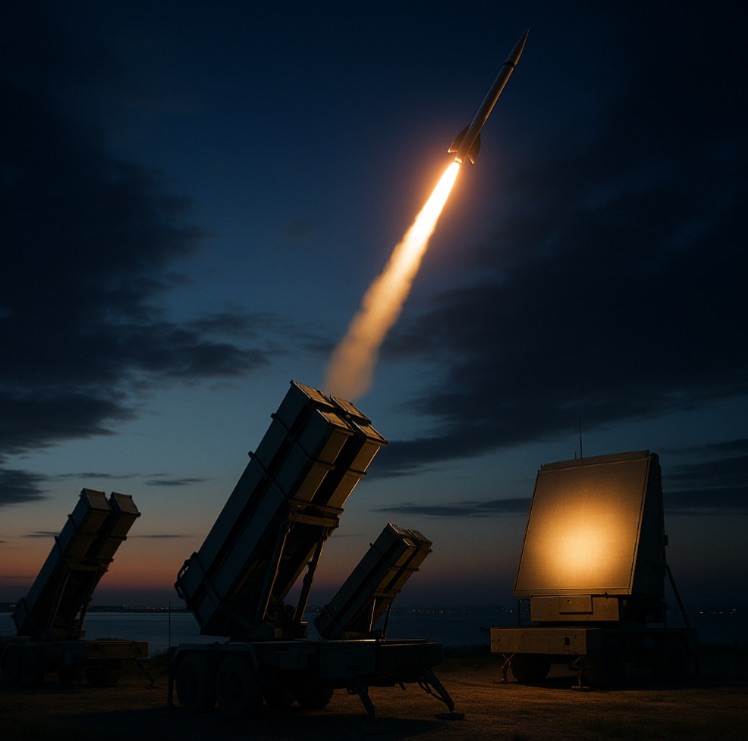
Western nations have invested over $100 billion in advanced air defense systems that can intercept threats at ranges exceeding 200 kilometers. These systems, including the combat-proven Patriot, THAAD, and emerging laser weapons, form an integrated defensive network protecting millions of citizens and critical infrastructure. As hypersonic missiles and drone swarms emerge as new threats, NATO members are accelerating development of AI-enhanced detection systems and directed energy weapons. Understanding these capabilities is crucial for taxpayers, policymakers, and anyone interested in how modern democracies defend their airspace in an increasingly dangerous world.
Introduction: When Seconds Count
On a January night in 2025, Ukraine’s Patriot air defense system successfully intercepted a salvo of Russian hypersonic Kinzhal missiles targeting Kyiv—weapons once thought unstoppable. This real-world demonstration of Western air defense capabilities highlights why nations are investing billions in systems that operate at the bleeding edge of technology. As aerial threats evolve from traditional aircraft to hypersonic missiles traveling at five times the speed of sound, the race to build impenetrable air shields has become a defining feature of 21st-century defense strategy.
Why Air Defense Matters: The Civilian Perspective
Before examining the technology, it’s essential to understand what these systems protect. Modern long-range air defense systems safeguard:
- Major population centers housing millions of citizens
- Critical infrastructure including power grids, water supplies, and communication networks
- Economic assets such as ports, airports, and industrial facilities
- Military installations and government centers
The absence of effective air defense leaves nations vulnerable to both military strikes and economic blackmail. The ongoing conflict in Ukraine demonstrates how air defense systems directly save civilian lives by intercepting missiles aimed at cities and infrastructure.
Understanding Long-Range Air Defense: A Primer
Long-range air defense systems are sophisticated military platforms that create protective umbrellas extending over 100 kilometers from their launch sites. Unlike short-range systems that protect specific buildings or bases, these systems can shield entire metropolitan areas or regions.
Think of these systems as ultra-high-tech versions of a goalkeeper in soccer—but instead of blocking one ball, they must simultaneously track hundreds of potential threats, calculate intercept trajectories in milliseconds, and launch precision-guided interceptors to destroy incoming missiles traveling faster than rifle bullets.
The Technology Behind the Shield
Advanced Radar Systems: The All-Seeing Eye
Modern air defense relies on Active Electronically Scanned Array (AESA) radar—essentially thousands of tiny radar modules working together to create a detailed picture of the airspace. The newest system, the LTAMDS radar recently approved for production in April 2025, provides true 360-degree coverage without any blind spots.
Cost Reality Check: Each LTAMDS radar costs approximately $125-130 million initially, though prices are expected to decrease as production scales up.
Interceptor Missiles: The Knockout Punch
Modern interceptors employ two primary destruction methods:
- Hit-to-Kill Technology: Like cosmic billiard balls, these interceptors physically collide with incoming threats, using kinetic energy to obliterate targets
- Proximity Warheads: These detonate near targets, creating a cloud of fragments to shred incoming missiles
Network-Centric Command: The Digital Brain
AI-enhanced systems now process data from multiple sensors simultaneously, identifying and prioritizing threats faster than human operators could manage alone. Recent developments include AI tools that can distinguish between civilian drones and military threats in real-time, preventing false alarms while maintaining security.
Leading Western Air Defense Systems: A Comparative Analysis
System Profiles
Patriot (USA): The workhorse of Western air defense, Patriot has proven its effectiveness in Ukraine, intercepting everything from cruise missiles to ballistic threats. The system’s upcoming LTAMDS radar upgrade will eliminate its current limitation of defending only a 120-degree arc.
SAMP/T (Europe): Europe’s answer to Patriot, this Franco-Italian system is becoming central to European defense integration. The next-generation version can detect targets beyond 350 kilometers and engage them at 150+ kilometers.
THAAD (USA): Specialized for high-altitude ballistic missile defense, THAAD is the only Western system designed to intercept targets both inside and outside Earth’s atmosphere. Seven batteries currently protect key locations in South Korea, UAE, and recently, Israel.
Arrow (Israel): Battle-tested in recent Middle East conflicts, Arrow provides exo-atmospheric interception capability, destroying threats in space before they re-enter the atmosphere.
The European Sky Shield Initiative: Strength in Unity
Launched as a German-led project, the European Sky Shield Initiative represents a paradigm shift in continental defense. Rather than each nation maintaining separate systems, ESSI creates an integrated network where Polish radars can guide Italian interceptors to protect German cities. This collaboration reduces costs while maximizing coverage.
NATO’s recent Formidable Shield 25 exercise (May 2025) demonstrated this integration in action, with multiple nations successfully coordinating their systems to defeat simulated mass missile attacks.
Economic Impact: Following the Money
The air defense industry generates significant economic activity:
- Direct Employment: Over 100,000 high-skill jobs across NATO nations
- R&D Investment: Annual spending exceeds $5 billion on next-generation technologies
- Export Revenue: Allied nations purchase systems worth $10-15 billion annually
- Supply Chain Effects: Thousands of suppliers provide specialized components
Taxpayer Perspective: While individual interceptors cost millions, the economic damage from a single successful attack on critical infrastructure could reach billions. The 2019 attack on Saudi oil facilities, which temporarily disrupted 5% of global oil supply, demonstrates the economic rationale for robust air defense.
Current Challenges and Future Solutions
The Hypersonic Threat
Hypersonic weapons traveling at Mach 5+ with unpredictable flight paths challenge existing defenses. Western nations are developing:
- Space-based early warning satellites for earlier detection
- Faster interceptors capable of Mach 10+ speeds
- AI systems that predict flight paths despite maneuvers
The Drone Swarm Dilemma
Traditional interceptors costing millions cannot economically defeat $1,000 drones. Solutions include:
Laser Weapons: Israel’s Iron Beam has become the first combat-proven laser defense system, costing just $2 per “shot” compared to $100,000+ for missile interceptors.
Electronic Warfare: Systems that jam or hijack drone control signals
AI-Enabled Guns: Automated cannons using smart ammunition to destroy multiple drones rapidly
What This Means for Global Security in 2025
The proliferation of advanced air defense systems is reshaping international relations:
- Deterrence Enhancement: Robust air defense makes military aggression more costly and less likely to succeed
- Alliance Strengthening: Integrated systems require close cooperation, deepening NATO unity
- Technology Competition: The race for superior air defense drives innovation in sensors, computing, and materials
- Strategic Stability: Effective defenses may reduce the temptation for preemptive strikes
Frequently Asked Questions
Q: How accurate are these systems? A: Modern systems achieve 80-95% success rates against their designed targets under optimal conditions. Real-world performance varies based on threat complexity and engagement scenarios.
Q: Can these systems stop nuclear missiles? A: Systems like THAAD and Arrow 3 can intercept ballistic missiles that might carry nuclear warheads, but no defense is 100% effective. These systems form one layer of deterrence alongside diplomatic and offensive capabilities.
Q: Why are interceptors so expensive? A: Each interceptor contains sophisticated sensors, computers, and propulsion systems equivalent to a small spacecraft. They must perform flawlessly under extreme conditions with no second chances.
Q: How do these systems avoid hitting civilian aircraft? A: Integration with civilian air traffic control and IFF (Identification Friend or Foe) systems prevents engagement of authorized aircraft. Multiple safeguards require human approval for engagement in peacetime.
Looking Ahead: The Next Decade
By 2035, Western air defense will likely feature:
- Orbital interceptors providing global coverage against ballistic threats
- Megawatt-class lasers capable of destroying missiles at 500+ kilometer ranges
- Quantum radar detecting stealth targets previously invisible
- Autonomous defense networks responding faster than human reaction times
- Cost-effective micro-interceptors for defeating cheap drones and rockets
Conclusion: The Price of Security
Advanced air defense systems represent democracy’s insurance policy against aerial aggression. While the price tags seem staggering—over $100 billion invested with billions more planned—the cost of vulnerability in an era of precision weapons and nuclear proliferation is infinitely higher. As threats evolve from slow bombers to hypersonic missiles and autonomous swarms, Western nations must continue innovating to maintain the protective shield that allows free societies to thrive.
These systems do more than intercept missiles; they preserve the peace of mind that citizens in democratic nations often take for granted—the confidence that somewhere, sophisticated technology and dedicated professionals stand ready to defend the sky above.
Limitations of Modern Air Defense Systems and Mitigation Strategies
Modern long-range air defense systems, despite their sophisticated capabilities, face significant operational constraints that potential adversaries actively exploit. Understanding these limitations and their mitigation strategies is crucial for defense planners and policymakers investing billions in these protective systems.
Technical and Physical Limitations
The most fundamental constraint facing air defense systems is the magazine depth problem. Each defensive battery contains a finite number of interceptors, typically between 8 and 48 missiles depending on the system configuration. Adversaries can exploit this limitation through saturation attacks, launching more threats than defenders have interceptors. The mathematics are unforgiving: if an enemy launches 100 cheap drones while a Patriot battery has only 32 interceptors, even perfect accuracy cannot prevent some threats from penetrating the defense.
This challenge becomes economically unsustainable when considering cost asymmetry. A Patriot PAC-3 interceptor costs approximately $4 million, while the drones or simple rockets it might intercept cost mere thousands. This thousand-to-one cost disadvantage means adversaries can potentially bankrupt defense systems through sustained low-cost attacks. The situation worsens with cruise missiles, where interceptor costs often exceed the attacking missile’s price by significant margins.
Radar limitations present another critical vulnerability. Despite advances in AESA technology, physics imposes hard limits on detection capabilities. Low-flying threats exploiting terrain masking can approach undetected until they cross the radar horizon, potentially as close as 30-40 kilometers for sea-skimming missiles. Stealth technology further compounds this challenge, reducing detection ranges against modern aircraft and missiles designed with radar-absorbing materials and shapes.
Coverage gaps exist even in the most sophisticated defensive networks. The curvature of the Earth creates natural blind spots that cannot be eliminated through ground-based sensors alone. Mountainous terrain exacerbates these gaps, creating valleys and shadows where threats can maneuver undetected. Even the newest 360-degree radar systems cannot see through solid mountains or detect targets flying in deep valleys.
Operational and Environmental Constraints
Electronic warfare presents an increasingly sophisticated challenge to air defense operations. Modern adversaries employ jammers that can degrade radar performance, spoof false targets, or corrupt data links between system components. GPS jamming can affect interceptor guidance systems, while cyber attacks might target the command and control networks that coordinate defensive responses. These electronic attacks are particularly insidious because they can degrade system performance without physically destroying any components.
Environmental factors significantly impact system effectiveness in ways that specifications sheets rarely acknowledge. Heavy precipitation can attenuate radar signals, reducing detection ranges by 20-30% during severe weather. Atmospheric ducting can create false targets or hide real ones. Solar activity can interfere with satellite communications links. Extreme temperatures affect both electronic components and missile propulsion systems, potentially degrading intercept probabilities.
The human element introduces additional limitations through training and readiness challenges. Operating these complex systems requires extensive training that must be constantly maintained. Crew fatigue during extended operations can lead to errors. The stress of actual combat, particularly when facing saturation attacks, can overwhelm operators despite their training. Studies from recent conflicts show that crew performance degrades significantly after 72 hours of continuous operations.
Strategic and Systematic Vulnerabilities
Modern air defense systems suffer from integration complexity that creates vulnerabilities. Different systems from various manufacturers often struggle to communicate effectively, creating seams in the defensive coverage that sophisticated adversaries can exploit. Data formats, communication protocols, and engagement procedures vary between systems, requiring extensive modification for true integration. NATO’s efforts to standardize these elements continue but remain incomplete.
Target discrimination poses increasingly difficult challenges as the variety of aerial threats expands. Systems must instantly differentiate between military drones and civilian aircraft, between ballistic missiles and space debris, between genuine threats and decoys. Adversaries exploit this challenge by mixing legitimate civilian traffic patterns with military operations or deploying sophisticated decoys that mimic real missile signatures.
Political constraints often limit the effectiveness of air defense systems in ways that pure military analysis overlooks. Rules of engagement may prevent engaging threats until they demonstrate hostile intent, reducing reaction time. Concerns about collateral damage in populated areas can restrict defensive options. International borders create artificial limitations where pursuing threats across boundaries might escalate conflicts.
Comprehensive Mitigation Strategies
Addressing these limitations requires a multi-layered approach combining technological innovation, operational adaptation, and strategic planning. The layered defense concept provides the foundation, employing multiple defensive systems at different ranges and altitudes. This approach ensures that threats face multiple engagement opportunities, compensating for single-system limitations. Short-range systems like Iron Dome handle rockets and drones, medium-range systems engage cruise missiles and aircraft, while long-range systems focus on ballistic threats.
Technological solutions are rapidly evolving to address specific limitations. Directed energy weapons offer potentially unlimited magazines, eliminating the shot-versus-cost calculation that favors attackers using cheap munitions. Israel’s operational Iron Beam system demonstrates this potential, with per-shot costs measured in dollars rather than millions. Artificial intelligence enhances threat discrimination and engagement planning, processing sensor data faster than human operators and identifying optimal interceptor allocation strategies.
Network-centric integration represents another crucial mitigation approach. Modern command and control systems like IBCS (Integrated Battle Command System) enable different defensive systems to share data seamlessly, eliminating coverage gaps through sensor fusion. This integration allows a radar from one system to guide interceptors from another, maximizing defensive efficiency. Distributed architectures ensure that destroying one node doesn’t cripple the entire network.
Economic solutions focus on reducing interceptor costs and improving production capacity. Manufacturers are developing cheaper interceptor variants specifically for low-end threats. Some concepts involve kinetic interceptors without explosive warheads, reducing costs while maintaining effectiveness against drones and rockets. Industrial base expansion ensures surge production capability during conflicts, preventing adversaries from simply exhausting interceptor inventories.
Operational adaptations enhance system effectiveness within existing limitations. Shoot-look-shoot tactics conserve interceptors by assessing the first shot’s result before launching additional missiles. Predictive algorithms anticipate threat trajectories, pre-positioning interceptors for optimal engagement geometry. Mobile deployment patterns prevent adversaries from mapping and exploiting static coverage gaps.
Future Mitigation Technologies
Emerging technologies promise to address current limitations more comprehensively. Hypersonic interceptors under development will engage threats at speeds exceeding Mach 10, reducing the advantage of hypersonic offensive weapons. Space-based sensors will eliminate terrain-masking advantages, providing persistent surveillance unaffected by weather or geography. Quantum radar technologies might defeat stealth by detecting disturbances in quantum fields rather than traditional radar returns.
The integration of offensive and defensive capabilities offers another mitigation pathway. Rather than purely reactive defense, future systems might launch preemptive strikes against detected launch sites. This “left of launch” strategy prevents saturation by eliminating threats before they multiply. However, this approach raises escalation concerns that require careful political consideration.
Conclusion
While modern air defense systems face significant limitations ranging from magazine constraints to electronic warfare vulnerabilities, comprehensive mitigation strategies continue to evolve. The key lies not in expecting any single system to provide perfect protection, but in creating resilient, adaptable defensive networks that address each limitation through complementary capabilities. Success requires continued investment in technology development, realistic training acknowledging system limitations, and strategic planning that integrates air defense into broader security frameworks. Understanding these limitations proves as crucial as appreciating capabilities for anyone involved in planning, procuring, or operating these vital defensive systems.
AI-assisted article

