

The NASAMS and the IRIS-T SL are both modern ground‐based air defence solutions used by NATO and partner nations, but differ in terms of architecture, primary interceptor missiles and sensors and operational concepts.
IRIS-T SL: Infra Red Imaging System Tail/Thrust Vector Controlled – Surface Launched.
Developed by the German company Diehl Defence, evolved from the IRIS-T air-to-air missile—a highly agile, short-range interceptor originally developed to replace older AIM-9 Sidewinders. Its ground-based variants are based on the same missile technology, and commonly designated as SLS for the short-range configuration and SLM for the medium-range version.

IRIS-T SL system is designed for integration with various radar systems and command and control centers, allowing for flexibility based on national requirements and existing defense infrastructure.
However, IRIS-T SL batteries can be integrated with different radar systems such as HENSOLDT TRML-4D, Saab Giraffe series and the CEA CEAFAR. Moreover the batteries are coupled with modern battle management systems, where one alternative is the Fortion IBMS (Integrated Battle Management Software) from Airbus. Another marketed solution is the Lockheed Martin system named SkyKeeper.


An IRIS-T fire unit consists of the 3D radar, a tactical operations centre and three eight-unit launchers as well as auxiliary vehicles for maintenance and loading. The application-dependent range is up to 40 km and is to be increased to 80 km with IRIS-T SLX system.
—Diehl Defence
NASAMS: Norwegian (or National) Advanced Surface-to-Air Missile System.
Developed jointly by Raytheon and Kongsberg Defence & Aerospace, and is a network‐centric, modular, and distributed medium‐range air defence system. Using the air-to-air AIM-120 AMRAAM missile in a ground-launched role.


NASAMS features multiple dispersed launchers, radars, and a central Fire Distribution Center (FDC) that links sensors and shooters over wide areas, coordinates engagement management, target allocation, and integrates data via multiple datalinks.
The system use electronically scanned radars such as the Raytheon Sentinel or potentially the newer medium-range radars like the GhostEye MR, as well as TV/IR cameras.
Normally, a number of NASAMS fire units are netted together in a uniquely designed ”hard-realtime” communication network to ensure minimum latency over large distances for maximum system performance utilizing the unique capabilities of the AMRAAM missile
—Kongsberg
In October 2021, Raytheon unveiled a new medium-range air and missile defense radar for NASAMS called the GhostEye MR radar.
—Raytheon
Range & Effectiveness
IRIS-T SL. The SLS variant is optimized for very short-range defense (approximately 12 km range, lower altitude coverage), while the SLM variant achieves medium-range performance with ranges up to about 40 km and ceilings around 20 km.


In October 2022, when the enemy massively attacked objects of critical infrastructure in Ukraine, the SAM shot down 100 percent of the targets. —Ukrainian IRIS-T SL operator «Kum»
We have received confirmation that IRIS-T SLM exceeds even the highest expectations in terms of hit accuracy, reliability and lethality even over long distances and in adverse weather conditions. —H. Rauch CEO Diehl Defence, March 2023
… it has served as a bulwark against the countless missiles that Russia shoots at Ukraine every day, having shot down over 250 projectiles of various sorts… a hit rate of 95%.
—Chancellor Olaf Scholz, September 2024
NASAMS. Depending on the missile variant employed, NASAMS can engage targets at various ranges from a few kilometers to several tens of kilometers, and well into the medium range category when employing extended-range interceptors.
Featuring an enlarged rocket motor and other enhancements, AMRAAM-ER will greatly expand the NASAMS engagement envelope with a 50 percent increase in maximum range and 70 percent increase in maximum altitude.
—Raytheon, October 2016
About 900 missiles and drones have been shot down by NASAMS, with a hit rate of 94. That is a very, very high number.
—Head of the Royal Norwegian Air Force’s support to Ukraine, February 2025
Use Cases, Mobility & Deployments
IRIS-T SL batteries are well suited for 360° point defence, as well as part of a layered air defense network in cooperation with longer-range systems – or dispersed while protecting moving battlegroups. The system with containerized and truck-mounted launchers, radars and command units offer rapid reaction times – combat ready postures are achieved minutes after relocation.
Although the IRIS-T SL is a relatively new system compared to NASAMS, it has been acquired by several countries, including Ukraine. See IRIS-T SL for extensive list of user countries.
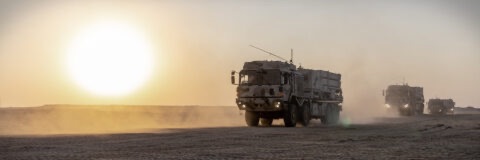
NASAMS is a network‐centric, modular, and distributed system that features multiple dispersed launchers, radars, and a central FDC that links sensors and shooters over wide areas.
NASAMS leverages a network‐centric and modular design. This distributed concept allows for radars, launchers and command posts to be separated by tens of kilometers thus enhancing survivability while enabling a 360° and wide-area key assets protection – remaining linked and coordinated by a central FDC.
Components are typically vehicle-mounted, often on trucks or trailers, and suited for rapid relocation, enabling both static base defence and more dispersed operations.
NASAMS is by nature a highly mobile system designed with a focus on operational flexibility for protection of Air Bases, Sea Ports, Populated Areas, other High-Value Assets and Army Forces. The launcher has a short into-action-time and can either be emplaced on the ground before firing or be fired from truck. —Kongsberg
As of 2024, NASAMS is deployed by 13+ countries, amongst others Norway, the United States, Spain, the Netherlands, Finland, and Ukraine.
Future developments
IRIS-T SL
Diehl Defence is constantly developing its systems to face emerging threat scenarios. The range is to be increased to 80 km with IRIS-T SLX system. —Diehl Defence

NASAMS
NASAMS is designed to evolve with the development of technology and can integrate with or utilize future technology when available. This can be future active or passive radars and sensors, Sense & Warn capability, and a wide range of effectors, like C-RAM, C-UAS and the Raytheon Family of Missiles; Aim 9X Sidewinder Block II, AIM-120 AMRAAM an AMRAAM ER. The evolution is enabled by the open architecture in the FDC. —Kongsberg

More on
Check out
Image collage: Royal Norwegian Airforce / Diehl Defence
AI-assisted article.

