
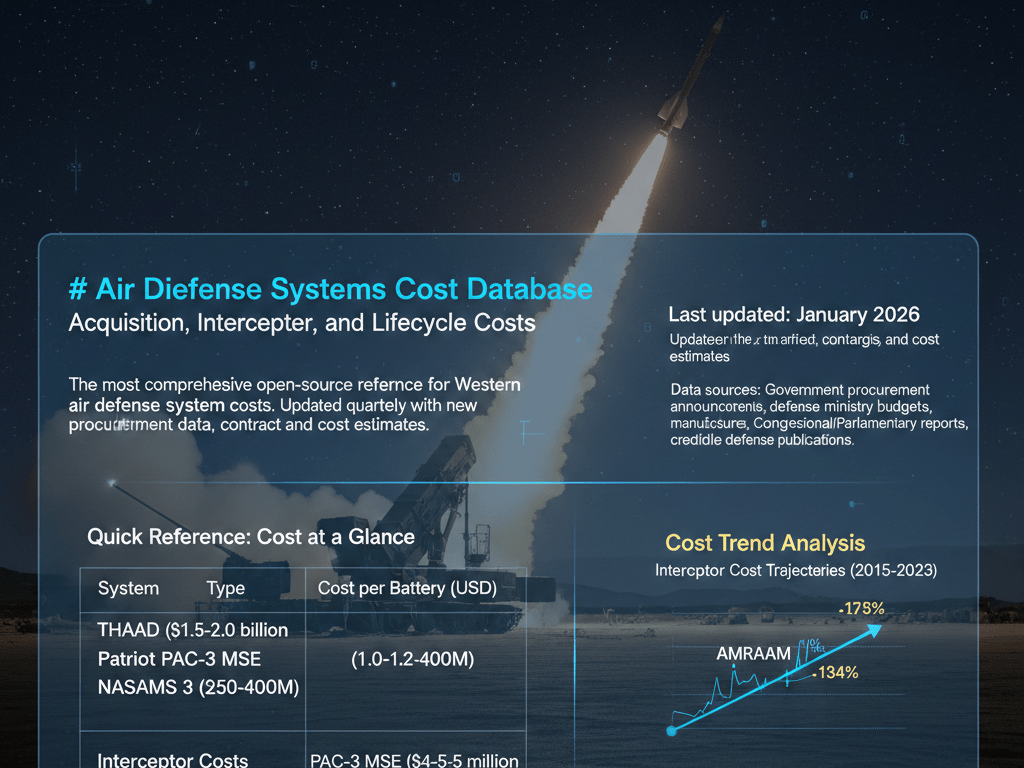
The most comprehensive open-source reference for Western air defense system costs. Updated quarterly with new procurement data, contract announcements, and cost estimates.
Last updated: January 2026
Data sources: Government procurement announcements, defense ministry budgets, manufacturer disclosures, Congressional/Parliamentary reports, credible defense publications
Currency note: All figures converted to USD at time of contract/announcement. EUR and NOK figures provided where relevant for European readers.
Quick Reference: Cost at a Glance
For readers seeking immediate answers, this summary table provides ballpark figures. Detailed breakdowns follow in system-specific sections.
Battery/System Acquisition Costs
| System | Type | Cost per Battery (USD) | Cost per Battery (EUR) | Notes |
|---|---|---|---|---|
| THAAD | Upper-tier BMD | $1.5-2.0 billion | €1.4-1.8 billion | Includes AN/TPY-2 radar |
| Arrow-3 | Exo-atmospheric BMD | $500M-700M | €450-630M | Israeli domestic cost; export pricing higher |
| Patriot PAC-3 MSE | Long-range | $1.0-1.2 billion | €900M-1.1B | Full configuration with radar |
| SAMP/T NG | Long-range | $800M-1.0 billion | €700-900M | With Ground Fire 300 radar |
| David’s Sling | Long-range | $500-700M | €450-630M | With MMR radar |
| NASAMS 3 | Medium-range | $250-400M | €225-360M | Configuration-dependent |
| IRIS-T SLM | Medium-range | $180-250M | €160-220M | Standard 3-launcher battery |
| Sky Sabre | Medium-range | $300-350M | €270-315M | UK costs; export may vary |
| Iron Dome | C-RAM/SHORAD | $50-100M | €45-90M | Per battery; radar shared |
Interceptor/Missile Costs
| Interceptor | System | Cost per Missile (USD) | Trend |
|---|---|---|---|
| THAAD missile | THAAD | $12-15 million | Stable |
| SM-3 Block IIA | Aegis BMD | $28-36 million | Increasing |
| SM-3 Block IB | Aegis BMD | $12-15 million | Stable |
| Arrow-3 | Arrow system | $2-3 million | Estimated |
| Arrow-2 | Arrow system | $3 million | Estimated |
| PAC-3 MSE | Patriot | $4-5.5 million | Increasing |
| PAC-3 | Patriot | $3-4 million | Stable |
| PAC-2 GEM-T | Patriot | $1-2 million | Decreasing (legacy) |
| Aster 30 B1NT | SAMP/T NG | $2.5-3.5 million | New variant |
| Aster 30 B1 | SAMP/T | $2-3 million | Stable |
| Stunner | David’s Sling | $1-1.5 million | Decreasing |
| SkyCeptor | David’s Sling | $500K-1 million | New low-cost variant |
| AMRAAM-ER | NASAMS | $1.5-2.5 million | New variant |
| AIM-120C AMRAAM | NASAMS | $1-1.5 million | Stable |
| IRIS-T SL | IRIS-T SLM | $430-500K | Stable |
| CAMM | Sky Sabre | $1-1.5 million | Stable |
| CAMM-ER | Various | $1.5-2 million | New variant |
| Tamir | Iron Dome | $40-50K | Stable |
Understanding Air Defense Costs
Before examining specific systems, readers should understand the cost categories that comprise total air defense expenditure.
Cost Categories Explained
1. Acquisition Cost (Capital Expenditure)
The upfront purchase price, typically including:
- Launchers and fire control equipment
- Radar systems (often the most expensive component)
- Command and control systems
- Initial interceptor inventory
- Training and technical documentation
- Initial spare parts package
2. Interceptor Cost (Recurring)
The per-missile cost for engagement. This becomes the dominant cost driver over system lifetime, particularly in high-threat environments. A single night of intense combat can consume $100M+ in interceptors.
3. Operations and Maintenance (O&M)
Annual costs for:
- Personnel (often the largest O&M component)
- Training and exercises
- Consumables and spare parts
- Software updates and licensing
- Facility costs
4. Lifecycle Cost
Total cost over the system’s operational life (typically 25-40 years), including:
- Acquisition
- Cumulative O&M
- Mid-life upgrades
- Interceptor replenishment
- Eventual disposal
Why Cost Estimates Vary
Published cost figures for the same system often differ by 30-50%. Key reasons include:
| Factor | Impact on Reported Cost |
|---|---|
| Configuration | Basic vs. full capability can differ 2x |
| Quantity | Larger orders reduce per-unit cost 20-40% |
| FMS vs. Direct Commercial | US Foreign Military Sales adds ~15-20% overhead |
| Currency fluctuation | EUR/USD swings affect European system comparisons |
| Included scope | With/without radar, C2, training, spares |
| Contract type | Fixed-price vs. cost-plus |
| Domestic vs. export | Export versions often 20-50% more expensive |
| Offset requirements | Industrial participation adds hidden costs |
This database attempts to normalize these factors where possible, but readers should treat all figures as estimates subject to significant variation.
Upper-Tier Ballistic Missile Defense Systems
These systems represent the highest capability—and highest cost—tier of air defense, designed to intercept ballistic missiles at extreme altitudes and ranges.
THAAD (Terminal High Altitude Area Defense)
Manufacturer: Lockheed Martin (USA)
Primary operators: USA, UAE, Saudi Arabia, South Korea
In service since: 2008
Acquisition Costs
| Component | Cost (USD) | Notes |
|---|---|---|
| Complete battery | $1.5-2.0 billion | 6 launchers, 48 interceptors, radar, C2 |
| AN/TPY-2 radar | $400-500 million | Often the largest single component cost |
| Launcher (1x) | $30-40 million | 8 missiles per launcher |
| Fire control & C2 | $150-200 million | THAAD-specific systems |
| Training package | $50-100 million | Varies by buyer sophistication |
Interceptor Costs
| Variant | Cost per Missile | Trend | Notes |
|---|---|---|---|
| THAAD missile | $12-15 million | Stable | Single-stage hit-to-kill |
Known Procurements
| Buyer | Year | Quantity | Value | Per-Battery Cost |
|---|---|---|---|---|
| UAE | 2012 | 2 batteries | $3.49 billion | $1.75 billion |
| Saudi Arabia | 2017 | 7 batteries (planned) | $15 billion (total package) | ~$2 billion |
| South Korea | 2017 | 1 battery | ~$1.5 billion | $1.5 billion |
Cost Drivers
THAAD’s high cost reflects:
- Exo-atmospheric intercept capability requiring specialized kill vehicle
- AN/TPY-2 radar’s extreme performance (1,000+ km detection range)
- Limited production volume (fewer than 10 batteries sold)
- Extensive US government testing and certification requirements
- Hit-to-kill technology with zero margin for error
Arrow-3
Manufacturer: Israel Aerospace Industries / Boeing
Primary operators: Israel, Germany (on order)
In service since: 2017
Acquisition Costs
| Component | Cost (USD) | Notes |
|---|---|---|
| System (Israeli domestic) | $500-700 million | Integrated with Arrow-2 |
| System (export) | $700M-1 billion+ | Germany deal suggests higher export pricing |
| Super Green Pine radar | $150-250 million | Integrated with Arrow system |
Germany Arrow-3 Procurement
Germany’s 2023 Arrow-3 purchase provides the clearest export pricing data:
| Element | Value | Notes |
|---|---|---|
| Total contract | €4.3 billion (~$4.7B) | Initial announcement |
| Scope | Arrow-3 systems + integration | For ESSI framework |
| Delivery | 2025-2028 | Accelerated timeline |
| Interceptor inventory | Classified | Substantial stockpile reported |
The Germany deal suggests export pricing of €1+ billion per operational capability, though this includes extensive integration, infrastructure, and support not typical of Israeli domestic costs.
Interceptor Costs
| Variant | Cost per Missile | Notes |
|---|---|---|
| Arrow-3 | $2-3 million (estimated) | Exo-atmospheric kill vehicle |
| Arrow-2 | $3 million (estimated) | Endo-atmospheric intercept |
Arrow interceptor costs are notably lower than THAAD or SM-3, reflecting Israeli industrial efficiencies and different design philosophy.
SM-3 (Standard Missile-3) / Aegis BMD
Manufacturer: Raytheon
Primary operators: USA, Japan, Spain, South Korea, Romania (Aegis Ashore), Poland (Aegis Ashore)
In service since: 2004 (Block IA)
System Costs
SM-3 is primarily ship-based (Aegis cruisers and destroyers), making “per battery” comparisons difficult. Land-based Aegis Ashore provides reference points:
| Installation | Cost | Notes |
|---|---|---|
| Aegis Ashore Romania | $800 million | Deveselu site, operational 2016 |
| Aegis Ashore Poland | $6 billion+ (total program) | Redzikowo site, complex delays |
| Per-ship Aegis BMD upgrade | $100-300 million | Varies by ship class and scope |
Interceptor Costs
| Variant | Cost per Missile | Trend | Notes |
|---|---|---|---|
| SM-3 Block IIA | $28-36 million | Increasing | US-Japan co-development; most capable |
| SM-3 Block IB | $12-15 million | Stable | Workhorse variant |
| SM-3 Block IA | $10-12 million | Legacy | Limited production |
SM-3 Block IIA’s extreme cost reflects its exo-atmospheric intercept capability with very large kinetic warhead for midcourse ICBM/IRBM engagement.
Long-Range Air and Missile Defense Systems
The “backbone” tier for national and theater air defense, these systems engage aircraft, cruise missiles, and tactical ballistic missiles at operationally significant ranges.
Patriot PAC-3 MSE
Manufacturer: Raytheon (prime), Lockheed Martin (PAC-3 missile)
Primary operators: USA, Germany, Netherlands, Japan, Saudi Arabia, UAE, Kuwait, Qatar, South Korea, Poland, Romania, Sweden, and others
In service since: 1984 (Patriot); 2015 (PAC-3 MSE)
Acquisition Costs
| Configuration | Cost (USD) | Cost (EUR) | Notes |
|---|---|---|---|
| Full battery (6 launchers) | $1.0-1.2 billion | €900M-1.1B | With AN/MPQ-65A, full C2 |
| Battery (4 launchers) | $800-950 million | €720-850M | Reduced configuration |
| AN/MPQ-65A radar | $125-150 million | €112-135M | Upgraded version |
| Engagement Control Station | $40-50 million | €36-45M | Per ECS |
| Launcher (M903) | $10-15 million | €9-13.5M | 16 PAC-3 MSE or 4 GEM-T |
Interceptor Costs
| Variant | Cost per Missile (USD) | Trend | Role |
|---|---|---|---|
| PAC-3 MSE | $4-5.5 million | Increasing | Primary TBM/cruise missile |
| PAC-3 | $3-4 million | Stable | TBM/cruise missile |
| PAC-2 GEM-T | $1-2 million | Decreasing | Aircraft, large targets |
Recent Procurements
| Buyer | Year | Value | Contents |
|---|---|---|---|
| Poland | 2018-2023 | $10.5 billion | 6 batteries, Wisła Phase I |
| Romania | 2017-2020 | $4.0 billion | 4 batteries + missiles |
| Sweden | 2018 | $3.2 billion | 4 batteries (modified config) |
| Switzerland | 2021 | CHF 2.1B (~$2.3B) | 5 batteries (rejected by referendum) |
| Germany | 2023+ | €1.3 billion | Additional PAC-3 MSE missiles |
Norway Patriot Consideration
Norway formally requested Patriot pricing from the United States in December 2024. While no contract has been announced, Norwegian defense planning documents suggest:
| Scenario | Estimated Cost (NOK) | Estimated Cost (USD) |
|---|---|---|
| 2 batteries | 15-20 billion | $1.4-1.8 billion |
| 4 batteries | 28-35 billion | $2.5-3.2 billion |
These estimates include launchers, interceptors, radar, C2, training, initial spares, and facilities but exclude ongoing O&M.
Lifecycle Cost Considerations
A 2019 US Government Accountability Office report estimated Patriot lifecycle costs at approximately $3.9 billion per battery over 30 years, including:
- Acquisition: ~30% of lifecycle cost
- O&M: ~55% of lifecycle cost
- Upgrades: ~15% of lifecycle cost
SAMP/T (Aster 30)
Manufacturer: Eurosam (MBDA/Thales joint venture)
Primary operators: France, Italy, Singapore
In service since: 2011 (France), 2013 (Italy)
Acquisition Costs
| Configuration | Cost (EUR) | Cost (USD) | Notes |
|---|---|---|---|
| SAMP/T battery (standard) | €500-700 million | $550-770M | With Arabel radar |
| SAMP/T NG battery | €700-900 million | $770M-1B | With Ground Fire 300 radar |
| Ground Fire 300 radar | €150-200 million | $165-220M | New AESA radar for NG |
| Arabel radar | €80-120 million | $88-130M | Original radar |
| Launcher (8 cells) | €25-35 million | $27-38M | Vertical launch |
Interceptor Costs
| Variant | Cost per Missile (EUR) | Cost (USD) | Notes |
|---|---|---|---|
| Aster 30 B1NT | €2.5-3.5 million | $2.8-3.8M | Enhanced TBM capability |
| Aster 30 B1 | €2-2.5 million | $2.2-2.8M | Standard long-range |
| Aster 30 | €1.5-2 million | $1.7-2.2M | Original version |
| Aster 15 | €1-1.5 million | $1.1-1.7M | Naval/short-range |
Known Procurements
| Buyer | Year | Value | Contents |
|---|---|---|---|
| Singapore | 2020 | ~$1.1 billion | SAMP/T systems (quantity unclear) |
| France/Italy (upgrade) | 2023 | €700 million+ | SAMP/T NG conversion |
SAMP/T vs. Patriot Cost Comparison
| Factor | SAMP/T NG | Patriot PAC-3 MSE |
|---|---|---|
| Battery acquisition | €700-900M | €900M-1.1B |
| Interceptor (primary) | €2.5-3.5M | €4-5M |
| European industrial content | 100% | ~10-15% |
| Offset potential | High | Limited |
| Competition | Single source | Single source |
SAMP/T offers lower per-unit costs, but Patriot’s larger production base may provide better long-term availability and upgrade paths.
David’s Sling
Manufacturer: Rafael Advanced Defense Systems (Israel) / Raytheon (USA)
Primary operators: Israel, Finland (on order)
In service since: 2017
Acquisition Costs
| Component | Cost (USD) | Notes |
|---|---|---|
| Battery | $500-700 million | With MMR radar |
| MMR radar | $100-150 million | Multi-mission radar |
| Launcher | $30-40 million | 12 missiles per launcher |
Interceptor Costs
| Variant | Cost per Missile | Notes |
|---|---|---|
| Stunner | $1-1.5 million | Primary interceptor |
| SkyCeptor | $500K-1 million | Cost-reduced variant for export |
David’s Sling’s interceptor cost advantage is significant: Stunner costs roughly 75% less than PAC-3 MSE while addressing similar threat classes (cruise missiles, large rockets, short-range ballistic missiles).
Finland Procurement
Finland’s 2023 David’s Sling selection provides recent export pricing data:
| Element | Value | Notes |
|---|---|---|
| Contract value | ~$400-500 million (estimated) | Finnish sources |
| Scope | 1 battery + interceptors | Initial capability |
| Delivery | 2026-2028 | Projected |
Medium-Range Air Defense Systems
The volume tier of air defense, these systems provide cost-effective coverage against aircraft, cruise missiles, and drones without the acquisition and sustainment burden of long-range systems.
NASAMS
Manufacturer: Kongsberg Defence & Aerospace (Norway) / Raytheon (USA)
Primary operators: Norway, USA, Finland, Netherlands, Spain, Lithuania, Chile, Indonesia, Qatar, Ukraine, and others
In service since: 1994 (NASAMS I); 2019 (NASAMS 3)
Acquisition Costs
| Configuration | Cost (USD) | Cost (NOK) | Notes |
|---|---|---|---|
| NASAMS 3 battery (standard) | $250-350 million | 2.7-3.8 billion | 3-4 launchers, radar, C2 |
| NASAMS 2 battery | $150-250 million | 1.6-2.7 billion | Previous generation |
| Fire Distribution Center | $30-50 million | 325-540 million | C2 node |
| Launcher (6 cells) | $15-25 million | 160-270 million | Canister-based |
| Sentinel radar | $25-40 million | 270-430 million | 3D surveillance |
Interceptor Costs
| Variant | Cost per Missile | Notes |
|---|---|---|
| AMRAAM-ER | $1.5-2.5 million | Extended range (40+ km) |
| AIM-120C AMRAAM | $1-1.5 million | Standard variant |
| AIM-9X Sidewinder | $500K-800K | Short-range option |
Recent Procurements
| Buyer | Year | Value | Contents |
|---|---|---|---|
| Norway | 2024 | NOK 6.5 billion (~$600M) | Up to 4 batteries, NASAMS upgrade |
| Ukraine | 2022-2024 | $1.2 billion+ | 8+ systems donated/purchased |
| Australia | 2021 | AUD 900M (~$600M) | NASAMS 3 for short-range air defense |
| Hungary | 2020 | $1 billion | NASAMS + radar integration |
Norway’s NASAMS Investment
As the co-developer and anchor customer, Norway’s NASAMS costs provide baseline reference:
| Investment Phase | Value (NOK) | Value (USD) | Scope |
|---|---|---|---|
| 2024 contract | 6.5 billion | ~$600 million | Up to 4 batteries equipment |
| Cumulative (est.) | 15+ billion | ~$1.4 billion | Total Norwegian NASAMS investment |
IRIS-T SLM
Manufacturer: Diehl Defence (Germany)
Primary operators: Germany, Egypt, Ukraine, Slovenia, Estonia (on order), and others
In service since: 2022 (SLM variant)
Acquisition Costs
| Configuration | Cost (EUR) | Cost (USD) | Notes |
|---|---|---|---|
| IRIS-T SLM battery | €150-200 million | $165-220M | 3 launchers, radar, C2 |
| TRML-4D radar | €40-60 million | $44-66M | Multi-function AESA |
| Launcher (8 cells) | €20-30 million | $22-33M | Vertical launch |
Interceptor Costs
| Variant | Cost per Missile (EUR) | Cost (USD) | Notes |
|---|---|---|---|
| IRIS-T SL | €380-450K | $420-500K | 40 km range |
| IRIS-T SLS | €250-350K | $275-385K | 12 km range (SHORAD) |
IRIS-T’s interceptor cost is the lowest among medium-range Western systems—roughly 60-70% less than AMRAAM—making it economically attractive for high-volume engagements.
Recent Procurements
| Buyer | Year | Value | Contents |
|---|---|---|---|
| Germany (domestic) | 2022-2025 | €4+ billion | Multiple batteries + stockpile |
| Ukraine | 2022-2024 | €1.5+ billion | 4+ systems (donated/funded) |
| Egypt | 2021 | €800+ million | Multiple batteries |
| Estonia | 2023 | €300+ million | Battery with integration |
| Slovenia | 2024 | €300+ million | IRIS-T SLM battery |
Sky Sabre / CAMM
Manufacturer: MBDA
Primary operators: UK, Sweden (as RBS 98), Poland (on order)
In service since: 2021
Acquisition Costs
| Configuration | Cost (GBP) | Cost (USD) | Notes |
|---|---|---|---|
| Sky Sabre battery | £200-280 million | $250-350M | UK configuration |
| Giraffe AMB radar | £40-60 million | $50-75M | Saab radar |
| Launcher (8 cells) | £15-25 million | $19-31M | Soft-launch |
Interceptor Costs
| Variant | Cost (GBP) | Cost (USD) | Notes |
|---|---|---|---|
| CAMM | £800K-1.2M | $1-1.5M | 25+ km range |
| CAMM-ER | £1.2-1.8M | $1.5-2.3M | 45+ km range |
Poland CAMM Procurement
Poland’s Narew (short-range) program selected CAMM:
| Element | Value | Notes |
|---|---|---|
| Total program | $2-3 billion (estimated) | Multiple phases |
| Phase I | ~$800 million | Initial batteries |
| Integration | Significant | With Polish radars |
Short-Range and Counter-Drone Systems
The fastest-growing segment of air defense investment, driven by drone proliferation and the economics of engaging low-cost threats.
Iron Dome
Manufacturer: Rafael Advanced Defense Systems (Israel)
Primary operators: Israel, USA (Marine Corps)
In service since: 2011
Acquisition Costs
| Component | Cost (USD) | Notes |
|---|---|---|
| Battery | $50-100 million | 3-4 launchers, radar shared |
| EL/M-2084 radar | $50 million+ | Shared across multiple batteries |
| Launcher (20 cells) | $5-10 million | Rapid reload capable |
Interceptor Costs
| Variant | Cost per Missile | Notes |
|---|---|---|
| Tamir | $40-50K | Primary interceptor |
| Tamir NG | $50-60K (estimated) | Enhanced seeker |
Tamir’s low cost enables engagement of threats that would be economically prohibitive for other systems. However, even at $40K, engaging a $500 drone creates 80:1 cost disadvantage.
US Iron Dome
The US procurement provides export pricing data:
| Element | Value | Notes |
|---|---|---|
| Initial batteries | $373 million | 2 batteries for Marine Corps |
| Per-battery cost | ~$186 million | Higher than Israeli domestic |
| Integration costs | Significant | US C2 integration |
Directed Energy / Laser Systems
Laser systems promise near-zero marginal cost per engagement, fundamentally changing air defense economics.
| System | Developer | Estimated Cost | Cost per Shot | Status |
|---|---|---|---|---|
| Iron Beam | Rafael | $50-100M per system | ~$2 | Development |
| HELWS | Raytheon | $15-25M per system | ~$1 | Limited fielding |
| Dragonfire | UK consortium | £100M+ program | TBD | Testing |
| Rheinmetall HEL | Germany | €30-50M per system | ~$1 | Development |
The economic case: A laser system costing $50 million that can engage 1,000 drones at $2 each ($2,000 total) vs. a missile system where 1,000 engagements would cost $40-50 million (using Tamir) fundamentally changes procurement calculus.
Cost Trend Analysis
Interceptor Cost Trajectories (2015-2025)
| System | 2015 Cost | 2025 Cost | Change | Driver |
|---|---|---|---|---|
| PAC-3 MSE | $3.5M | $5M+ | +43% | Inflation, supply chain |
| SM-3 Block IIA | $24M | $33M | +38% | Limited production |
| AMRAAM | $800K | $1.3M | +63% | Demand surge |
| IRIS-T SL | €350K | €430K | +23% | Modest increase |
| Tamir | $35K | $50K | +43% | Production scaling |
Key trends:
- US-origin interceptors show highest inflation (40-60%)
- European interceptors more price-stable
- Demand from Ukraine has accelerated price increases across all systems
- Production capacity, not technology, is the primary cost driver
Production Capacity Constraints
Current production rates vs. wartime consumption estimates:
| Interceptor | Annual Production | Days of High-Intensity Combat |
|---|---|---|
| PAC-3 MSE | 500-650 missiles | 10-15 days |
| IRIS-T SL | 300-400 missiles | 8-12 days |
| Tamir | 1,000+ missiles | 2-3 days |
This production/consumption mismatch explains why interceptor costs are increasing despite economies of scale: production cannot keep pace with demand, eliminating competitive pricing pressure.
Total Cost of Ownership: 20-Year Scenarios
For strategic planners, these scenarios estimate total cost of ownership for representative national architectures.
Scenario A: Small Nation (Norway-scale)
| Component | Units | Acquisition | 20-Year O&M | 20-Year Interceptors | Total |
|---|---|---|---|---|---|
| Patriot PAC-3 MSE | 2 batteries | $2.2B | $1.5B | $500M | $4.2B |
| NASAMS 3 | 4 batteries | $1.2B | $600M | $200M | $2.0B |
| SHORAD | TBD | $300M | $150M | $50M | $500M |
| Total | — | $3.7B | $2.25B | $750M | $6.7B |
Scenario B: Medium Nation (Poland-scale)
| Component | Units | Acquisition | 20-Year O&M | 20-Year Interceptors | Total |
|---|---|---|---|---|---|
| Patriot PAC-3 MSE | 6 batteries | $6.5B | $4B | $1.5B | $12B |
| NASAMS/Medium | 8 batteries | $2.5B | $1.2B | $500M | $4.2B |
| SHORAD | Multiple | $800M | $400M | $200M | $1.4B |
| Total | — | $9.8B | $5.6B | $2.2B | $17.6B |
Scenario C: Major European Power (Germany-scale)
| Component | Units | Acquisition | 20-Year O&M | 20-Year Interceptors | Total |
|---|---|---|---|---|---|
| Arrow-3 | 2-3 batteries | $5B | $2B | $500M | $7.5B |
| Patriot PAC-3 MSE | 12 batteries | $12B | $7B | $3B | $22B |
| IRIS-T SLM | 12 batteries | $2.5B | $1.2B | $600M | $4.3B |
| SHORAD/C-UAS | Extensive | $2B | $1B | $300M | $3.3B |
| Total | — | $21.5B | $11.2B | $4.4B | $37.1B |
Data Sources and Methodology
Primary Sources
Government Sources:
- US Defense Security Cooperation Agency (DSCA) FMS notifications
- Congressional Budget Office reports
- European Defence Agency publications
- National defense budget documents (Norway, Germany, Poland, UK, France)
Manufacturer Disclosures:
- Annual reports (Raytheon RTX, Lockheed Martin, MBDA, Kongsberg, Diehl)
- Investor presentations
- Contract announcements
Research Institutions:
- CSIS Missile Defense Project
- IISS Military Balance
- SIPRI Arms Transfers Database
- RAND Corporation studies
Limitations
This database should be used with the following caveats:
- All figures are estimates. Actual contract values often remain classified or commercially sensitive.
- Configuration matters enormously. A “battery” can mean different things across systems and buyers.
- FMS overhead. US Foreign Military Sales adds 15-20% to base costs; our figures attempt to normalize this but cannot always succeed.
- Currency volatility. EUR/USD fluctuations of 10-15% can significantly affect comparisons.
- Offset distortions. Industrial offset requirements can add 10-30% to apparent costs while providing domestic economic benefits.
- Time value. Contracts span multiple years; we use announcement-year values.
Revision History
| Date | Changes |
|---|---|
| January 2026 | Initial publication; comprehensive database structure |
| Planned Q2 2026 | Update with Norway Patriot decision data (if available) |
| Planned Q3 2026 | Annual interceptor cost refresh |
This database is maintained as a public resource. Corrections, additional data points, and sourced updates are welcome.
Related articles:

