
What four years of high-intensity air warfare reveal about how aircraft actually die — and why Norway’s unfulfilled ballistic missile defence requirement matters more than ever
Introduction
A Hush-Kit analysis published on 24 March 2026 compiled what may be the first comprehensive ranking of the most frequently shot-down aircraft types of the 21st century. Their headline finding: over 380 crewed aircraft have been shot down since 2000, out of nearly 690 total losses from all causes. The list spans fourteen types, from the CH-47 Chinook to what almost certainly tops the ranking — the Mi-8/Mi-17 Hip family. The data is drawn overwhelmingly from three theatres: the Russo-Ukrainian War (2022–present), the Syrian Civil War (2011–2024), and the Western counterinsurgency campaigns in Iraq and Afghanistan (2001–2021).
What the ranking reveals, when read through the lens of air defence analysis, is not merely which aircraft have suffered most. It reveals how those aircraft died. And the answer, with striking consistency across every theatre and every era of the past quarter-century, is that ground-based air defence systems — from shoulder-fired MANPADS to Patriot batteries operating at the upper boundary of their engagement envelope — are the dominant mechanism by which aircraft are destroyed in modern warfare.
This article examines the 21st-century shootdown record as a body of evidence for the strategic value of ground-based air defence (GBAD) investment. It is written with Norway’s specific situation in mind: a nation that co-developed and operates NASAMS, whose combat record in Ukraine now includes approximately 900 successful interceptions at a 94% effectiveness rate, but which has not yet selected a system for the ballistic missile defence requirement committed to in its 2025–2036 Long-Term Defence Plan.
The Data: Where Aircraft Die
The 21st-century shootdown record is dominated by one conflict above all others. The Russo-Ukrainian War, now in its fifth year, has produced aircraft attrition on a scale not seen in Europe since 1945. Open-source tracking by Oryx has visually confirmed over 500 aircraft destroyed across both belligerents. Russian losses alone include approximately 40 fixed-wing aircraft and 17 helicopters confirmed in 2025, with total Russian losses since February 2022 likely exceeding 200 aircraft by conservative OSINT estimates. Ukrainian official claims are substantially higher, at over 400 Russian fixed-wing aircraft destroyed.
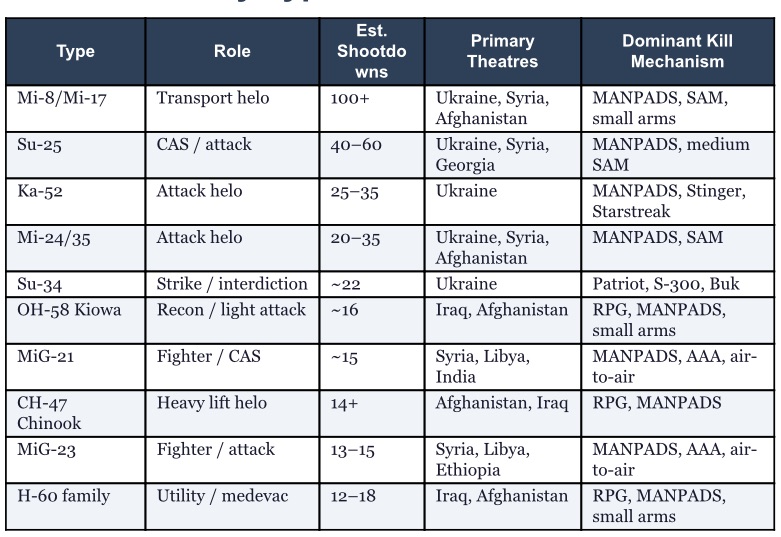
The Hush-Kit ranking places the Sukhoi Su-34 Fullback at position nine with approximately 22 confirmed shootdowns — representing perhaps 25–30% of Russia’s pre-war fleet. The Su-25 Frogfoot, Ka-52 Alligator, Mi-24/35 Hind, and the ubiquitous Mi-8/Mi-17 Hip almost certainly occupy higher positions. Below the Su-34 on the list, the MiG-21 Fishbed (approximately 15 shootdowns across Syria, Libya, and India–Pakistan), the MiG-23 Flogger (13–15 across Syria, Ethiopia, and Libya), and several Western helicopter types round out the bottom of the fourteen.
The second major contributor is the Syrian Civil War. By mid-2013, Syrian Air Force losses already totalled nearly one hundred fixed-wing aircraft and one hundred helicopters. The types lost — MiG-21s, MiG-23s, Su-22s, L-39s — were overwhelmingly Soviet-era platforms employed in low-altitude ground attack roles and killed by MANPADS, anti-aircraft artillery, and rebel attacks on airbases.
The Iraq and Afghanistan campaigns produced lower overall numbers but sustained helicopter attrition over two decades: approximately 14 CH-47 Chinooks, 16 OH-58 Kiowas, and 12–18 H-60 Black Hawks destroyed by hostile fire while airborne, primarily by RPGs, small arms, and MANPADS in counterinsurgency environments.
Table 1: Selected 21st-Century Aircraft Shootdowns by Type
The Kill Mechanism: Ground-Based Air Defence Dominates
The most striking pattern in the 21st-century shootdown data is the near-total dominance of ground-based air defence as the mechanism of aircraft destruction. True air-to-air shootdowns — one crewed aircraft destroying another in flight — are vanishingly rare. The confirmed cases since 2000 can be counted on two hands: a Turkish F-16 downing a Syrian MiG-23 (2014) and a Russian Su-24 (2015), a U.S. Navy F/A-18E downing a Syrian Su-22 (2017), a Pakistani F-16 downing an Indian MiG-21 (2019), and scattered incidents in Libya and Ethiopia. Against several hundred GBAD kills, air-to-air combat accounts for perhaps 2–3% of all shootdowns.
This is not a statistical artifact. It reflects a structural shift in how airpower is contested. Modern GBAD systems have become so effective, so networked, and so widely proliferated that they have largely supplanted fighter aircraft as the primary threat to opposing air operations. The Ukraine conflict has demonstrated this with particular clarity.
In the 21st century, ground-based air defence systems have accounted for approximately 95–98% of all aircraft shootdowns. Air-to-air combat — once the defining mode of aerial warfare — has become a statistical footnote.
The Layered Kill Chain in Ukraine
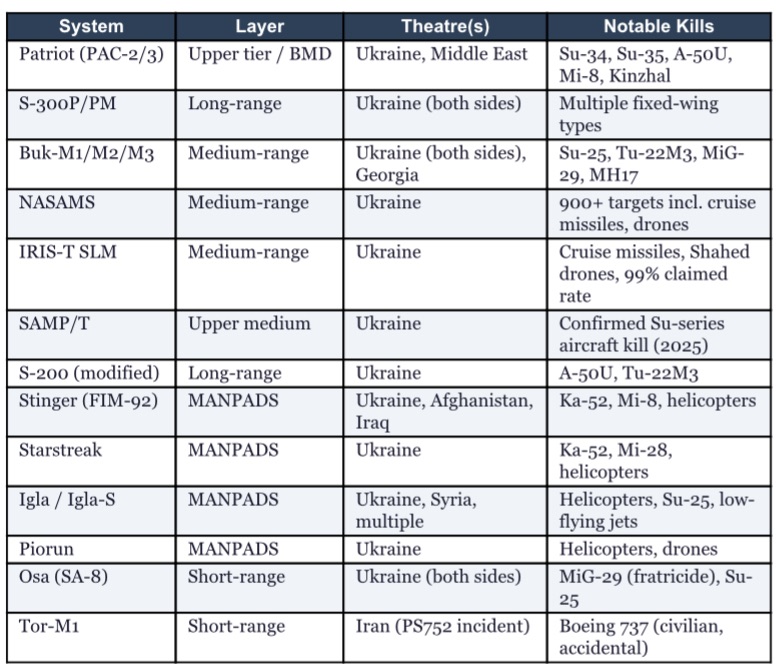
Ukraine’s air defence network provides the clearest modern case study of GBAD effectiveness at scale. The systems doing the killing span the full spectrum. At the short-range layer, MANPADS (Stinger, Starstreak, Igla, Piorun) have accounted for the majority of helicopter and low-altitude fixed-wing kills, particularly in the war’s early months when Russian aviation flew aggressively at low altitudes. The Stinger and Starstreak in particular have proven devastating against Ka-52 and Mi-8 helicopters operating below 3,000 metres.
At the medium-range layer, Ukrainian Buk-M1 systems, S-300P batteries, and Western-supplied IRIS-T SLM and NASAMS have created overlapping engagement zones that have progressively pushed Russian fixed-wing operations to higher altitudes and greater standoff distances. NASAMS alone has destroyed approximately 900 air targets with a 94% effectiveness rate, according to the Norwegian Air Force’s support group for Ukraine. IRIS-T SLM has achieved near-perfect intercept rates against cruise missiles, with one Ukrainian launcher credited with over 30 kills. A SAMP/T battery confirmed its first aircraft kill in early 2025.
At the upper tier, the Patriot system has produced the war’s most consequential individual engagements. In May 2023, a single Patriot battery operating from the Kharkiv region shot down a Su-34, a Su-35, and three Mi-8 helicopters in Bryansk Oblast — deep inside Russian airspace. In January 2024, what was reportedly a German-supplied Patriot battery ambushed and destroyed a Beriev A-50U early warning aircraft over the Sea of Azov, valued at approximately $330 million — one of the most significant single air defence kills in modern history. A month later, a second A-50 was downed by what Ukrainian sources identified as a modified S-200 missile.
The cumulative effect has been transformative. Russia’s air force has been unable to achieve air superiority over Ukraine despite possessing a numerically and technologically superior air arm. Russian fixed-wing aircraft have been progressively pushed back from the front lines, forced to release glide bombs from standoff distances rather than conducting precision strikes at closer range. This represents a fundamental validation of the GBAD-centric approach to air defence.
Table 2: GBAD Systems with Confirmed Aircraft Kills in the 21st Century
What the Record Means for Norwegian Defence Planning
Norway occupies a distinctive position in this landscape. It is the co-developer and primary operator of one of the most combat-validated air defence systems in history. NASAMS, a joint Kongsberg/Raytheon product, has compiled a combat record in Ukraine that has driven procurement decisions across Europe and beyond. The system’s 94% effectiveness rate against cruise missiles and drones, its proven integration with Western C2 architectures, and its operational maturity are matters of documented fact.
The 2025–2036 Long-Term Defence Plan reflects this confidence. Norway has committed to doubling its NASAMS capacity with four additional batteries, alongside new radars and command infrastructure. Orders totalling over NOK 2.4 billion have been placed with Kongsberg since late 2023. The NASAMS backbone is being reinforced with purpose.
But NASAMS is designed for threats in the low-to-medium altitude band. Its AMRAAM-family interceptors are not designed to engage ballistic missiles, which follow fundamentally different flight profiles at altitudes and closing velocities outside the AMRAAM engagement envelope. The LTDP’s second air defence commitment — to procure a long-range system capable of defending one geographical area against tactical ballistic missiles — remains unfulfilled. No system has been selected. No contract has been signed.
Norway has signed a contract for Chunmoo long-range fires. It has not signed a contract for ballistic missile defence. The empirical record of 21st-century air warfare suggests the latter is at least as urgent as the former.
The Ballistic Missile Gap
The 21st-century shootdown record demonstrates that GBAD investment pays direct operational dividends. But it also reveals what happens when specific layers of the air defence architecture are absent. Ukraine’s experience with ballistic missile defence is instructive.
A RUSI analysis of missile strike records compiled between September 2022 and October 2025 found that Russia fired 939 Iskander and Kinzhal ballistic or aeroballistic missiles at Ukraine. Only 227 were intercepted — an average success rate of approximately 24%. In 273 of 345 recorded attacks that included these missiles, none were intercepted at all. Patriot batteries achieved dramatic individual successes, including confirmed Kinzhal intercepts, but there were simply too few of them to provide consistent coverage. The Financial Times has reported months when Ukrainian ballistic missile interception rates dropped into single digits as Russian warhead modifications took effect.
This is the gap Norway faces. The Iskander-M system, with variants reportedly capable of ranges approaching 1,000 kilometres, could place Norwegian military infrastructure within reach from ground-based launchers on Russian territory. Russia announced plans to deploy extended-range Iskander variants from Kaliningrad in January 2025. Whether similar deployments occur on the Kola Peninsula — directly adjacent to Norway’s northern border — remains an open question, but the production timeline suggests these systems will be available in increasing numbers through the period covered by the LTDP.
NASAMS cannot address this threat. Neither can Chunmoo, which is an offensive fires system, not a defensive interceptor. The relationship between fires and terminal defence is not one of substitution. Deep strike may reduce threat volumes; it does not eliminate the need for a terminal intercept capability. This is a lesson the Ukraine conflict has provided at considerable cost.
The Procurement Landscape Has Shifted
When the LTDP was presented in April 2024, the assumption was that Patriot would be the default choice for Norway’s ballistic missile defence requirement. The system had the combat record, the NATO integration, and the institutional momentum. Two years later, that assumption requires examination.
U.S. interceptor supplies fell to approximately 25% of Pentagon-required levels by mid-2025, following large-scale donations to Ukraine and sustained combat expenditure in the Middle East. Switzerland, which ordered five Patriot fire units as the cornerstone of its Air2030 programme, was informed in early 2026 that deliveries would be delayed by four to five years. The Swiss government has responded by instructing its defence ministry to evaluate a second long-range system, preferably European-produced.
Meanwhile, two European alternatives have matured. The Franco-Italian SAMP/T NG, equipped with the Aster 30 Block 1NT interceptor, completed its final system-level qualification firings in December 2025 and is entering service in 2026. Denmark has already ordered it. Germany’s IRIS-T SLM/X combination, unveiled at Enforce Tac 2026, pushes the IRIS-T family into the upper-medium engagement envelope with ranges to 80 km and altitude coverage to 30 km, though it remains a complement to rather than a substitute for dedicated BMD systems.
Norway’s procurement decision will be shaped by these realities: delivery timelines, interceptor availability, industrial base resilience, and the question of whether European or American supply chains offer greater security of supply over a twelve-year planning horizon. The 21st-century shootdown record does not answer the procurement question. But it answers the capability question with empirical clarity.
Conclusion: The Evidence Is Not Ambiguous
The 21st-century record of aircraft attrition tells a story that should be uncomfortable for air forces and reassuring for air defence advocates. Over 380 crewed aircraft have been shot down since 2000. Approximately 95–98% of those kills were made by ground-based systems, spanning every layer from man-portable missiles to strategic-level SAM batteries. The air-to-air fighter duel — the scenario around which much of Western airpower doctrine was built — accounts for a marginal fraction of actual kills.
For Norway, the implications are threefold. First, the NASAMS investment has been empirically validated to a degree that few defence programmes ever achieve. Second, the absence of a ballistic missile defence layer is not a theoretical gap but a demonstrated vulnerability, as Ukraine’s struggle to intercept Iskander missiles with too few Patriot batteries has shown. Third, the procurement environment for BMD systems is more constrained and more competitive than it was when the LTDP was drafted, making early and decisive action on system selection more important, not less.
The Chunmoo contract, signed on 30 January 2026, answered Norway’s long-range fires question. The ballistic missile defence question remains open. The 21st-century shootdown record suggests it should not remain open for long.
This article draws on open-source data from Oryx, Hush-Kit, RAND, RUSI, the Ukrainian Air Force, and publicly available procurement records. All cost figures and performance claims are sourced from official announcements, manufacturer data, or peer-reviewed open-source analysis. The editorial position of this publication is analytical and non-prescriptive; the evidence is presented for the reader’s own assessment.

