
Critical Cost Analysis of U.S. and European SHORAD systems.
Short range air defense—the SHORAD tier covering engagements from point-blank out to roughly 15 kilometers, protecting maneuver forces, forward operating bases, and critical infrastructure against low-altitude threats—has undergone a dramatic revaluation since Russia’s full-scale invasion of Ukraine in February 2022. After two decades of institutional neglect driven by assumptions of persistent Western air superiority, the proliferation of armed drones, loitering munitions, and low-flying cruise missiles has forced NATO nations to urgently rebuild capabilities that were systematically dismantled during the Global War on Terror era. The U.S. Army divested most of its SHORAD force structure after 2005. Germany retired its Gepard self-propelled anti-aircraft guns in 2010. The result was a SHORAD gap that persisted across the alliance for over a decade.
This analysis examines the cost structures of the principal American and European SHORAD systems now competing to fill that gap: vehicle-mounted gun and missile platforms—the U.S. Army’s M-SHORAD (SGT Stout) and Germany’s Rheinmetall Skyranger 30—alongside the MANPADS missiles that equip them and the programmable ammunition that increasingly defines their engagement economics. The findings reveal that at the vehicle-system level, American and European platforms occupy a remarkably similar cost band. The decisive cost differentials emerge at the effector level, where the choice between gun-based and missile-based engagement—and between American and European munitions—produces cost-per-kill ratios that vary by orders of magnitude.
SHORAD vehicle platforms converge on cost
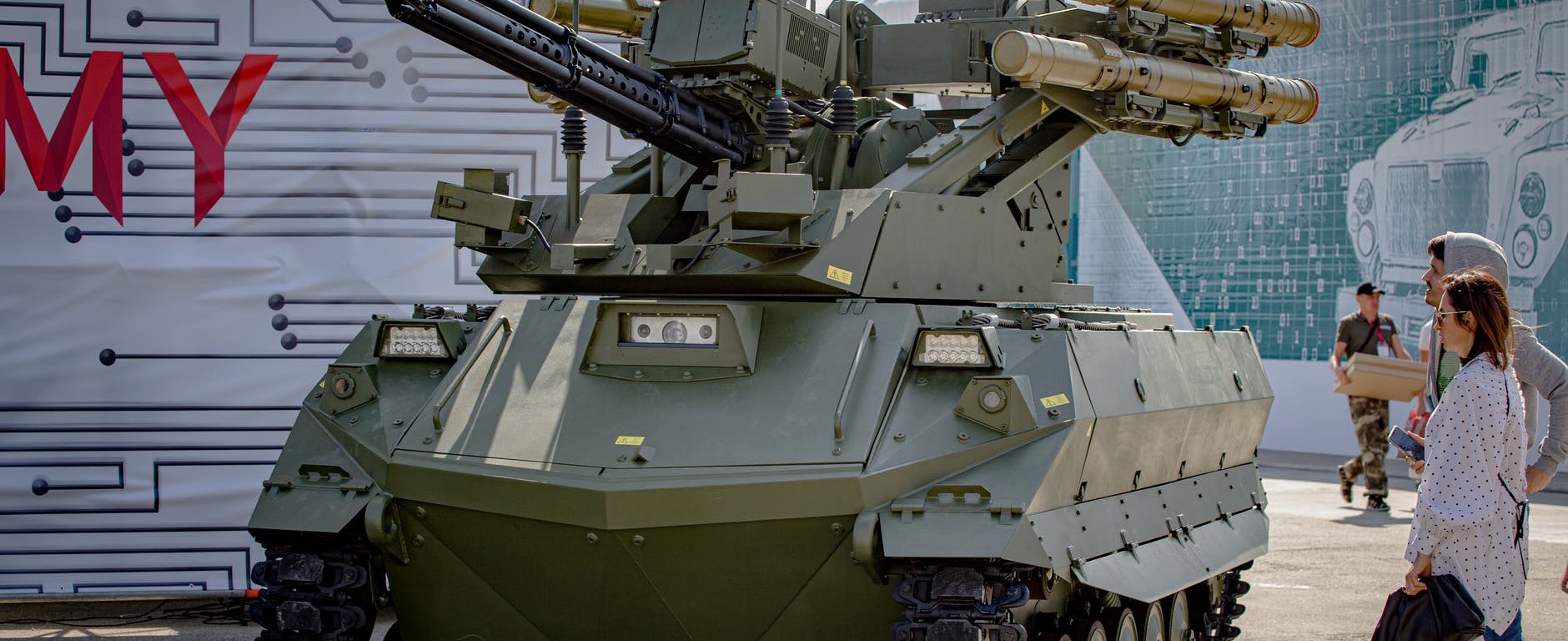
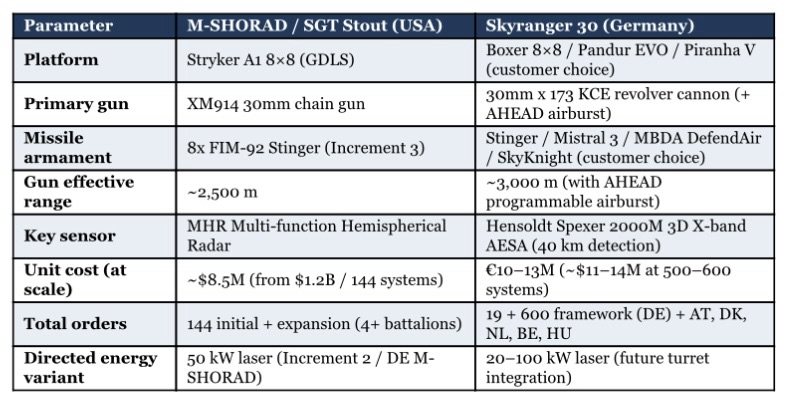
The American M-SHORAD Increment 1, formally designated SGT Stout in June 2024 in honor of the only Air Defense Artillery soldier to receive the Medal of Honor, is built on the Stryker A1 8×8 wheeled armored vehicle. Leonardo DRS integrates the mission equipment package, which General Dynamics Land Systems then installs on the Stryker chassis. The armament suite combines a 30mm XM914 chain gun, FIM-92 Stinger missiles, and—in the original configuration—AGM-114L Longbow Hellfire anti-tank missiles mounted externally. The Increment 3 configuration, now in development, removes the Hellfires due to durability issues caused by constant vehicle vibration and environmental exposure, doubling the Stinger loadout from four to eight missiles per vehicle instead.
The original September 2020 contract awarded General Dynamics $1.219 billion for 144 systems destined for four active-duty battalions of 36 vehicles each, yielding an approximate unit cost of $8.5 million per vehicle system. A June 2025 contract modification worth $621 million for additional systems, parts, and support indicates stable or modestly increasing unit pricing as the Army expands procurement to National Guard units. The FY2026 Army Budget Overview commits $729 million to M-SHORAD alone, part of a broader $2.0 billion air defense investment package—a scale of investment that underscores how urgently the Army is working to reconstitute a capability it spent a decade deliberately shedding.
The principal European SHORAD vehicle contender, Rheinmetall’s Skyranger 30, follows a different procurement trajectory shaped by Germany’s belated recognition that retiring the Gepard without a replacement was a strategic error. The Gepard’s unexpected combat vindication in Ukraine—where its twin 35mm cannons proved devastatingly effective against Russian Shahed-136 kamikaze drones—transformed European thinking about gun-based air defense virtually overnight. The Skyranger 30 mounts a single 30mm x 173 KCE revolver cannon and short-range missiles on an unmanned turret weighing approximately 4.25 tonnes, designed for integration onto 8×8 wheeled armored vehicles.
Germany’s initial February 2024 order for one prototype and 18 production Skyranger 30 vehicles on Boxer chassis totaled €595 million—roughly €31 million per unit in a deliberately small initial batch carrying heavy non-recurring engineering costs. The transformative order came with Rheinmetall CEO Armin Papperger’s August 2025 announcement of a framework contract worth €6–8 billion for an estimated 500–600 systems, to be delivered in phases through 2035 under Germany’s Nah- und Nächstbereichsschutz (NNbS) short and very short range air defense program. At these volumes, the projected unit cost settles to €10–13 million per vehicle (≈$11–14 million)—a figure that converges meaningfully with the American M-SHORAD price point. Austria’s 36 systems on Pandur EVO at €1.8 billion (€50 million per unit) and Denmark’s initial 16 turrets on Piranha V represent higher initial-batch pricing typical of first-customer integration programs.
The cost convergence between these platforms is analytically significant. Despite emerging from entirely different industrial ecosystems and procurement cultures, the American and European SHORAD vehicles land in a similar $9–14 million band when normalized for comparable production volumes. The meaningful differentiation lies not in headline acquisition price but in what each platform fires—the ammunition and missiles—and the resulting cost-per-engagement economics against different classes of threat.
The Gepard precedent: combat-proven gun-based SHORAD and its cost lessons
Any analysis of contemporary SHORAD economics must account for the Gepard’s unexpected second career in Ukraine, which fundamentally reshaped European procurement thinking. Germany transferred Gepard self-propelled anti-aircraft guns to Ukraine beginning in mid-2022, and the system—armed with twin 35mm Oerlikon cannons firing AHEAD airburst ammunition—proved devastatingly effective against Russian Shahed-136/Geran-2 one-way attack drones. Documented engagements showed Gepards destroying multiple Shaheds in single overnight operations, with the cost economics overwhelmingly favorable: a burst of 35mm AHEAD rounds costing perhaps $15,000–$30,000 to destroy a drone valued at $20,000–$50,000, versus the alternative of expending a missile costing hundreds of thousands of dollars or more.
The Gepard experience exposed two interrelated lessons. First, gun-based SHORAD—a capability class that most Western nations had dismissed as obsolete—remained not merely relevant but essential against the drone threat. Second, the ammunition supply chain for legacy gun systems was dangerously brittle. Switzerland’s neutrality-based restrictions on re-exporting 35mm ammunition originally manufactured by Oerlikon Contraves forced Germany into a scramble for alternative sources, with Norwegian manufacturer Nammo among the suppliers pressed into service. This supply chain vulnerability directly informed the Skyranger 30’s design: by adopting the 30mm x 173 caliber (compatible with a broader NATO ammunition base) alongside the option for 35mm x 228 in the Skyranger 35 variant, Rheinmetall addressed both the capability requirement and the logistics fragility that the Gepard experience had revealed.
Rheinmetall subsequently deployed Skynex—a static, containerized system also built around the 35mm revolver cannon and AHEAD ammunition—to Ukraine, where it has reportedly achieved consistent kills against Shahed drones. The Italian Army contracted Rheinmetall in January 2025 for an initial Skynex system valued at €73 million, with options for three additional units at €204 million through 2027. These data points collectively validate the engagement economics of gun-based SHORAD and provide the operational foundation on which the Skyranger 30 program rests.
MANPADS economics reveal sharp transatlantic pricing divergence
While vehicle platform costs converge, the missiles that arm SHORAD systems and supplement their gun armament display the clearest cost disparity between American and European alternatives. It is at the MANPADS tier that the European cost advantage finds its strongest empirical support.
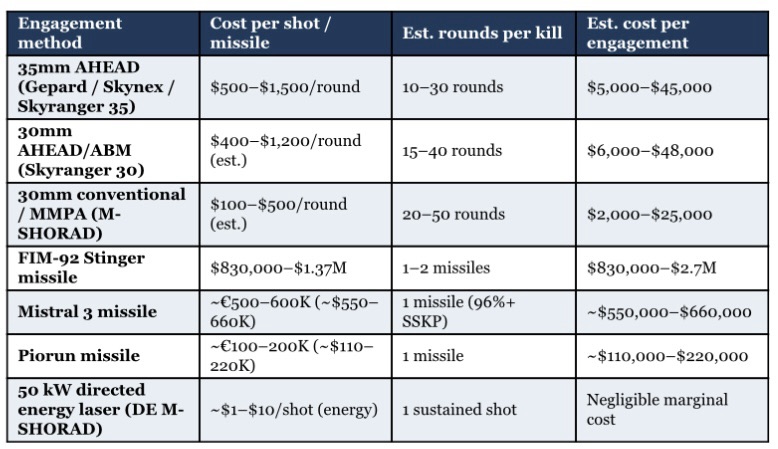
The FIM-92 Stinger’s procurement economics have grown increasingly problematic. Production was effectively discontinued after the Cold War, and RTX’s 2022 restart required 30 months to rebuild supplier networks and retool production lines. Current output targets approximately 60 missiles per month—a fraction of Cold War-era rates. The Dual Detector Assembly, a critical seeker component, must be entirely redesigned because the original part is no longer manufactured, with new-component missiles expected from 2026. Unit costs reflect this scarcity: NATO allies Germany, Italy, and the Netherlands procured 940 FIM-92K Stinger Block I missiles through NATO’s NSPA for $780 million in 2024, equating to approximately $830,000 per missile. Morocco’s non-NATO Foreign Military Sales request for 600 Stingers at $825 million yields $1.375 million per unit—a 66% markup illustrating the export pricing premium for non-alliance partners. Germany’s Bundestag separately approved 506 Stingers at €395 million (€780,000 per unit), broadly consistent with the NATO price.
France’s MBDA Mistral 3 competes directly in this tier with a more modern seeker. The Mistral 3 was the first VSHORAD missile to employ an infrared matrix imager, and MBDA claims a single-shot kill probability exceeding 96%. It engages targets at ranges up to 8,000 meters and altitudes of 6,000 meters at supersonic speed (930 m/s), with a rated 20-year maintenance-free service life. Romania’s procurement of 200 launchers and over 1,000 missiles at €626 million suggests a blended per-missile cost around €500–600,000 when isolated from launcher and support costs. A joint European EDIRPA procurement framework—covering France, Belgium, Cyprus, Estonia, and Hungary—is designed to aggregate demand, with MBDA targeting production of 40 missiles per month by 2026. Denmark selected Mistral 3 for its Skyranger 30 vehicles in March 2025, joining a growing European customer base that values the missile’s fire-and-forget capability and advanced countermeasure resistance.
Poland’s Piorun represents the most cost-competitive MANPADS in NATO. Norway’s November 2022 procurement of several hundred missiles and launchers for NOK 350 million ($35.6 million) defeated competing bids from Sweden (RBS 70 NG), France (Mistral), and the United States (Stinger) in an open tender. The Norwegian Defense Materiel Agency described Piorun as delivering “the best combination of time, performance and cost.” Slovakia’s comparative evaluation priced 36 Piorun systems at €65.9 million (€1.8 million per system including launcher, missiles, and accessories), versus €39.5 million for 12 RBS 70 NG (€3.3 million each) and €35 million for 12 Mistral 3 (€2.9 million each). Sweden’s subsequent €273 million order in September 2025 confirmed Piorun’s export momentum. Mesko is expanding to a second production line, with output exceeding 1,000 systems annually—already faster than Stinger production.
Sweden’s RBS 70 NG from Saab occupies a distinct niche as a beam-riding system. Unlike the fire-and-forget Stinger, Mistral, and Piorun, the RBS 70 NG requires the operator to maintain laser guidance on the target throughout the engagement—a disadvantage in rapid-fire scenarios but an advantage in electronic warfare environments, as the missile emits no seekable signature. Lithuania received a third Saab MSHORAD order valued at approximately SEK 1.4 billion for deliveries through 2026–2030, and Sweden’s own army MSHORAD program integrates the system with Saab’s Giraffe AMB radar. The RBS 70 NG’s estimated system cost of €3.3 million places it at the premium end of European MANPADS, reflecting its more sophisticated fire-control architecture.
Ammunition economics: the gun-versus-missile cost calculus
The most consequential cost variable in SHORAD is not the platform but the effector: what is fired at each target, and what it costs to achieve a kill. This is where the gun-versus-missile debate acquires its sharpest financial edge, and where European gun-based systems—armed with Rheinmetall’s AHEAD programmable airburst ammunition—introduce a structural cost advantage that compounds with every engagement.
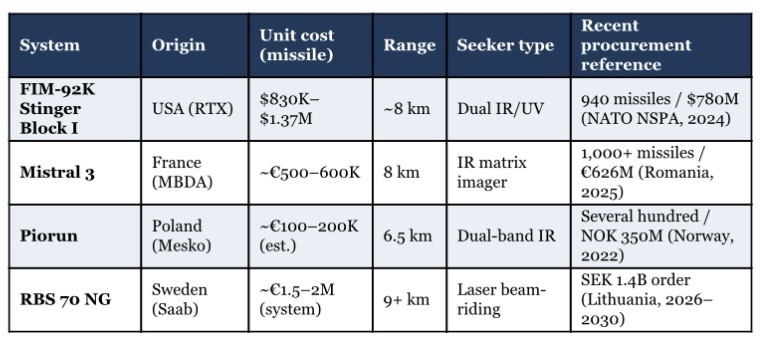
AHEAD (Advanced Hit Efficiency And Destruction) fundamentally alters SHORAD engagement economics. Available in 35mm x 228 and 30mm x 173 calibers, each AHEAD round contains a programmable fuse inductively set by a muzzle-mounted coil as the round exits the barrel, using real-time velocity data to calculate optimal burst timing. The standard 35mm round disperses 152 tungsten sub-projectiles in a cone-shaped pattern. Specialized variants—the PMD330 with 407 sub-projectiles for point protection and the PMD428 with 675 sub-projectiles optimized for counter-FPV drone engagements—demonstrate ongoing adaptation to evolving threats. While per-round pricing remains commercially sensitive, open-source analysis and contract reporting suggest AHEAD rounds cost in the range of $500–$1,500 per round depending on variant and procurement volume. A typical engagement against a drone-class target might require a burst of 10–30 rounds, yielding a cost-per-engagement of approximately $5,000–$45,000.
The cost asymmetry against drone threats becomes stark when comparing effector types. Firing a single Stinger missile at a $500 commercial drone costs $830,000 at the best available price—a ratio that is economically indefensible at any operational scale. Even the most affordable MANPADS option, the Piorun, represents a significant cost mismatch against low-value UAS targets. This arithmetic is not abstract: it drove Germany’s decision to invest €6–8 billion in Skyranger 30 gun systems, and it explains why hybrid gun-missile platforms that can match the response to the threat value represent the emerging SHORAD consensus across NATO.
The American M-SHORAD’s XM914 30mm chain gun currently fires conventional ammunition, though the developmental XM1223 Multi-Mode Proximity Airburst (MMPA) munition aims to deliver similar burst-fragmentation effects to AHEAD. However, MMPA has not yet achieved the maturity or combat track record of the AHEAD family, which benefits from iterative refinement across multiple conflicts and demonstrated performance in Ukraine against real-world targets. The Skyranger 30’s KCE revolver cannon architecture also provides inherently higher air-target precision than the M-SHORAD’s chain gun, due to the revolver mechanism’s barrel stability characteristics—though the chain gun offers greater versatility across both air and ground engagement roles.
Design philosophies reflect different operational doctrines
The American SHORAD approach reflects a doctrine shaped by expeditionary warfare and the requirement that air defense must integrate into existing mechanized formations. The M-SHORAD was conceived specifically to address a capability gap identified after Russia’s 2014 annexation of Crimea exposed the U.S. Army’s lack of organic SHORAD for maneuver units. The Stryker platform was selected for compatibility with existing Stryker Brigade Combat Teams, and the multi-weapon turret—gun, missiles, and originally anti-armor weapons—embodied the American preference for multi-mission flexibility over single-role optimization. The M-SHORAD is fundamentally a missile platform with a gun, designed to fire Stinger (and eventually NGSRI) interceptors as its primary air defense effector, with the 30mm cannon as a secondary capability.
The European approach, crystallized in the Skyranger 30, inverts this hierarchy. The Skyranger is a gun platform with missiles—the 30mm revolver cannon firing AHEAD airburst ammunition serves as the primary effector, with short-range missiles providing supplementary capability against targets that exceed the cannon’s engagement envelope. This gun-first philosophy directly addresses the cost-asymmetry problem that has come to dominate SHORAD planning: when the primary threat consists of cheap drones and loitering munitions costing $500–$50,000 each, responding with cannon rounds costing $500–$1,500 rather than missiles costing $830,000 is not merely cost-effective but operationally sustainable in a way that missile-only solutions are not.
The Skyranger 30 turret’s modularity represents a distinct European competitive advantage. Customer nations can select from at least five missile integration options: Stinger, Mistral 3, MBDA DefendAir (a small anti-drone missile derived from the Enforcer, with 5–6 km range and up to 12 missiles per turret), Halcon SkyKnight, and vertically-launched Cheetah C-UAS missiles. Denmark chose Mistral 3 in March 2025, Germany selected Stinger combined with DefendAir, and Austria opted for Mistral 3 given existing stockpile compatibility. This open-architecture approach allows each operator to optimize the gun-missile mix for their specific threat environment and budget. The M-SHORAD’s more fixed armament configuration offers less customer flexibility, though the U.S. Army’s Next Generation Short Range Interceptor program—which achieved its first successful test flight in late 2025, with Lockheed Martin and Raytheon competing for a FY2028 selection—signals American recognition that the Stinger’s replacement must deliver improved performance at a sustainable cost point.
Production capacity and supply chain dynamics
Stinger production remains constrained by structural supply chain fragility. RTX required 30 months to restart manufacturing after the post-Cold War shutdown, and current output of approximately 60 missiles per month (roughly 720 annually) cannot simultaneously meet U.S. Army replenishment, Foreign Military Sales obligations, and growing NATO demand. The critical Dual Detector Assembly must be entirely redesigned because the original part is no longer in production, with new-component deliveries expected from 2026. This brittleness creates pricing instability: when demand exceeds supply, prices escalate and delivery timelines extend, as demonstrated by the sharp differential between NATO-price Stingers ($830,000) and non-NATO FMS pricing ($1.375 million)—a 66% markup applied within the space of months.
European MANPADS production benefits from competitive pressure and diversified manufacturing. MBDA targets 40 Mistral 3 missiles per month by 2026, up from 20 in early 2023, accelerated by the joint EDIRPA procurement framework aggregating demand across six nations. Poland’s Mesko is expanding to a second Piorun production line at its Jelcz facility, with current output exceeding 1,000 systems over 12 months—already materially faster than Stinger production. The competitive dynamics between these manufacturers benefit European customers directly: Norway’s 2022 Piorun selection over Stinger, Mistral, and RBS 70 NG in an open tender demonstrated that performance-per-dollar competition, not alliance allegiance, is increasingly driving MANPADS procurement decisions.
The Skyranger 30 procurement wave is creating its own economies of scale. With confirmed or pending orders from Germany (500–600 systems), Austria (36), Denmark (16 initial), the Netherlands (22 initial), Belgium (announced June 2025), and Hungary (integration contract), total European Skyranger demand likely exceeds 700 systems. Rheinmetall’s transition from Swiss prototype production to German series manufacturing at Neuss should drive meaningful learning-curve cost reductions. The AHEAD ammunition supply chain is expanding in parallel: Rheinmetall’s contracts for 35mm AHEAD to European customers have reached “low triple-digit million euro” values, signaling production volumes that will stabilize per-round pricing and ensure ammunition sustainability that the Gepard’s Swiss-origin supply chain could not.
Directed energy as a disruptive SHORAD cost layer
Both American and European SHORAD programs are pursuing directed energy weapons as the ultimate answer to the cost-asymmetry problem, but their approaches and operational maturity diverge.
The U.S. Army’s DE M-SHORAD (Increment 2) deployed four Stryker-mounted 50 kW laser prototypes to the Middle East in February 2024 for operational testing against real-world aerial threats. Initial soldier feedback was characterized as “not overwhelmingly positive,” with officials noting that laboratory and test-range results differed substantially from tactical conditions—a candid assessment that underscores the gap between demonstrated capability and operational reliability. The Army plans to finalize the DE M-SHORAD configuration by 2026, with a subsequent competition to select an Enduring High Energy Laser system. At a marginal cost-per-shot measured in single-digit dollars, a mature laser SHORAD system would fundamentally break the engagement cost curve—but the technology has not yet demonstrated the reliability required to displace kinetic effectors in operational service.
Rheinmetall’s laser integration roadmap for the Skyranger begins at 20 kW with a growth path to 50 kW and an aspirational target of 100 kW. The company has demonstrated laser engagements against drone-class targets and envisions a hybrid turret combining revolver cannon, missiles, and laser in a single weapon station. The timeline is less aggressive than the American program, reflecting a European emphasis on gun-first solutions with laser augmentation rather than laser replacement of kinetic systems. For both programs, the decisive question is not whether directed energy can destroy targets—it demonstrably can under controlled conditions—but whether it can sustain that performance in the dust, rain, obscurants, and electromagnetic clutter of real battlefields. Until that question is definitively resolved, the gun-missile cost equation remains the operative SHORAD procurement calculus.
Strategic assessment
American SHORAD systems offer integration maturity and expeditionary readiness. The M-SHORAD is operational today across multiple battalions with a defined growth path through directed energy variants. The Stinger’s installed base across 30 nations provides logistical depth and interoperability that newer European alternatives cannot yet replicate. For nations embedded in American defense ecosystems or prioritizing interoperability with U.S. expeditionary forces, the integration premium retains value.
European SHORAD alternatives offer superior cost-per-engagement economics against the dominant threat. The Skyranger 30’s AHEAD-based cannon engagement model provides a cost ratio against small UAS targets one to two orders of magnitude more favorable than missile-based responses, and the platform’s open-architecture modularity allows customers to calibrate their effector mix to budget and threat profile. The growing MANPADS competition between Piorun, Mistral 3, and Stinger is creating pricing discipline that benefits all buyers. The Gepard’s combat record in Ukraine provides empirical validation that no amount of modeling can match.
The decisive variable is not platform cost but engagement economics. At comparable vehicle-system price points ($9–14 million), the American and European SHORAD approaches diverge most sharply in what they fire and what each shot costs. In a high-volume drone and loitering munition environment—which is the threat environment that current conflict data indicates will dominate—the European gun-first philosophy offers a fundamentally more sustainable cost equation. Against manned aircraft, helicopters, or cruise missiles, missile-based engagement remains essential regardless of origin. The optimal SHORAD architecture, as the cost data increasingly demonstrates, is not a choice between philosophies but a calibrated layering of gun, missile, and—eventually—directed energy effectors, matched to the value of each threat.
AI-generated article.

