
Europe’s Combat-Proven Air Defense at Competitive Pricing
The IRIS-T SL family commands €0.43–4.4 million per interceptor depending on variant, positioning it as Europe’s most cost-effective combat-proven medium-range air defense system. This pricing reflects a modular family approach — from the short-range SLS using the baseline IRIS-T air-to-air missile to the medium-range SLM with an enlarged motor and radio-command midcourse guidance, and the forthcoming long-range SLX with a dual-mode seeker and doubled engagement range. Combat deployments in Ukraine since October 2022, with a reported near-100% success rate across more than 250 intercepts, have validated the system’s effectiveness and driven an unprecedented wave of European procurement.
The IRIS-T SL’s strategic value lies in filling a critical gap in European layered air defense architectures. While Patriot PAC-3 MSE handles ballistic missile defense and NASAMS provides short-to-medium range coverage, IRIS-T SLM bridges these layers with a combination of proven combat performance, competitive unit costs, and a European industrial base that supports strategic autonomy. The forthcoming SLX variant extends this coverage toward the lower end of what Patriot provides, creating a comprehensive European alternative.
Current cost structure reveals competitive European positioning
IRIS-T SLS interceptors cost approximately €0.43–0.56 million each, using the same missile as the air-to-air variant with adapted software for surface-launched employment. The SLS provides engagement ranges up to 12 kilometers and altitudes up to 8 kilometers, making it the most affordable option in the family for countering drones, helicopters, and low-altitude cruise missiles. Sweden operates the SLS variant as the Robotsystem 98 (RBS 98), and Norway integrates IRIS-T SLS launchers into its NOMADS short-range air defense system.
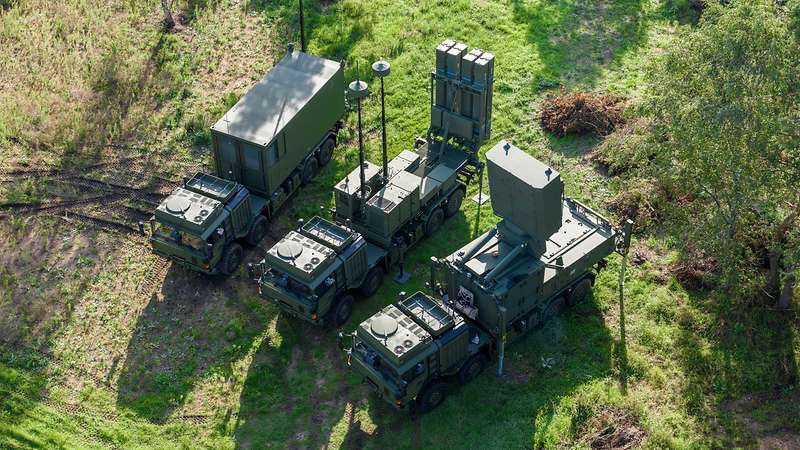
IRIS-T SLM interceptors cost an estimated €1–4.4 million each, with the wide range reflecting the difference between marginal missile production cost and fully loaded system-integration pricing. The baseline air-to-air variant underlying the SLM is priced at approximately €0.9 million, but the enlarged rocket motor, radio-command midcourse guidance, and system integration drive the effective cost higher. A complete IRIS-T SLM fire unit — comprising three truck-mounted launchers (24 missiles), a Hensoldt TRML-4D radar, and a command post — costs €115–200 million depending on configuration and missile stockpile. Germany’s benchmark contract of six fire units with 216 missiles for €950 million implies approximately €158 million per battery with 36 interceptors.
IRIS-T SLX interceptors, currently in development with an expected completion around 2029–2030, will feature a dual-mode seeker (active radar and imaging infrared) and a dual-pulse rocket motor. With engagement ranges up to 80 kilometers and altitudes up to 30 kilometers, the SLX roughly doubles the SLM’s envelope. No public unit cost has been confirmed, but the SLX is designed to share launchers, command posts, and radars with the existing SLM architecture, which should limit cost growth relative to the capability increase.
Patriot PAC-3 MSE interceptors cost $3.7–4.7 million each, and a complete Patriot battery exceeds $1 billion. Bulgaria’s decision to procure seven IRIS-T SLM batteries for an estimated $1.4 billion — versus approximately $7 billion for equivalent Patriot coverage — illustrates the cost advantage that drives European procurement decisions.
Combat effectiveness validates rapid European adoption
The IRIS-T SLM’s near-100% reported success rate in Ukraine represents the most extensive combat validation of any European air defense system in decades. By June 2024, Diehl Defence CEO Helmut Rauch confirmed over 240 successful intercepts by IRIS-T SLM and SLS systems in Ukraine. By early 2025, Ukrainian operators reported a 99% interception rate, with one battery neutralizing 15 cruise missiles in a single engagement and another achieving eight kills with eight interceptors in under thirty seconds.
Combat-proven multi-threat capability distinguishes the IRIS-T SLM from systems that remain untested under fire. Ukrainian forces have employed it against Russian cruise missiles (Kh-101, Kalibr), Iranian-supplied Shahed-series loitering munitions, and — in a significant development confirmed by Ukraine’s ambassador to Germany in July 2025 — short-range ballistic missiles. While the IRIS-T SLM was not originally designed as a dedicated ballistic missile defense system, its demonstrated ability to intercept some ballistic threats under favorable conditions adds an unexpected layer of capability.
Technical specifications across the family demonstrate scalable performance: The SLS engages targets at ranges up to 12 kilometers and altitudes up to 8 kilometers using the proven imaging infrared seeker from the air-to-air missile. The SLM extends this to 40 kilometers range and 20 kilometers altitude through an enlarged rocket motor and radio-command midcourse guidance with infrared terminal homing. The SLX will push to 80 kilometers range and 30 kilometers altitude with a two-stage propulsion system and dual-mode seeker, enabling engagement of stand-off weapon carriers and providing limited ballistic missile defense capability. Beyond the SLX, the HYDEF (Hypersonic Defence Interceptor) project — funded under a €100 million European Commission grant — uses IRIS-T SLX technologies as the baseline for a two-stage interceptor targeting hypersonic glide vehicles at altitudes beyond 50 kilometers and ranges over 100 kilometers.
International sales demonstrate explosive growth trajectory
The European Sky Shield Initiative (ESSI) has transformed IRIS-T SLM into the backbone of European medium-range air defense. At least eight ESSI member nations — Germany, Sweden, Estonia, Latvia, Bulgaria, Switzerland, Denmark, and Slovenia — have signed contracts, with Lithuania, Romania, and Austria in various stages of negotiation or planning. This represents the fastest procurement ramp-up of any European air defense system in the post-Cold War era.
Major contracts demonstrate the scale of demand: Germany ordered six fire units with 216 missiles for €950 million in June 2023, with plans to eventually procure 50 IRIS-T SLM systems. Sweden signed a €810 million contract for seven fire units in June 2025. Switzerland committed to five fire units under a CHF 660 million budget allocation, with options for additional SLM and SLX systems through 2032. Estonia and Latvia jointly procured three systems for an estimated €1 billion combined. Ukraine’s cumulative orders, including a €2.2 billion contract signed in May 2025, represent the single largest commitment. Germany further announced plans in July 2025 to procure up to 100 mobile IRIS-T SLS systems plus additional SLM and SLX batteries, with Rheinmetall developing a self-propelled Boxer-based SLS launcher under a €1.2 billion development contract.
Production scaling reflects industrial mobilization: Diehl Defence has invested approximately €1.5 billion to expand manufacturing capacity, growing its workforce from 2,800 in 2021 to over 5,000 by 2025. Missile production increased tenfold from roughly 150–200 missiles in 2023 to 800–1,000 annually by end of 2025, with new facilities planned to reach 2,000 missiles per year. System production targets 10 batteries in 2026, scaling to 16 batteries annually within two years thereafter.
Naval integration expands the addressable market: In November 2025, Lockheed Martin and Diehl signed a contract to integrate IRIS-T SLM into the Mk41 Vertical Launch System and AEGIS combat system. A naval demonstrator was successfully tested aboard the German frigate Baden-Württemberg during the Maritime Firing Exercise 2025. Hanwha has also signed a memorandum of understanding with Diehl to integrate its Multi-Function Radar family, targeting new export markets. These naval and partnership developments position IRIS-T SLM for markets well beyond the current European ground-based procurement wave.
Strategic value proposition drives European defense architecture decisions
IRIS-T SL fills the critical medium-range gap in European air defense that has been exposed by Russia’s war against Ukraine. The system occupies a price-performance sweet spot: significantly more affordable than Patriot while offering combat-proven effectiveness against the cruise missiles, drones, and loitering munitions that constitute the bulk of modern air threats. For nations that cannot afford or do not require Patriot’s ballistic missile defense focus, IRIS-T SLM provides a credible alternative at roughly one-fifth the battery cost.
The modular family approach maximizes cost-effectiveness across different threat scenarios. A single IRIS-T SL fire unit can integrate SLS launchers for short-range defense alongside SLM launchers for medium-range coverage, and the forthcoming universal launcher will enable mixed SLM/SLX loads within the same vehicle. This allows forces to tailor interceptor expenditure to threat type — using €0.43 million SLS missiles against drones rather than expending €4 million Patriot rounds — while maintaining the option to engage higher-end threats with the same command and radar infrastructure.
European strategic autonomy considerations increasingly favor IRIS-T over American alternatives. Diehl Defence is a German company with a European supply chain (NAMMO in Norway supplies rocket motors), and procurement through ESSI enables coordinated European acquisition without dependence on U.S. Foreign Military Sales processes. France has criticized ESSI for favoring German industry over the Franco-Italian SAMP/T, but the competitive pricing, combat validation, and delivery timeline advantages of IRIS-T have made it the de facto European standard for medium-range air defense.
The IRIS-T SL family’s trajectory from a niche air-to-air missile adaptation to the centerpiece of European air defense represents one of the most significant defense-industrial success stories of the 2020s. Its combination of combat-proven performance, competitive pricing, modular scalability from short-range to emerging long-range variants, and a rapidly expanding European industrial base positions it as the defining system of the post-Ukraine European air defense architecture. The forthcoming SLX and HYDEF developments promise to extend this relevance into the ballistic missile and hypersonic defense domains that currently remain the preserve of American and Israeli systems.
Image: Diehl Defence
AI-assisted article.

