

COMPARATIVE ANALYSIS
Europe’s Long-Range Air Defense Options in 2026
Introduction
The question of which long-range air defense system a European country should buy has never been more consequential—or more constrained. Operation Epic Fury, the ongoing American military campaign against Iran that began on February 28, 2026, has consumed thousands of Patriot and THAAD interceptors in barely two weeks of combat, draining inventories that were already at critically low levels after years of support to Ukraine. The United States is now pulling THAAD components from South Korea and Patriot interceptors from the Indo-Pacific to sustain operations in the Middle East, a reallocation that has sharpened an uncomfortable reality for European defense planners: the supply chain they depend on is not their own.
Simultaneously, two European systems are emerging as genuine alternatives. Germany’s Diehl Defence unveiled the IRIS-T SLM/X at Enforce Tac 2026 in February, combining its combat-proven SLM interceptor with the new long-range SLX variant on a single launcher, pushing engagement range to 80 km and altitude coverage to 30 km. The Franco-Italian SAMP/T NG, equipped with the Aster 30 Block 1NT interceptor and a new-generation AESA radar, completed its final system-level qualification firings in December 2025 and is entering service in 2026 with a 150 km engagement range against air-breathing targets and a dedicated ballistic missile defense capability. Denmark has already ordered SAMP/T NG. Switzerland, facing four-to-five-year Patriot delivery delays, is actively evaluating European alternatives.
This article examines all three systems across the dimensions that matter most to a procurement decision: technical performance, ballistic missile defense capability, cost structure, production availability, and strategic dependency. The analysis is written with Norway’s open ballistic missile defense requirement firmly in view, but the framework applies to any European state navigating this market in 2026.
The Systems at a Glance
Patriot: The Incumbent Under Siege
Any comparison of European air defense options must begin with Patriot, because every alternative is ultimately measured against it. The system’s combat record is unmatched. It has been operationally deployed in every major conflict involving Western forces since 1991, and its most recent iteration—the PAC-3 MSE hit-to-kill interceptor—represents the gold standard for terminal ballistic missile defense at the tactical level. No European system currently in service can replicate what PAC-3 MSE does against a maneuvering short-range ballistic missile in its terminal phase.
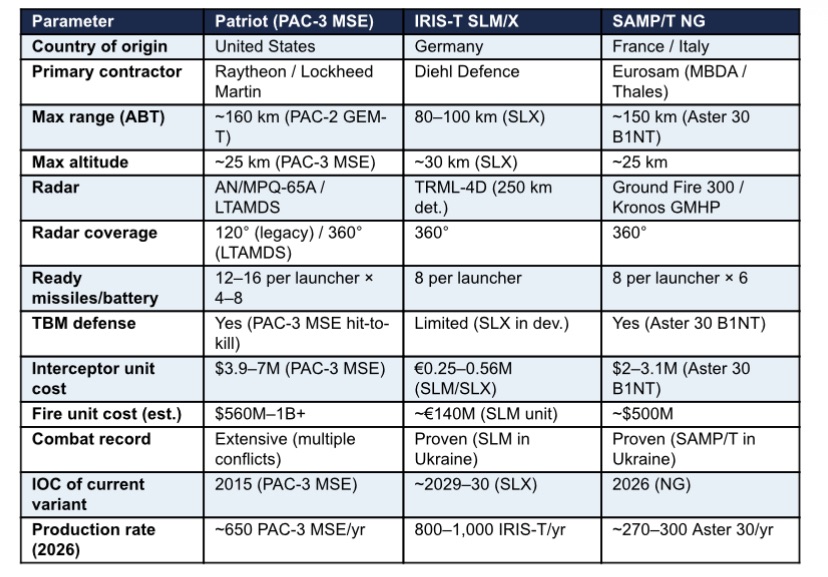
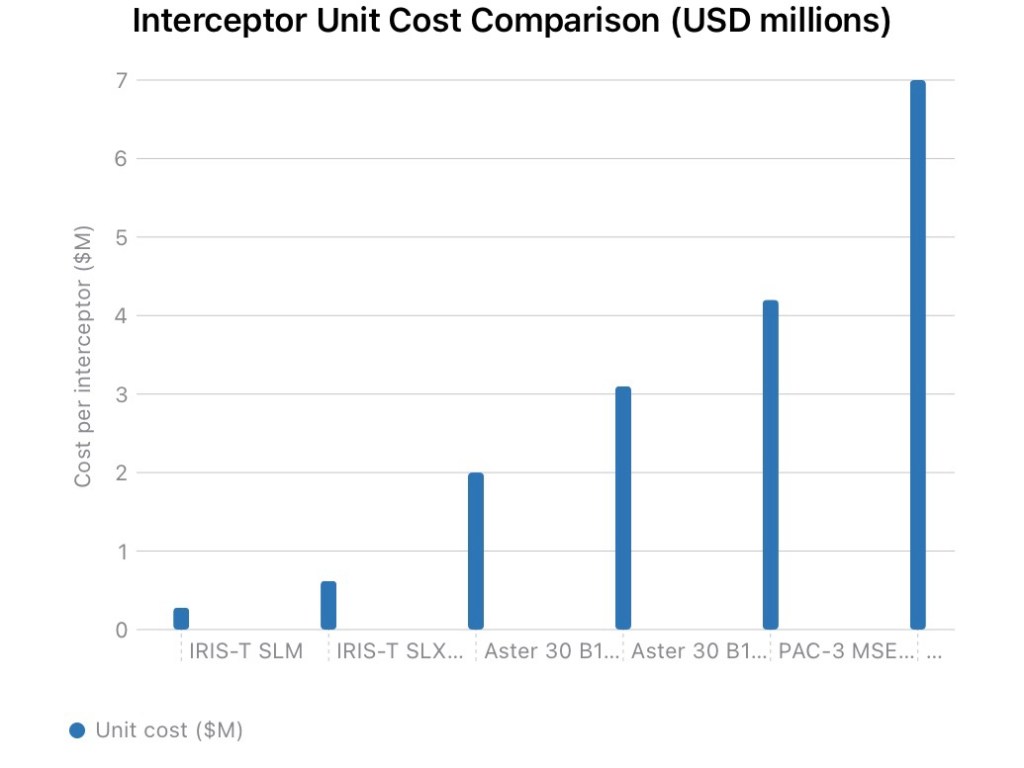
But the system’s dominance is now inseparable from its constraints. The PAC-3 MSE interceptor costs the U.S. Army approximately $3.9–4.2 million per unit at production scale, rising to $6.25–7 million per missile in export configurations that include storage canisters, warranty, and logistics packages. A fully equipped Patriot battery with four launchers and a standard missile loadout can reach $560 million in acquisition cost; comprehensive packages including long-term support, training, and integration routinely exceed $1 billion. Poland’s Phase I purchase—four radars, 16 launchers, and 219 PAC-3 MSE missiles—cost $4.75 billion.
The production pipeline, while expanding, is strained beyond precedent. Lockheed Martin received a $9.8 billion contract in September 2025 for 1,970 PAC-3 MSE interceptors—the largest order in the company’s Missiles and Fire Control history—covering fiscal years 2024 through 2026. Annual production has scaled from roughly 250 missiles to approximately 650 by 2025, with targets of over 1,100 by 2027 and 1,470 by 2029. But these numbers must be set against demand. U.S. Army interceptor supplies fell to approximately 25 percent of Pentagon-required levels by mid-2025, following large-scale donations to Ukraine and sustained combat expenditure. The Iran campaign has accelerated this crisis dramatically.
The Pentagon is reportedly days away from having to prioritize which targets to intercept—a statement that would have been unthinkable twelve months ago.
The delivery queue is the most immediate problem for new European customers. Switzerland, which ordered five Patriot fire units as the cornerstone of its Air2030 modernization program, was informed in early 2026 that deliveries would be delayed by four to five years due to U.S. reprioritization of production for Ukraine. The Swiss government has responded by instructing its defense ministry to evaluate a second long-range system, preferably European-produced. Norway, which has not yet selected a system for its ballistic missile defense requirement under the 2025–2036 Long-Term Defence Plan, would enter this same queue.
There is, however, a significant modernization underway. The Lower Tier Air and Missile Defense Sensor (LTAMDS) is replacing the legacy AN/MPQ-65 radar, delivering 360-degree coverage with more than double the transmit power in a similar footprint. LTAMDS achieved Milestone C in 2025 and is ramping production at eight radars per year, with plans to scale to twelve annually. Poland is the first export customer, incorporating twelve LTAMDS radars into a Phase II contract valued at up to $15 billion. The U.S. Army also confirmed plans in December 2025 to develop a new Patriot variant with a native 360-degree targeting capability—an implicit acknowledgment that the system’s legacy sector-limited architecture is a competitive liability.
The system’s radar limitation matters for Norwegian geography. Legacy Patriot batteries require repositioning or multiple overlapping deployments to cover threats arriving from different azimuths—a significant operational constraint in a country where ballistic missiles could arrive from multiple vectors across a 2,500-kilometer coastline. LTAMDS addresses this, but the timeline for widespread LTAMDS deployment among export customers remains uncertain. A Financial Times investigation in October 2025 reported that Ukrainian Patriot intercept rates against modified Russian Iskander missiles dropped sharply as Russia adapted terminal-phase maneuver profiles. French Army assessments indicated that SAMP/T outperformed Patriot against these modified Iskander variants—a data point that, while contested, has influenced European procurement discussions.
IRIS-T SLM/X: The Scalable Challenger
The IRIS-T SLM has been the air defense success story of the Ukraine war. Deployed to Ukraine from late 2022, the system has demonstrated near-perfect intercept rates against cruise missiles and one-way attack drones, establishing a combat record that has driven orders from across Europe and beyond. Diehl Defence is scaling production from roughly 500–600 interceptors per year to 800–1,000 by 2026, with investments of €1.5 billion to reach a capacity of 2,000 missiles per year. Ten complete SLM fire units are expected in 2026, rising to sixteen by 2028.
The SLM/X configuration, unveiled at Enforce Tac 2026 on February 24, represents Diehl’s bid to push the IRIS-T family into territory traditionally reserved for Patriot and SAMP/T. The concept is architecturally elegant: a single eight-canister launcher that can fire both SLM medium-range interceptors and the new SLX long-range variant in any combination. The SLX uses a dual-mode seeker—infrared and radio frequency—and a dual-pulse rocket motor to extend engagement range to approximately 80 km and altitude coverage to 30 km, without requiring new fire control systems, radars, or command infrastructure beyond what is already fielded for SLM. A force can tailor its launcher loads to the threat environment—four SLM and four SLX, seven of one and one of the other—using a single tactical operations center and radar input.
The cost advantage is substantial. An IRIS-T SLM fire unit, including radar, command post, and launchers, costs approximately €140 million. Individual missile costs range from €250,000 to €560,000 depending on variant and customer. Even at the upper end, an SLX interceptor would cost roughly one-seventh to one-tenth of a PAC-3 MSE. For a country defending against saturation attacks where interceptor economics determine sustainability, this ratio matters enormously.
But the system has clear limitations that must be honestly assessed. First, the SLX does not yet exist as a fielded weapon. The concept was demonstrated at Enforce Tac 2026, and reporting suggests a concept demonstration is possible around 2029, with operational availability in 2029–2030. For any procurement decision made today, the SLM’s 40 km range and 20 km altitude ceiling define the system’s actual capability—not the SLX’s projected performance.
The IRIS-T SLM/X is a compelling medium-range system expanding upward. It is not a long-range ballistic missile defense system expanding downward. The distinction matters.
Second, and more fundamentally, the IRIS-T family’s ballistic missile defense capability is limited by physics. The SLM operates at altitudes up to 20 km; the SLX will reach approximately 30 km. A short-range ballistic missile like the Iskander reenters at terminal velocities exceeding Mach 5–6, descending from apogees of 50 km or higher, with terminal-phase maneuver capability. Intercepting such a target requires engagement at altitudes and closure rates that are at the outer edge—or beyond—what the IRIS-T SLX is designed for. The system can likely engage quasi-ballistic threats and shorter-range rockets, but it is not a substitute for a dedicated TBM defense system against Iskander-class threats. Diehl’s own roadmap acknowledges this gap: the IRIS-T HYDEF variant, explicitly designed for hypersonic and ballistic missile defense with engagement ranges up to 100 km and altitude coverage up to 50 km, is a separate development program under the European Defence Fund.
Third, the “100 km range” figure associated with the SLM/X requires scrutiny. Defense Express noted that the 100 km figure refers to the distance from the command post to the target, not the missile’s flight range. The launcher can be positioned up to 20 km from the command post, yielding 80 km of missile range plus 20 km of command-post offset. The missile itself reaches 80 km. This is not deceptive—it reflects how distributed architectures actually operate—but it should not be compared directly with the 150 km engagement range of an Aster 30 B1NT or the 160+ km range of a PAC-2 GEM-T.
Where does this leave IRIS-T SLM/X for a country like Norway? It is an excellent medium-range layer—arguably the best available in its class for cost-effectiveness, production scalability, and proven combat performance against air-breathing threats. It would complement NASAMS effectively, extending the defended area and adding a higher-altitude capability. But it does not close Norway’s ballistic missile defense gap. The LTDP’s requirement to “procure a long-range air defence system in order to protect one geographical area against tactical ballistic missiles” demands a system that can reliably intercept Iskander-class threats at terminal altitudes. IRIS-T SLM/X, in its current and near-term configurations, is not that system.
SAMP/T NG: Europe’s Strategic Answer
The SAMP/T NG is the system that European defense planners designed specifically for the mission that Patriot currently dominates: long-range air and missile defense with a dedicated anti-tactical ballistic missile capability. It is also the system that most directly challenges Patriot’s dominance in the European market—not by matching it feature for feature, but by offering an alternative supply chain, a purpose-built European industrial base, and a 360-degree engagement architecture that Patriot is only now retrofitting.
The technical foundation is the Aster 30 Block 1NT interceptor, which replaces the Block 1 missile in the legacy SAMP/T. The B1NT features a new Ka-band active radar seeker (replacing the Ku-band seeker of the Block 1), upgraded guidance algorithms, and MBDA’s PIF-PAF control system that combines aerodynamic surfaces with lateral thrusters for extreme terminal agility. The missile weighs approximately 450 kg, measures 4.9 meters in length, and reaches speeds of Mach 4.5. Eurosam states engagement ranges beyond 150 km against air-breathing targets and the ability to intercept maneuvering ballistic missiles launched from ranges exceeding 600 km in autonomous mode—placing it squarely in the Iskander-class threat envelope.
The radar is where SAMP/T NG makes its strongest competitive argument. France’s Thales Ground Fire 300 and Italy’s Leonardo Kronos Grand Mobile High Power are both GaN-based AESA radars providing native 360-degree azimuth coverage and 90-degree elevation. Ground Fire delivers air surveillance out to 400 km, tracks over 1,000 targets simultaneously, and refreshes at one revolution per second in rotating mode or up to ten updates per second in staring mode. This is a generation ahead of the legacy AN/MPQ-65 Patriot radar and competitive with LTAMDS, with the advantage of being fielded now rather than in the early stages of production ramp.
A SAMP/T NG battery scales up to six vertical launchers, each carrying eight Aster 30 missiles, for up to 48 ready-to-fire interceptors per battery. The system deploys in under 30 minutes, supports shoot-and-scoot operations, and integrates with NATO’s Integrated Air and Missile Defence architecture via Link-16 and satellite communications. Interoperability with Patriot, NASAMS, and Aegis Ashore is a design requirement, not an afterthought.
The combat record is real but still thin. Legacy SAMP/T systems have been deployed to Ukraine since 2023, with up to three batteries now operational. A Ukrainian SAMP/T battery intercepted a Russian combat aircraft at approximately 90-mile range in March 2025. French Army assessments have credited SAMP/T with outperforming Patriot against modified Iskander flight profiles—though the Wall Street Journal and other analysts have also reported that SAMP/T initially struggled with software-related issues in Ukraine, and that Aster 30 interceptors have at times underperformed relative to PAC-3 in many-on-one ballistic missile engagement scenarios.
The cost structure is the critical differentiator. The Aster 30 B1NT interceptor costs an estimated $2.0–3.1 million per unit—roughly half to two-thirds the cost of a PAC-3 MSE at production scale, and potentially one-third the cost at export pricing. A SAMP/T battery is estimated at approximately $500 million, compared to $560 million to over $1 billion for a comparable Patriot configuration. Singapore’s 2013 order for two batteries and 200 missiles was valued at €651 million, though the NG configuration will be priced differently.
Production is the system’s most significant constraint. MBDA has dramatically scaled Aster output—from a baseline of roughly 220–240 missiles per year (across all variants) before 2022, through a ramp that delivered five times the originally planned output in 2025. The stated objective is over 300 Aster missiles per year by 2028, with Aster 30 variants (B1 and B1NT) likely accounting for 230–300 interceptors annually by 2026. Production lead times have been reduced from 42 months per missile in 2022 to approximately 30 months currently, with a target of 18 months by 2026. MBDA plans to invest €2.4 billion between 2025 and 2029 to expand production facilities, including robotic machining and expanded factory capacity. But the production base remains fundamentally constrained by a Franco-Italian-British supply chain that requires missiles to be transported multiple times across the Alps between facilities—a geography of production that shareholders have declined to consolidate.
The customer pipeline is accelerating rapidly. France has ordered eight SAMP/T NG systems under its 2024–2030 military programming law, with the first expected to enter service in 2026. Italy is receiving its first systems for operational evaluation in early 2026. Denmark ordered SAMP/T NG in September 2025. Belgium, Croatia, Estonia, Greece, and Romania are evaluating the system. Around ten countries may ultimately purchase SAMP/T NG. President Macron has committed to deploying the first SAMP/T NG systems to Ukraine ahead of French and Italian forces.
The Norwegian Question
Norway’s air defense posture is defined by a deliberate dual-track strategy. The first track—NASAMS expansion—is funded, contracted, and underway. Four new NASAMS batteries have been ordered from Kongsberg for delivery starting in 2027, valued at approximately NOK 4.8 billion. This is a system Norway co-developed, operates intimately, and has validated in combat through Ukraine’s approximately 900 successful interceptions with a reported 94 percent effectiveness rate against cruise missiles and Shahed-type drones. NASAMS is the backbone, and it is secure.
The second track—long-range air defense against tactical ballistic missiles—is the open question. The Long-Term Defence Plan commits the government to “procure a long-range air defence system in order to protect one geographical area against tactical ballistic missiles.” As of March 2026, no system has been selected. No competition timeline has been publicly stated. No budget envelope has been disclosed. The contrast with Norway’s precision fires program—parliamentary vote on January 16, 2026, Chunmoo contract signed two weeks later—is evident in the pace.
What does the comparison reveal for this requirement?
Patriot: Capable but Constrained
Patriot with PAC-3 MSE is the most proven system for the specific mission Norway needs: terminal interception of Iskander-class ballistic missiles. It is the only system in the comparison with extensive combat data against ballistic targets across multiple theaters. But Norway would enter the back of a delivery queue that now stretches years, compete for interceptors against the U.S. military’s own wartime consumption, and depend on a supply chain whose priorities are demonstrably elsewhere. The cost is the highest of the three options, and the legacy radar limitation—absent LTAMDS, which adds further cost and schedule uncertainty—is a genuine operational concern for Norway’s multi-axis threat environment.
IRIS-T SLM/X: Wrong Mission, Right Layer
IRIS-T SLM/X is the most cost-effective and production-scalable system in the comparison. It has a proven combat record against air-breathing threats and would integrate naturally into a NASAMS-centric architecture. But it does not meet the LTDP’s stated requirement for TBM defense. The SLX variant is years from operational availability, and even at maturity, its engagement envelope does not cover the Iskander-class threat with the confidence required for a national-level defensive commitment. IRIS-T SLM/X should absolutely be part of Norway’s air defense discussion—as a complementary medium-range layer, not as the answer to the ballistic missile gap.
SAMP/T NG: The European Alternative
SAMP/T NG is the only European system that directly competes with Patriot for Norway’s TBM defense mission. It offers ballistic missile defense against Iskander-class threats, 360-degree radar coverage as a baseline, a European supply chain under European control, a lower interceptor cost, and growing political momentum across NATO. Its combat record is thinner than Patriot’s, its production base is more constrained, and early-deployment challenges in Ukraine have raised legitimate questions about software maturity against modified ballistic missile profiles. But the system is entering service now, the customer pipeline is growing, and the industrial trajectory is upward.
The Strategic Dimension: Supply Chain Sovereignty
The Iran campaign has transformed the air defense procurement debate from a technical comparison into a strategic one. When the United States pulls THAAD components from South Korea and Patriot interceptors from the Indo-Pacific to sustain operations in a theater where Norway has no direct stake, the implications for a small allied nation at the end of the supply chain are concrete, not hypothetical.
EU Defence Commissioner Kubilius’s “missile tour” of European capitals in March 2026, explicitly calling for urgent European missile production capacity, reflects a political consensus that did not exist two years ago. The EU’s €800+ billion defense spending plan requires that 55 percent of all weapons purchases come from European or Ukrainian manufacturers by 2030. Germany’s own procurement plans show only 8 percent of 154 major defense purchases going to U.S. suppliers—a dramatic shift. The European Defence Fund is allocating €168 million in 2026 specifically for hypersonic counters and high-end endo-atmospheric interception. The direction of travel is clear.
Norway occupies a distinctive position in this landscape. It is a NATO founder and long-standing U.S. ally. It co-developed NASAMS—one of the most successful Western air defense systems in active service. Kongsberg is one of Europe’s largest missile producers, and Nammo supplies rocket motors for multiple European interceptor programs. Norway has industrial equities in the European defense ecosystem that a purely American procurement would not leverage. At the same time, Norway did not sign the European Sky Shield Initiative MOU—the German-led framework that has become the primary vehicle for coordinated European air defense procurement. Finland selected David’s Sling from Israel. Sweden is procuring IRIS-T SLM. Denmark chose SAMP/T NG. Norway’s Nordic neighbors have all made their choices. Oslo has not.
The question is no longer which system performs best in a vacuum. It is which system a European nation can actually acquire, sustain, and replenish when the interceptors are needed most.
Conclusion
There is no single correct answer to Europe’s long-range air defense procurement question in 2026. The correct answer depends on what problem a nation is trying to solve, how quickly it needs a solution, and how much strategic risk it is willing to accept on supply chain dependency.
For dedicated ballistic missile defense against Iskander-class threats with the deepest available combat validation, Patriot with PAC-3 MSE remains the reference system—if you can get it, if you can afford it, and if you can accept the dependency on a supply chain that is currently prioritizing a different war.
For cost-effective, high-volume air defense against cruise missiles, drones, and air-breathing threats with the most scalable production base in Europe, IRIS-T SLM/X is the strongest option available—and will become stronger as the SLX matures. But it is not a TBM defense system, and should not be evaluated as one.
For a European-produced system that combines long-range air defense with dedicated ballistic missile defense capability, 360-degree radar coverage, and a supply chain under European industrial sovereignty, SAMP/T NG is the emerging answer. Its maturity is lower than Patriot’s, its production base is tighter, and its combat record against ballistic missiles is still being written. But it is the system that the European defense industrial trajectory is building toward, and the system that the political consensus is coalescing around.
Norway’s LTDP committed to closing the ballistic missile defense gap. The Chunmoo contract demonstrated that Oslo can move decisively when the requirement is clear and the political will exists. The air defense question is harder—technically, industrially, and strategically. But the longer the decision is deferred, the longer the queue grows, and the wider the gap remains. The interceptors being consumed over the Persian Gulf today are the same interceptors Norway would need to defend Bodø or Ørland tomorrow. That arithmetic does not improve with time.
AI-written article

