
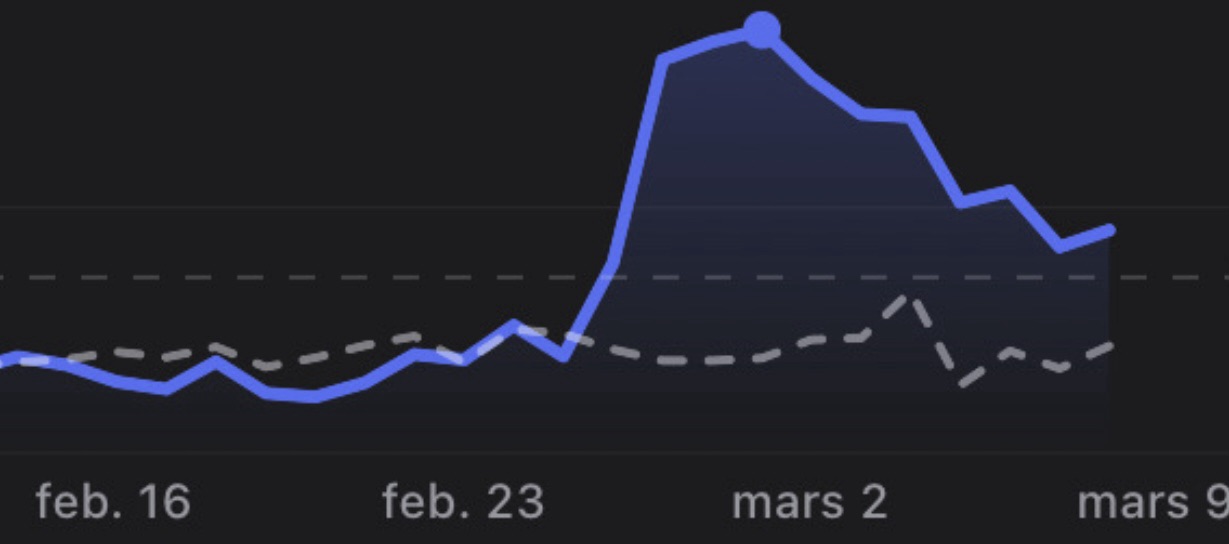
Web traffic data from the past few weeks tells an interesting story.
In the days around March 1–3, traffic on this site spiked sharply. Readership reached several multiples of the baseline — a peak not driven by a major policy announcement, a leaked defense budget, or a parliamentary debate. What happened was that the United States escalated its military campaign against Iran.
Operation Epic Fury, launched in February 2026, is the direct cause. When American airpower and naval forces begin systematically engaging Iranian targets, and when Iranian ballistic missiles and drones engage in return, public interest in air and missile defense rises — not just among specialists, but broadly.
That breadth is worth examining.
What traffic actually measures
Web analytics are a blunt instrument. They do not distinguish between a defense analyst seeking a technical update, a journalist looking for background, a policy staffer preparing a brief, and a curious reader who followed a link from social media. But that imprecision is precisely what makes the pattern meaningful: it is wide.
The graph does not show a narrow professional community reacting to an internal document. It shows a general pulse. When the threshold for searching “air defense” or “missile defense” drops for a large number of people, it is because something in the news environment has made the topic feel relevant — not just to experts, but to ordinary citizens trying to make sense of what is happening.
That is the canary effect the headline refers to. Public interest in air defense is not merely a byproduct of geopolitical events. It is an early signal that the threat perception of a broad population is shifting.
From abstract to concrete
For much of the post-Cold War period, air and missile defense was a technical niche. Patriot was something the Americans deployed in the Gulf. THAAD was a talking point in congressional testimony. The concepts appeared in defense budget documents and specialist journals, but carried little emotional weight outside the community.
That has been changing since 2022, and the pace is accelerating. Ukraine made air defense visual and legible in a way that no volume of policy papers could. Images of Patriot batteries in Kyiv, live coverage of intercepts over Tel Aviv, and now: daily reporting from an active theater in the Middle East where interceptor expenditure rates are measurable, public, and debated in the open press.
People across the West are beginning to understand things that were previously confined to defense circles: that a missile defense system is something that gets used up, that production capacity is a genuine constraint, that an interceptor that costs orders of magnitude more than the drone it destroys represents a structural problem with no easy solution. The stockpile depletion debate — once the exclusive concern of acquisition officials and defense economists — is now something a general reader can follow and form views on.
That is a significant shift in the cognitive baseline of Western publics.
What it means for policy
Defense investment decisions in democratic societies are, in the long run, shaped by what publics are willing to support. The political economy of air defense has for decades been unfavorable: the threat was diffuse, the systems were expensive and opaque, and the constituency for sustained investment was narrow.
When general public interest in air and missile defense rises — not to crisis-level panic, but to a durable, higher baseline — the political incentives change. Journalists ask more specific questions. Legislators hear from constituents who have actually followed the debate. Ministers can no longer assume that the public will stop paying attention as soon as the news cycle moves on.
This creates an opening. Governments across NATO have struggled to communicate why air defense investment requires long-term commitment rather than reactive procurement. An informed public is not a sufficient condition for better decisions, but it is increasingly a necessary one. Public pressure, correctly directed, can break through the bureaucratic inertia that has left allied inventories dangerously thin.
The traffic always falls back
An honest reading of the data requires acknowledging the obvious: after the spike of March 2–3, numbers declined again. They always do. News-driven interest is episodic. Sustained public engagement with a technically complex field requires more than one dramatic week in the Middle East.
But the baseline appears to be tracking higher than it did a year ago. If that holds — and a few weeks of data are not enough to conclude — it represents a structural change, not a noise event.
The canary effect does not mean the birds are always singing. It means that when they go silent, something is wrong — and that the fact people have started listening at all is itself a signal worth tracking.

