
The Western World’s Backbone Air Defense at a Crossroads
Patriot PAC-3 MSE interceptors cost $4.2 million per unit based on the FY2025 Army budget request, positioning the system as the most widely deployed — and currently most strained — missile defense platform in the Western arsenal. This pricing reflects four decades of continuous development from a Cold War aircraft killer into a combat-proven ballistic missile interceptor. Sustained combat consumption in Ukraine and the Middle East, combined with record international demand, has exposed the gap between what Patriot can do and how fast the industrial base can replace what it shoots. The system’s follow-on upgrade — the LTAMDS radar — is now entering production at $125–130 million per unit, promising to fundamentally transform what Patriot sees and tracks even as the interceptor inventory runs thin.
Patriot’s strategic value lies in its ubiquity and interoperability. With 18 operator nations and a combat record spanning four decades, it forms the connective tissue of Western integrated air and missile defense. No other system matches its combination of proven performance, allied interoperability, and global supply chain depth — though that depth is now being tested as never before.
Current cost structure reveals a system under pressure
Patriot PAC-3 MSE interceptors cost $4.2 million each based on FY2025 Army budget documentation, though export pricing and full-support packages frequently reach $6.25–7 million per unit when storage canisters, warranty provisions, and logistics are included. Army batch procurement under the FY2024–2026 Multiyear Procurement contract, covering a minimum of 692 missiles, yields estimated savings of approximately $79.9 million compared to three separate annual contracts. Total program acquisition unit cost declined 4.33 percent from FY2018 to FY2024 as production scaled from roughly 250 to over 500 missiles annually.
PAC-2 GEM-T interceptors cost approximately $4 million each, providing blast-fragmentation engagement capability against aircraft and cruise missiles at ranges up to 70 kilometers. A NATO consortium of Germany, Romania, Spain, and the Netherlands signed a $5.5 billion joint procurement for up to 1,000 GEM-T missiles in 2024, with production partially shifting to a new MBDA plant in Schrobenhausen, Germany.
A complete Patriot battery — typically comprising one AN/MPQ-65 radar, an engagement control station, four to eight launchers, and a missile load of 24 PAC-3 MSE and 8 GEM-T — carries an acquisition cost ranging from $560 million for hardware and missiles alone to over $1 billion for fully supported configurations including training, spares, and integration.
Poland’s Phase I contract for four batteries, 16 launchers, and 219 PAC-3 MSE missiles totaled $4.75 billion.
Sweden’s four-battery procurement including 12 launchers, 100 GEM-T, and 200 PAC-3 missiles came to approximately $3.2 billion.
The LTAMDS radar, Patriot’s next-generation sensor replacement, currently costs $125–130 million per unit at initial production rates — compared to $110–115 million for the legacy AN/MPQ-65 it replaces. With total program value reaching $3.8 billion following a $1.7 billion contract modification awarded to Raytheon in August 2025, and 94 radars planned across the program’s life, unit costs are expected to decline as production scales from eight to twelve units annually.
Combat consumption is redefining the affordability question
Patriot’s combat record is extensive but increasingly contested. The system successfully intercepted Iraqi Scud missiles in 1991 and 2003, has engaged hundreds of Houthi ballistic missiles over Saudi Arabia and the UAE, and has been Ukraine’s primary defense against Russian cruise and ballistic missile strikes since 2022. However, the sheer volume of consumption is straining inventories across the alliance.
U.S. Army interceptor supplies fell to approximately 25 percent of Pentagon-required levels by mid-2025, following large-scale donations to Ukraine and sustained combat expenditure. The cost dimension is equally significant: burning through PAC-3 MSE interceptors at $4–7 million each against threats that may cost a fraction of that price has become one of the central strategic challenges of modern missile defense economics.
Performance against evolving threats has also come under scrutiny. A Financial Times investigation in October 2025 reported that Ukrainian Patriot intercept rates against modified Russian Iskander missiles dropped sharply as Russia adapted terminal-phase maneuver profiles specifically to exploit the system’s limitations. SAMP/T systems, according to French Army assessments, outperformed Patriot against these modified Iskander profiles. Russia reportedly introduced dedicated countermeasures targeting Patriot’s engagement envelope in spring 2025. These developments prompted the U.S. Army to announce in December 2025 a new Patriot development program — the first truly fundamental upgrade since the system entered service in 1981 — incorporating 360-degree targeting capability.
Against the Houthi and Iranian threat sets, however, Patriot has demonstrated strong performance across thousands of engagements, validating its core capability envelope against conventional ballistic missiles and cruise missiles.
LTAMDS transforms what Patriot sees — without replacing what it shoots
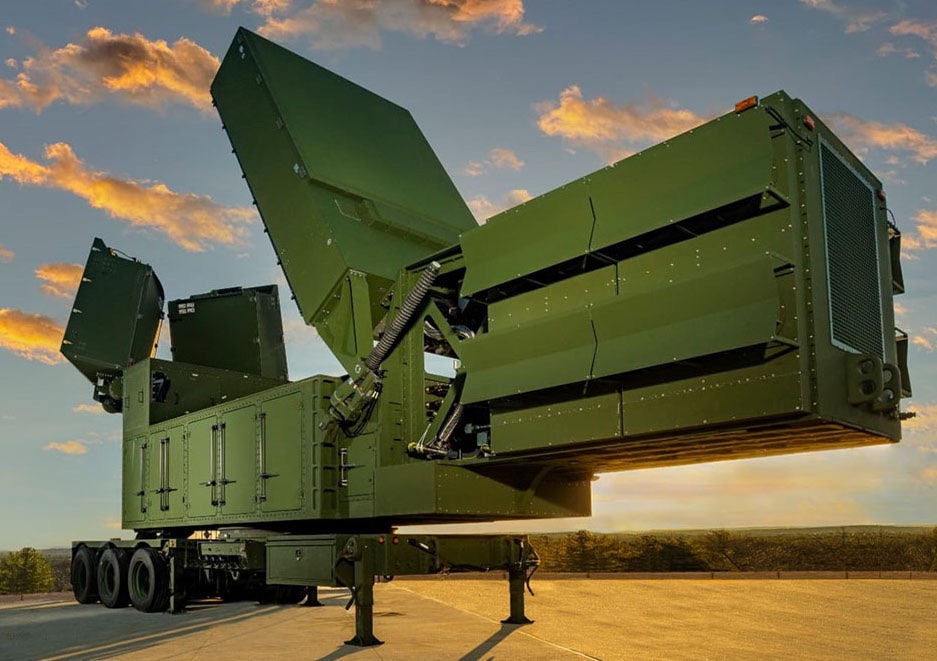
The Lower Tier Air and Missile Defense Sensor (LTAMDS) addresses Patriot’s most significant structural weakness: its legacy single-face phased array radar, the AN/MPQ-53/65, which provides only limited-sector coverage and requires reorientation to address multi-azimuth threats. LTAMDS replaces this with three active electronically scanned array antennas — one large primary array and two secondary arrays — delivering genuine 360-degree simultaneous detection, tracking, and fire control.
Capability improvements are substantial. Army program leadership describes LTAMDS as doubling legacy Patriot radar capability while eliminating the sector-coverage gap that adversaries have increasingly sought to exploit through simultaneous multi-azimuth attacks. The primary array delivers more than twice the transmit power of the AN/MPQ-65 despite occupying a similar footprint. A live-fire test in February 2025 successfully detected and tracked a high-speed cruise missile and guided a PAC-2 GEM-T interceptor to intercept. LTAMDS achieved Milestone C in 2025, formally entering the production and deployment phase.
Production is ramping deliberately. Raytheon has delivered the first six production-representative units and is currently producing eight radars per year, with plans to scale to twelve annually. The Army plans 94 radars total, with Poland as the first foreign customer — incorporating 12 LTAMDS radars into its national air defense as part of a Phase II contract that received State Department approval for up to $15 billion, encompassing six batteries, 644 PAC-3 MSE missiles, and 15 years of depot support. Over a dozen additional nations have requested pricing and availability information.
The 40-month production lead time is LTAMDS’s most significant operational constraint. The Army, working with Boston Consulting Group on supply chain optimization, is targeting a 36-month objective production cycle — critical given that battle-damaged or operationally degraded radar sets cannot be quickly replaced at current throughput.
IBCS extends Patriot’s strategic reach beyond battery boundaries
The Integrated Battle Command System (IBCS), developed by Northrop Grumman and already fielded across U.S. Army Patriot units, transforms Patriot from a battery-centric system into a networked fire control node. IBCS enables Patriot launchers to fire on tracks developed by other sensors — including NASAMS radars, Sentinel, G/ATOR, and even naval systems like the AN/SPY-6 — and allows Patriot’s own LTAMDS tracks to cue other effectors. Countries integrating IBCS pay approximately $65 million to network each launcher and radar set.
This interoperability dimension is central to how major customers are now structuring procurement. Denmark’s August 2025 State Department approval for an IBCS-enabled Patriot PAC-3 MSE package, valued at up to $8.5 billion, reflects the growing premium customers are willing to pay not just for missiles and radars but for deep integration into the NATO-wide air picture.
International sales demonstrate the system’s irreplaceable role — and its constraints
Patriot is by far the most widely procured Western long-range air defense system, with 18 operator nations and production contracts totaling tens of billions of dollars across the current decade alone.
Major recent procurements include Romania’s additional system at $280 million (April 2025), Kuwait’s $425 million upgrade package (April 2025) and Poland’s Phase II approval for up to $15 billion.
The system’s supply chain limitations are now a strategic variable in their own right. Production of PAC-3 MSE interceptors has scaled from approximately 250 annually in 2022 to over 600 in 2024, with Lockheed Martin’s Camden, Arkansas facility expanded to support further growth. Yet with six to eight nations simultaneously requesting additional missiles, U.S. Army inventories at historically low levels, and Ukraine consuming systems at wartime rates, the gap between demand and production capacity is a structural constraint on NATO defense planning that no price point can quickly resolve.
Twenty-year lifecycle costs for a complete Patriot battalion of four to six batteries, including operations, sustainment, software refreshes, LTAMDS integration, and interceptor replenishment, range from $2 to $3 billion — a figure that scales significantly in high-intensity conflict scenarios where interceptor consumption drives total cost of ownership far above peacetime sustainment baselines.
Strategic position: essential, combat-proven, and under modernization pressure
Patriot occupies a position in Western air defense that no available alternative can replicate at comparable scale. Its combination of combat history, operator familiarity, allied interoperability, and global supply chain makes it the default choice for nations seeking to anchor a credible long-range air and missile defense capability. LTAMDS and IBCS together represent the most significant capability step-change since the introduction of PAC-3, addressing the sensor and network limitations that adversaries have systematically learned to exploit.
The central strategic challenge is not whether Patriot remains relevant — it clearly does — but whether Western industrial capacity can produce interceptors at the rate that modern high-intensity conflict consumes them, and whether the $4–7 million per-shot cost of PAC-3 MSE is sustainable against adversaries willing to fire ballistic missiles at $500,000 apiece in saturation quantities. The December 2025 announcement of a next-generation Patriot interceptor program, and the MDA’s concurrent push for a sub-$750,000 endoatmospheric interceptor, signal that the U.S. Army has registered this cost-exchange challenge — and that the Patriot family’s evolution is far from complete.
AI-assisted article.

