
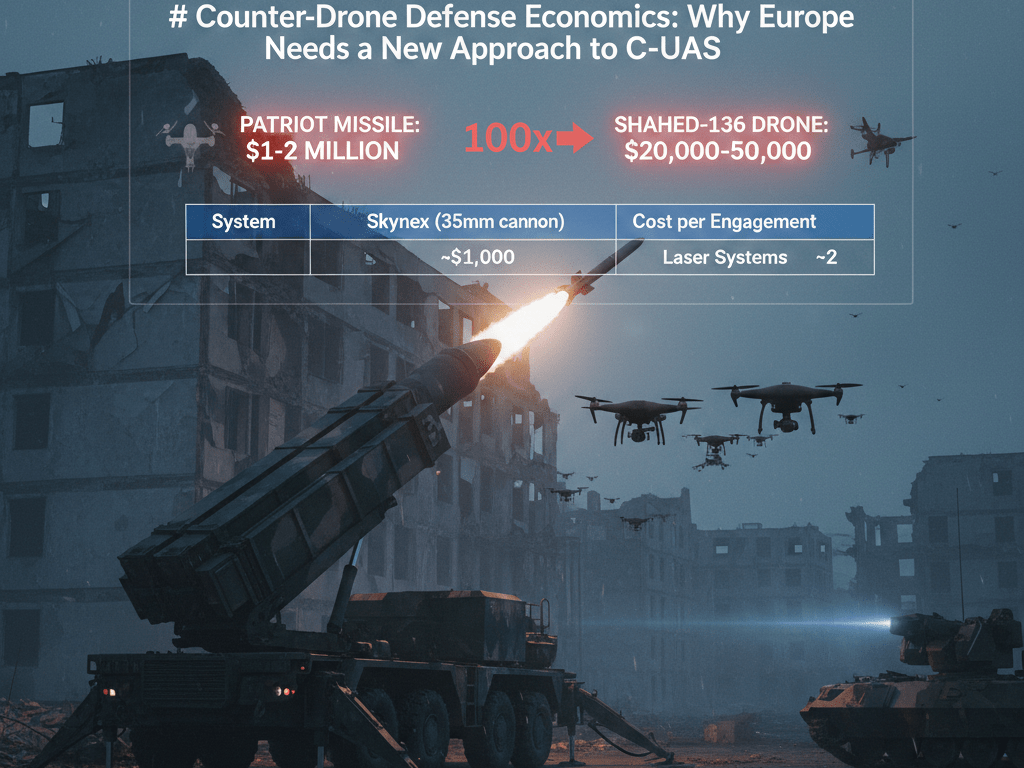
The proliferation of cheap drones has broken the traditional air defense cost model. Europe’s response so far has been fragmented and inadequate. This analysis examines the C-UAS challenge, surveys available solutions, and asks what a coherent European—and Norwegian—approach might look like.
The $3 Million Problem
In March 2024, a Patriot battery in Ukraine engaged a Russian Shahed-136 drone. The intercept was successful. The math was not.
The Shahed costs Iran approximately $20,000-50,000 to produce. The PAC-2 GEM-T missile that destroyed it costs $1-2 million. Even using the most conservative estimates, the defender spent 20-100 times more than the attacker.
This is not an edge case. It is the new normal.
Ukraine fires an estimated 10,000+ air defense missiles annually. If even 20% of engagements involve this kind of cost asymmetry, the economic sustainability of traditional air defense becomes questionable within years, not decades.
The Houthis demonstrated the same principle against the US Navy in the Red Sea throughout 2024. USS Carney and other destroyers expended SM-2 missiles ($2.1 million each) and Evolved Sea Sparrow Missiles ($1.65 million) against drone swarms costing a fraction of the defensive response. The USS Dwight D. Eisenhower carrier strike group reportedly fired over 500 munitions in a six-month deployment—a significant portion of which were expensive missiles engaging cheap threats.
This cost inversion represents a fundamental challenge to how NATO nations have structured air defense for decades. The traditional model assumed expensive platforms (aircraft, cruise missiles) as primary threats, justifying expensive interceptors. Drones have collapsed that assumption.
Defining the C-UAS Challenge
Counter-Unmanned Aerial Systems (C-UAS) encompasses technologies designed to detect, track, identify, and neutralize drone threats. The challenge is not singular—it spans a threat spectrum that demands different solutions at different price points.
The Drone Threat Taxonomy
NATO categorizes UAS by size and capability:
| Group | Weight | Example | Typical Cost | Threat Profile |
|---|---|---|---|---|
| Group 1 | <9 kg | DJI Mavic, FPV drones | $500-5,000 | Reconnaissance, grenade delivery |
| Group 2 | 9-25 kg | Commercial/military small UAS | $5,000-50,000 | ISR, small munitions |
| Group 3 | 25-600 kg | Shahed-136, Bayraktar TB2 | $20,000-5M | Strike, persistent ISR |
| Group 4 | >600 kg | MQ-9 Reaper class | $10M+ | Strategic ISR, precision strike |
Traditional air defense systems (Patriot, SAMP/T, NASAMS) were designed primarily for Group 4 threats and aircraft. They can engage Group 3 drones but at economically unsustainable cost ratios. For Groups 1-2, they are largely ineffective—these targets are too small, too slow, and too cheap to justify engagement.
The C-UAS problem is therefore not about capability but about economics: how do you defend against threats that cost 1/100th to 1/1000th of your interceptors?
Why Traditional Air Defense Struggles
| Factor | Traditional GBAD | C-UAS Requirement |
|---|---|---|
| Target RCS | >1 m² (aircraft) | 0.001-0.1 m² (small drones) |
| Target speed | 200-3,000 km/h | 50-200 km/h |
| Target altitude | 100-30,000 m | 0-500 m (often) |
| Engagement cost | $500K-5M acceptable | Must be <$100K, ideally <$10K |
| Magazine depth | 4-16 missiles per launcher | Potentially hundreds of engagements per day |
| Detection range | Optimized for high/fast | Struggles with low/slow/small |
NASAMS and IRIS-T SLM can engage larger drones effectively, but using a $400,000-1.5 million missile against a $20,000 Shahed still represents a 20:1 cost disadvantage. Against a $500 FPV drone, the ratio becomes absurd.
The C-UAS Solution Landscape
The market has responded to the drone threat with a proliferation of counter-drone technologies. These fall into several categories, each with distinct cost profiles and effectiveness characteristics.
Detection and Tracking Systems
Before you can defeat a drone, you must find it. Detection technologies include:
Radar Systems
- Traditional air defense radars often lack sensitivity for small UAS
- Specialized C-UAS radars (like Raytheon’s KuRFS) optimize for low-RCS targets
- Cost: $5-50 million depending on capability
- Limitation: Struggle with ground clutter in complex terrain
RF Detection
- Passive systems that detect drone-to-controller communications
- Can identify drone type and locate both drone and operator
- Cost: $100K-2M per system
- Limitation: Ineffective against autonomous drones with no RF emissions
Electro-Optical/Infrared
- Cameras and thermal sensors for visual detection and tracking
- Effective for final engagement cueing
- Cost: $50K-500K per system
- Limitation: Weather-dependent, limited range
Acoustic Sensors
- Detect drone motor/propeller signatures
- Low cost, passive operation
- Cost: $10K-100K per sensor
- Limitation: Very short range, environmental noise interference
Effective C-UAS requires sensor fusion—combining multiple detection methods to overcome individual limitations. This integration challenge is often more difficult than the individual sensor technologies.
Soft-Kill Effectors (Non-Kinetic)
Non-kinetic solutions disable drones without physical destruction, offering potentially unlimited “magazine depth.”
RF Jamming
Systems that overwhelm drone control links, forcing the drone to land, return home, or lose control.
| System | Manufacturer | Type | Range | Cost |
|---|---|---|---|---|
| DroneGun Tactical | DroneShield | Handheld | 1-2 km | $30-50K |
| AUDS | Chess Dynamics | Fixed/mobile | 5+ km | $1-2M |
| DedroneDefender | Dedrone | Fixed | 1-2 km | $200-500K |
Limitations:
- Ineffective against autonomous/pre-programmed drones
- Can jam friendly communications
- Legal restrictions in many jurisdictions
- Drones increasingly use jam-resistant protocols
GPS Spoofing
Systems that feed false navigation data to drones, redirecting them away from protected areas or forcing landing.
Limitations:
- Can affect other GPS-dependent systems
- Sophisticated drones use inertial navigation backup
- Legal and safety concerns near airports
High-Power Microwave (HPM)
Directed energy systems that fry drone electronics.
| System | Developer | Status | Range | Notes |
|---|---|---|---|---|
| Leonidas | Epirus (US) | Fielded | 1+ km | Counter-swarm capable |
| RAVEN | Raytheon | Development | TBD | Counter-electronics |
| Mjölnir | AFRL (US) | Development | TBD | High-power prototype |
HPM systems offer the theoretical advantage of engaging swarms simultaneously and very low cost-per-shot. However, they remain largely developmental and face challenges with range and precision targeting.
Hard-Kill Effectors (Kinetic)
When soft-kill fails or isn’t appropriate, kinetic solutions physically destroy the target.
Gun-Based Systems
Cannons with specialized ammunition for drone engagement.
| System | Country | Caliber | Range | Cost per System | Cost per Engagement |
|---|---|---|---|---|---|
| Skynex | Germany | 35mm | 4 km | €30-50M | ~$1,000 |
| Phalanx (C-RAM) | USA | 20mm | 2 km | $15M | ~$100 |
| Skyranger 30 | Germany | 30mm | 3 km | €15-25M | ~$500 |
| Oerlikon Revolver | Switzerland | 35mm | 4 km | €20-30M | ~$1,000 |
Gun systems offer excellent cost-per-engagement economics but limited range. They’re ideal for point defense but cannot provide wide-area coverage.
Specialized C-UAS Interceptors
Purpose-built missiles and drones designed to kill drones cost-effectively.
| System | Country | Type | Range | Unit Cost | Cost per Kill |
|---|---|---|---|---|---|
| Coyote Block 2 | USA | Jet-powered interceptor | 10-15 km | $100K | $100K |
| MADIS/Stinger | USA | IR missile | 8 km | $120K | $120K |
| Roadrunner-M | USA (Anduril) | Reusable interceptor | TBD | $200-300K | Lower if recovered |
| Anvil | USA (Anduril) | Kamikaze interceptor | Short | $10-20K | $10-20K |
| SkyWall 300 | UK | Net launcher | 300m | $50-100K | $100-500 |
Directed Energy (Laser) Systems
The theoretical endgame for C-UAS economics: near-zero marginal cost per engagement.
| System | Developer | Power | Status | Expected Cost per Shot |
|---|---|---|---|---|
| Iron Beam | Rafael (Israel) | 100 kW | Near operational | ~$2 |
| HELWS | Raytheon (US) | 50 kW | Limited fielding | ~$1 |
| Dragonfire | UK consortium | 50 kW | Testing | TBD |
| Rheinmetall HEL | Germany | 20-100 kW | Development | ~$1 |
| HELMA-P | EU | 100 kW | Development | TBD |
Lasers promise to solve the cost asymmetry problem entirely. A $50 million laser system that can engage 1,000 drones at $2 each ($2,000 total) versus a missile system where 1,000 engagements cost $100 million represents a fundamental shift in defensive economics.
However, current laser systems face limitations:
- Weather dependence: Rain, fog, dust degrade effectiveness
- Dwell time: Must hold on target for seconds to achieve kill
- Power requirements: High-power systems need substantial electrical generation
- Range limitations: Effective range currently 1-7 km for most systems
- Maturity: Most systems remain developmental or in limited fielding
Operational C-UAS: What’s Actually Deployed
Theory and marketing differ from operational reality. Which systems are actually defeating drones in combat?
United States
The US Army has fielded multiple C-UAS systems in response to drone threats in the Middle East:
M-LIDS (Mobile-Low, Slow, Small UAS Integrated Defeat System)
- Coyote Block 2 interceptors + KuRFS radar
- Mounted on M-ATV vehicles
- Actively engaging drones in Syria, Iraq, Jordan
FS-LIDS (Fixed Site-LIDS)
- Same components in fixed installation configuration
- Protecting bases and installations
M-SHORAD
- Stryker vehicles with Stinger missiles + 30mm cannon
- Combines traditional SHORAD with C-UAS capability
The Army plans to procure 6,700 Coyote interceptors from 2025-2029, indicating the scale of perceived need.
Israel
Israel operates the world’s most combat-tested C-UAS architecture:
Iron Dome
- Originally designed for rockets/artillery, adapted for larger drones
- Tamir interceptor at $40-50K offers better economics than traditional SAMs
- Has engaged thousands of targets since 2011
Iron Beam
- Laser system specifically for C-UAS and short-range rockets
- Expected operational 2025
- Intended to complement Iron Dome for cheapest threats
Drone Dome
- Integrated detection and jamming system
- Deployed around critical infrastructure
Ukraine
The most intensive C-UAS laboratory in history:
Layered Defense
Ukraine employs everything from Patriot (for high-value targets) through NASAMS and IRIS-T (medium threats) to mobile gun teams and electronic warfare (cheap drones). The key lesson: no single system suffices.
Improvised Solutions
- Pickup trucks with machine guns
- Modified AA guns from storage
- Civilian volunteers with shotguns
- Extensive EW networks
Cost Pressure
Ukraine has repeatedly emphasized the unsustainability of using $1M+ missiles against $50K drones, driving demand for cheaper solutions and gun-based systems.
Europe’s Fragmented Response
Despite the obvious threat, European C-UAS procurement remains fragmented and underinvested relative to the challenge.
Germany
Germany has made the most substantial C-UAS commitments:
Skynex
- 35mm gun-based system with AHEAD programmable ammunition
- Ordered for Bundeswehr
- Also selected by several export customers
IRIS-T SLS
- Short-range variant of IRIS-T for SHORAD/C-UAS
- Lower cost than SLM but still missile-based
Rheinmetall HEL
- Laser development with multiple prototypes demonstrated
- Targeting operational capability by 2027
Nächstbereichschutz
- Near-area protection program for laser C-UAS
- €20-40 million range per system expected
United Kingdom
Dragonfire
- 50 kW laser demonstrator
- Successfully tested 2024
- Potential operational capability by 2027
Sky Sabre / CAMM
- Can engage larger drones but cost-prohibitive for swarms
Counter-UAS Capability (CUAS)
- Evaluation program examining multiple solutions
- No major procurement announcements yet
France
Parade
- Multi-sensor C-UAS system
- Combines radar, EO, RF detection with jamming effectors
- Deployed for major events (Olympics 2024)
No Laser Program
France has notably not announced a military laser C-UAS program, relying instead on traditional effectors and jamming.
Nordic Countries
Finland
- Evaluating C-UAS as part of broader air defense modernization
- No major procurement announced
Sweden
- SAAB developing C-UAS solutions
- No major domestic procurement announced
Denmark
- Recent major air defense investment focused on NASAMS/Patriot-class
- C-UAS not publicly prioritized
Norway
- No announced C-UAS program
- NASAMS modernization ongoing
- Patriot consideration focused on BMD, not C-UAS
The European Gap
Compared to US and Israeli investments, European C-UAS remains:
| Dimension | US/Israel | Europe |
|---|---|---|
| Deployed systems | Multiple, combat-tested | Limited, mostly developmental |
| Laser programs | Operational/near-operational | 2027+ timelines |
| Procurement scale | Thousands of interceptors | Dozens to hundreds |
| Doctrinal integration | Mature | Emerging |
| Industrial base | Established | Fragmented |
The Norwegian Question
Norway faces a specific C-UAS calculus shaped by geography, threat environment, and existing capabilities.
Current State
Norway’s ground-based air defense centers on NASAMS, with Patriot under consideration for long-range/BMD capability. Neither system is optimized for C-UAS:
| System | C-UAS Capability | Limitation |
|---|---|---|
| NASAMS | Can engage Group 3+ drones | AMRAAM too expensive for Group 1-2 |
| Patriot (if acquired) | Can engage Group 3-4 drones | Massive cost asymmetry |
Norway has no dedicated C-UAS capability in current force structure or announced procurement plans.
Threat Assessment
Norway’s drone threat environment differs from Ukraine or the Middle East:
Lower Immediate Threat
- No active conflict
- Limited hostile drone activity currently
- Primary threat is Russian reconnaissance/harassment
Specific Vulnerabilities
- Critical infrastructure (oil/gas platforms, power grid) exposed
- Military bases, particularly in the north
- Naval vessels in littoral operations
- Border monitoring challenges
Potential Escalation
- Any conflict involving NATO’s northern flank would involve extensive drone use
- Russia has demonstrated mass drone employment doctrine
- Norwegian geography (coastline, mountains) creates C-UAS challenges
What Would Norway Need?
A coherent Norwegian C-UAS architecture might include:
Tier 1: Point Defense
- Gun-based systems (Skynex-class) for bases and critical infrastructure
- Laser systems as they mature (post-2027)
- Estimated need: 10-20 systems
- Estimated cost: NOK 3-6 billion
Tier 2: Mobile Protection
- Vehicle-mounted C-UAS for maneuver forces
- Similar to US M-SHORAD concept
- Could integrate with existing CV90 fleet
- Estimated need: 30-50 systems
- Estimated cost: NOK 2-4 billion
Tier 3: Wide-Area Detection
- Specialized C-UAS radar network
- Integration with NASAMS sensors
- RF detection for drone localization
- Estimated cost: NOK 1-2 billion
Total Estimated Investment: NOK 6-12 billion
This represents a significant investment—roughly equivalent to 1-2 NASAMS batteries—for a capability that Norway currently lacks entirely.
Integration with Layered Defense
C-UAS cannot be considered in isolation. It must integrate with Norway’s broader air defense architecture:
Threat Spectrum          Norwegian Response
─────────────────────────────────────────────
Ballistic missiles  →    Patriot (under consideration)
Aircraft/cruise     →    Patriot + NASAMS
Large drones        →    NASAMS (with limitations)
Medium drones       →    [GAP]
Small drones        →    [GAP]
FPV/micro drones    →    [GAP]
The gaps at the lower end of the spectrum represent the C-UAS requirement. Filling these gaps requires either:
- Dedicated C-UAS procurement (as outlined above)
- Upgraded NASAMS with cheaper effectors (if developed)
- Allied C-UAS support (relying on US/allied systems in crisis)
- Accepting risk at the low end of the threat spectrum
Option 4 has been the de facto Norwegian approach. Recent events suggest this may be increasingly untenable.
ESSI and European C-UAS Coordination
The European Sky Shield Initiative (ESSI) provides a potential framework for coordinated C-UAS procurement, though current focus remains on traditional air defense systems (Arrow-3, Patriot, IRIS-T).
ESSI Potential for C-UAS
| Opportunity | Status |
|---|---|
| Joint procurement of C-UAS systems | Not currently addressed |
| Shared sensor networks | Under discussion |
| Common C2 architecture | In development |
| Coordinated laser development | Limited |
ESSI could theoretically enable:
- Economies of scale for C-UAS interceptor procurement
- Interoperability between national systems
- Shared development of European laser systems
- Coordinated radar coverage for drone detection
However, ESSI’s current priority is filling the more traditional air defense gaps (BMD, long-range). C-UAS may remain a national responsibility for the near term.
NATO C-UAS Initiatives
NATO has recognized the C-UAS challenge through various initiatives:
Counter-UAS Architecture Study
- Examining alliance-wide requirements
- No major procurement recommendations yet
US Forward Presence
- US Army C-UAS systems in Europe (Germany, Poland)
- Could provide model for European procurement
Technology Sharing
- US Coyote approved for allied sales
- Potential for European procurement of proven US systems
Recommendations
For European Planners
- Accept C-UAS as a distinct tier of air defense, not an afterthought to traditional GBAD procurement
- Accelerate laser development timelines—the economics only close with directed energy
- Procure gun-based interim solutions while lasers mature; the threat exists now
- Establish common C-UAS standards through ESSI or NATO to enable interoperability
- Invest in sensor networks first; detection is the foundation of any C-UAS architecture
For Norwegian Planners
- Include C-UAS in the next defense planning cycle as a distinct capability requirement
- Evaluate gun-based systems (Skynex, Skyranger) for critical infrastructure protection
- Monitor German laser development for potential future procurement
- Ensure NASAMS modernization includes improved small-target detection
- Consider C-UAS integration with any Patriot procurement
- Assess industrial opportunities—Kongsberg could develop C-UAS solutions leveraging NASAMS expertise
Cost-Benefit Reality
The cost of inaction is not zero. Consider:
| Scenario | Cost of Defense | Cost of No Defense |
|---|---|---|
| Drone harassment of oil platform | NOK 100M (C-UAS system) | Production disruption, potential casualties |
| Drone ISR of military exercise | NOK 50M (mobile C-UAS) | Intelligence compromise |
| Mass drone attack on base | NOK 500M (layered C-UAS) | Base destruction, aircraft losses in billions |
The asymmetry that makes drones attractive to attackers is the same asymmetry that makes C-UAS investment attractive to defenders—if procured at the right cost point.
Conclusion: The Economics Will Force the Issue
The drone revolution in warfare is not a future scenario. It is happening now, in Ukraine, in the Middle East, and in gray-zone activities worldwide. The economics are inexorable: defenders must find ways to engage $500-50,000 threats without expending $500,000-5,000,000 interceptors.
Europe’s current approach—traditional air defense systems with some jamming capability—will become economically unsustainable against determined drone employment. The nations that invest now in gun systems, laser development, and specialized interceptors will be better positioned when the threat intensifies.
Norway faces a choice: continue treating C-UAS as someone else’s problem, or recognize it as an essential component of a complete air defense architecture. The gap in Norwegian capability is real. The question is whether it will be addressed proactively or in crisis.
The drone doesn’t care about your procurement timeline. It just needs to be cheaper than your missile.
This analysis consolidates and updates previous coverage of counter-drone systems on this site. For detailed examination of specific systems, see our Counter-Drone Systems Comparison and Drone Defense Economics articles.
Related articles:

