

From Fulda Gap to the Drone Swarm: The Rebirth of Brigade Air Defense
The evolution of brigade-level air defense represents one of the most critical shifts in modern warfare, driven by the urgent need to counter new threats like drone swarms, loitering munitions, and low-observable cruise missiles. Moving far beyond the Cold War’s manual SHORAD (Short-Range Air Defense) tactics, the future lies in a powerful synergy of AI-augmented decisioning, resilient mesh networks, multi-spectral sensors, and directed energy weapons.
This article explores the fundamental transformation of brigade air defense, contrasting legacy operations with future vignettes to illustrate how these advanced technologies are creating a more autonomous, lethal, and survivable force for the modern battlefield. Dive into the key systems and doctrines redefining how maneuver brigades will fight and win against the aerial threats of tomorrow.
Picture the Cold War battlefield: a SHORAD (Short-Range Air Defense) battery hunkered down in the forests of West Germany. Its world is defined by the slow, deliberate sweep of a rotating radar and the crackle of a SINCGARS radio net. The threat is known, monolithic, and kinetic—Soviet Mi-24 Hind helicopters and Su-25 Frogfoot attack jets. Engagements are a human-heavy affair, a tense race against time measured in half-minutes.
Fast forward to tomorrow. The threat is no longer just a squadron of jets; it’s a hundred-strong drone swarm, a volley of smart munitions, and a low-observable cruise missile, all attacking simultaneously from multiple domains. The old way of doing business—centralized command, fragile communications, and finite magazines—is a recipe for being overwhelmed.
The future of brigade-level air defense isn’t just an upgrade; it’s a fundamental reinvention. By weaving together technologies that are maturing today, these units will transform from reactive shields into proactive, networked fortresses. Let’s explore this evolution by contrasting the analog past with the digitized future.
The Brain: From Human Deliberation to AI Reflex
The Cold War Vignette: A lonely blip flashes on a green-phosphor screen in a stuffy command post. An operator identifies a potential cruise missile track from a fixed radar feed. He picks up a handset, relaying coordinates to the brigade command post. There, another soldier plots it on a map, cross-references it, and—after a tense verification—authorizes a Stinger team to engage. The entire sensor-to-shooter loop, bottlenecked by human processing and voice communications, takes a nail-biting 30 seconds. In that time, the threat has traveled another seven kilometers.
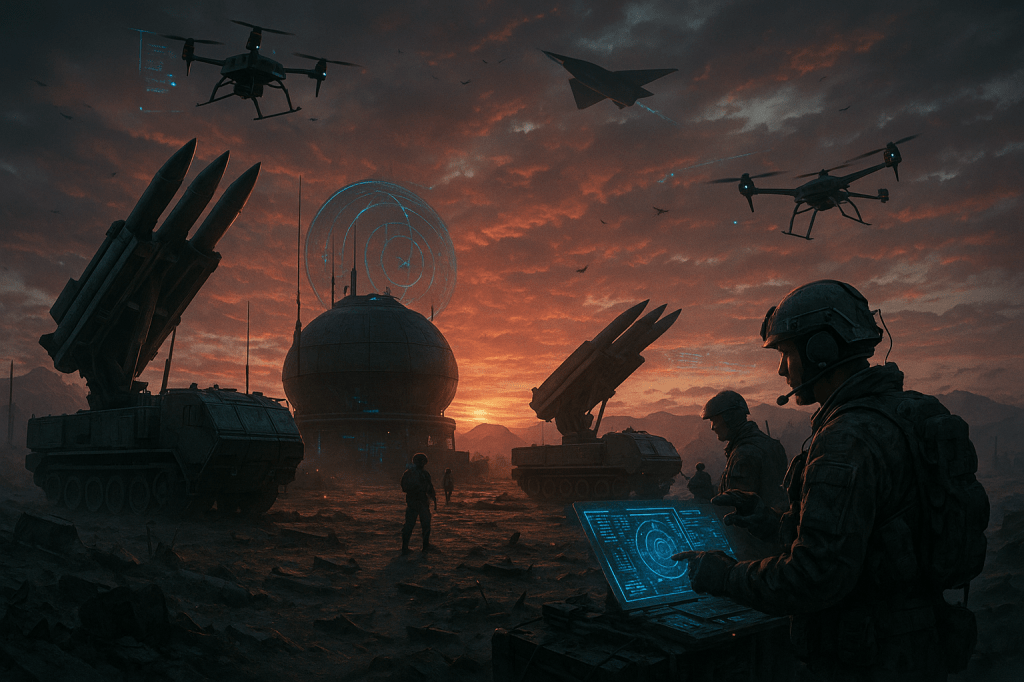
The Future Vignette: On a maneuvering combat vehicle, an AI agent acts as a silent co-pilot. It isn’t just watching one radar; it’s continuously fusing terabytes of data from the vehicle’s own AESA radar, its passive EW sniffers, and its 360-degree Electro-Optical/Infrared (EO/IR) sensors. When a drone swarm materializes from behind a treeline, the AI doesn’t wait for orders. In under 50 milliseconds, it has autonomously classified the threats, identified the swarm’s lynchpin communication node, and presented the human crew with an optimized engagement plan: jam the command-and-control drones, task the onboard laser to incinerate the closest threats, and cue loitering interceptors for the high-fliers. The human commander validates the logic, and the system executes, initiating a “shoot-look-shoot” cycle faster than a human can blink.
The Nervous System: From Fragile Chains to Resilient Webs
The Cold War Vignette: A SHORAD platoon’s lifeline is a single VHF/UHF radio net that connects them back to brigade headquarters. When a Soviet electronic warfare barrage targets their frequency, the net goes down. The repeater station on the next hill is silenced. Suddenly, the platoon is blind. Their situational awareness vanishes, and they are forced to halt all coordinated engagements, relying only on what their own eyes can see until someone can re-establish the fragile link.
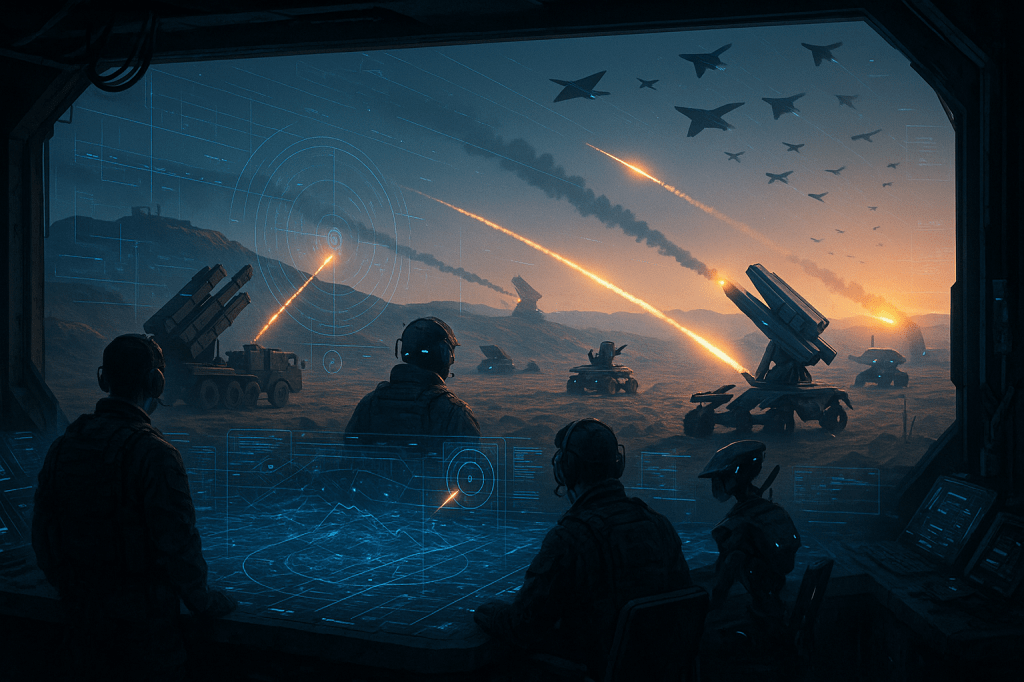
The Future Vignette: Every vehicle in the brigade is a node in a true peer-to-peer mesh network. Using agile, software-defined radios, they create a self-healing, high-bandwidth data fabric. When a sophisticated EW attack blacks out one vehicle’s link, data packets instantly and automatically reroute through dozens of alternate paths—other vehicles, unattended ground sensors, even a high-altitude balloon. Even if completely severed from higher echelons, the platoon maintains its own local, shared air picture. They can collaboratively track threats, deconflict engagement zones, and fight effectively as a disconnected yet fully coherent team.
The Senses: From a Periodic Glance to an Unblinking Stare
The Cold War Vignette: A towed, mechanically rotating radar dish provides the primary warning. Its beam sweeps the horizon once every ten seconds, creating a dangerous gap in coverage where a fast, low-flying cruise missile can sneak through masked by terrain. To determine the target’s altitude, the crew must switch to a separate “nodding” height-finder radar, introducing yet more delay into an already slow process.
The Future Vignette: The defense unit is a walking sensor hub. It doesn’t just rely on an active radar. It employs a suite of multi-spectral sensors: passive RF detectors sniffing for enemy communication or radar signals, acoustic arrays listening for the distinct sound signatures of incoming drones, and perhaps even an experimental quantum-enhanced radar. This quantum sensor can detect the faint environmental disturbances caused by a stealth aircraft with a tiny radar cross-section (RCS), even in heavy ground clutter, without ever emitting an active pulse. The passive detection cues the active sensors for a micro-second, high-fidelity track, allowing an intercept before the threat is even aware it has been seen.
The Fist: From Finite Ammo to Infinite Possibilities
The Cold War Vignette: A barrage of Soviet artillery rockets screams in. The only defense is a volley of Stinger missiles or the furious chatter of 23mm cannons. Against a saturation attack, ammunition stocks are finite and deplete with frightening speed. The vulnerable resupply convoy, lumbering its way to the front, becomes a prime target itself, risking the battery’s ability to fight at all.
The Future Vignette: The brigade’s air defense vehicle is armed with a diverse, layered toolkit. As a mixed barrage of mortar rounds and armed commercial quadcopters approaches, its integrated systems react. A solid-state, 75kW laser, powered by high-capacity capacitors, engages first. At the cost of diesel fuel, it slices through the incoming mortar shells and closest drones with surgical precision. Simultaneously, it launches a trio of its own loitering interceptor drones. These small, autonomous hunters fly out to meet the remaining quadcopters, engaging them miles away from the asset they are protecting. The cost-per-shot is near zero for the laser, and the system can adapt its effectors on the fly. Thanks to a modular, open-architecture design, the same vehicle can have its laser module swapped for a rack of advanced IR missiles overnight, tailoring its loadout for the next day’s anticipated threat.

The Backbone: From Guesswork to Predictive Endurance
The Cold War Vignette: Maintenance is a calendar-based ritual or, more often, a reaction to failure. In the heat of battle, a key motor in the radar’s rotation assembly seizes. The entire system is down. A replacement part must be requisitioned and trucked in from a depot, a process that could take days while the unit sits exposed.
The Future Vignette: The entire brigade exists not just on the battlefield, but as a “digital twin”—a perfect virtual replica fed by real-time data. Onboard health sensors constantly stream performance metrics from every vehicle component. An AI monitoring the digital twin flags an actuator bearing in a laser’s gimbal for showing microscopic signs of wear. It predicts a failure in 72 hours. The system automatically alerts the maintenance team, which pre-stages the part and a technician. During a planned operational halt for refueling, the technician swaps the part in 20 minutes. There is no unscheduled downtime. The vehicle never misses a beat.
The revolution in brigade-organic air defense is not about a single wonder weapon. It is about the powerful synergy of AI, resilient networks, multi-modal sensing, directed energy, modularity, and predictive logistics. Together, these technologies transform a static, reactive shield into a distributed, intelligent, and enduring organism—one that can see, think, and strike with a speed and precision the analog world could only dream of.
AI-assisted article.

