
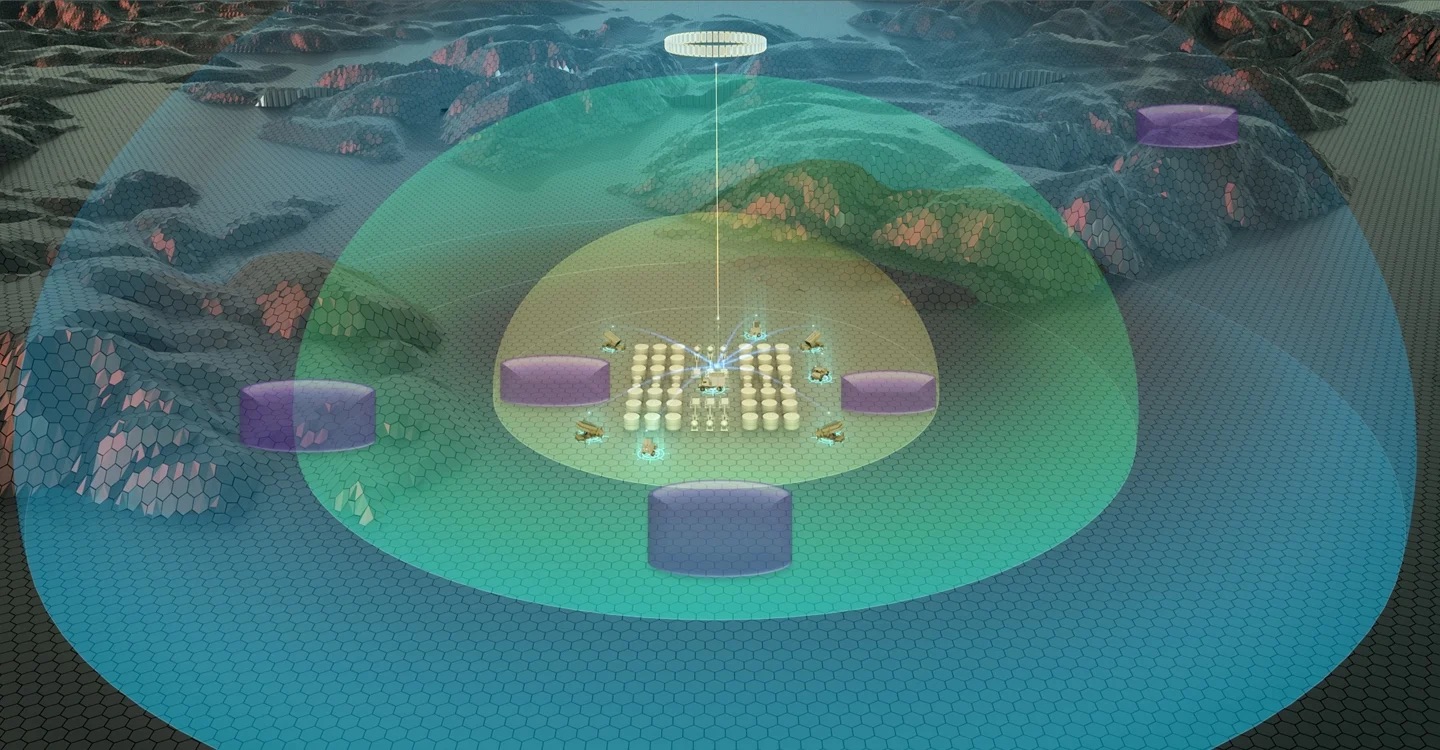
“Full Spectrum Air Defence,” as defined by Kongsberg, is a comprehensive, layered, and scalable air defense system-architecture designed to counter the full range of aerial threats. It integrates various layers of defense – very short, short, medium, and long range – each tailored to address specific threats like drones, cruise missiles, and ballistic missiles. This integrated approach ensures a unified and effective response to diverse aerial and missile attacks.
Norwegian Advanced Surface to Air Missile System (NASAMS) represents one of the world’s most combat-proven air defense platforms. NASAMS has achieved exceptional operational success with a 94% intercept rate across 900+ engagements in Ukraine, establishing itself as the gold standard for medium-range air defense.
Full Spectrum Air Defence (FSAD) emerges as an evolutionary strategic framework building upon the NASAMS foundation. Rather than a replacement, FSAD constitutes a strategic evolution that leverages NASAMS’ open architecture to address emerging threats across the full spectrum of air defense challenges, with development timelines targeting operational capability by 2030. FSAD represents a potential development program designed to extend NASAMS’ proven architecture into comprehensive, multi-layered air defense coverage.
FSAD in the words of Kongsberg is: «a layered, integrated air defence system where components share critical information within milliseconds, the system recommending operatoractions, and operators respond within seconds.»
And according to Carsten Thiis, air defence specialist at Kongsberg: «in addition to increased operational effect, FSAD also provides significant synergies and reduced life-cycle costs. The approach is fully aligned with the Norwegian Long-Term Defence Plan for 2025–2036, which outlines that NASAMS will serve as the backbone for the continued development of air defence»
NASAMS operational excellence and proven combat record
NASAMS currently operates as the world’s first operational network-centric ground-based air defense system, deployed across 13 nations with over 70 fire units delivered globally. The system has demonstrated exceptional operational effectiveness, particularly in Ukraine where it has achieved a 94% success rate intercepting over 900 missiles and drones since November 2022. This combat record includes successful engagements against sophisticated Russian cruise missiles (Kh-101, Kh-555, Kalibr), tactical ballistic missiles (Iskander-K), and various drone threats.
The system’s technical specifications reflect mature operational capability: short to medium engagement range and altitude depending on missile type and capacity for simultaneous engagement of up to 72 targets. Critical to its success is the modular, distributed architecture centered on the Fire Distribution Center (FDC), which enables components to operate separated by 20+ kilometers while maintaining hard real-time communication networks.
FSAD strategic vision extends NASAMS foundation
Full Spectrum Air Defence represents a comprehensive strategic framework designed to counter threats across very short, short, medium, and long-range defense layers. Unlike revolutionary new architecture, FSAD explicitly builds upon NASAMS’ proven foundation, with approximately 70% of FSAD capabilities leveraging existing NASAMS architecture.
The “full spectrum” concept encompasses multiple dimensions: range coverage from 0-500+ kilometers, threat diversity from small drones to hypersonic missiles, 360-degree protection across all strategic directions, and integration of both kinetic and non-kinetic effects. FSAD aims for millisecond-level information sharing between components with automated threat assessment while maintaining human decision authority.
Key additional capabilities beyond current NASAMS could include enhanced sensor integration across multiple domains (space-based, airborne, ground-based), artificial intelligence-assisted command and control, and extended range coverage through integration with long-range/ATBM systems. The framework should allow for advanced technologies including directed energy weapons, hypersonic defense capabilities, and enhanced counter-drone systems.
Concrete development timeline with substantial funding
Contrary to purely conceptual status, FSAD represents an active development program with committed funding and realistic timelines. Norway’s Long-Term Defence Plan for 2025-2036 provides NOK 611 billion in additional defense funding, with NASAMS/development identified as s high priority. The development timeline includes:
2024-2025
Active development of core FSAD technologies, including GhostEye radar integration and expanded production facilities
2027
Expected delivery of new NASAMS systems under $440 million Norwegian contract
2030
Target for FSAD operational capability
2025-2036
Full implementation period under Norway’s strategic defense plan
Major funding commitments include NOK 43 billion specifically allocated for ground-based air defense systems through 2030, complemented by significant private investment from Kongsberg ($100 million Virginia facility, $850 million Australia partnership). International cooperation strengthens development prospects, with the NASAMS Capabilities Collaborative Agreement between Norway, Kongsberg, and Raytheon formalizing tri-partite development coordination.
Multi-layered integration leverages NASAMS architecture
FSAD’s integration approach positions NASAMS as the proven medium-range backbone within a four-tier defense architecture:
Very Short Range
Counter-UAS and point defense systems, including NOMADS (National Manoeuvre Air Defence System) successfully tested in 2024
Short Range
Enhanced NASAMS coverage with AIM-9X integration and improved sensors
Medium Range
Extended NASAMS capabilities through AMRAAM-ER integration and advanced radar systems
Long Range and ATBM
Integration with e.g. Patriot and future strategic defense systems
Critical to this integration is NASAMS’ existing open architecture, which enables seamless addition of new capabilities without fundamental system redesign. The Fire Distribution Center already supports multiple missile types (AMRAAM, AMRAAM-ER, AIM-9X) and demonstrates integration capabilities with higher-echelon systems through NATO-standard Link 16 tactical data links.
Technical gaps analysis reveals integration challenges
The evolution from current NASAMS to full FSAD capability requires addressing specific technical gaps across range, sensor integration, and command coordination. Current NASAMS maximum range must expand to 100+ kilometer layered coverage, while current single X-band radar architecture requires multi-band, multi-mode sensing integration.
Critical capability gaps include: limited tactical ballistic missile defense, no hypersonic weapon engagement capability, insufficient coordination against swarm attacks with electronic warfare, and gaps in space-based persistent tracking integration.
Primary technical developments needed: multi-domain sensor fusion processing, extended-range interceptor integration, enhanced communications bandwidth supporting Gbps data rates, and advanced human-machine interfaces with augmented reality battlespace visualization. Integration challenges focus on data fusion complexity rather than individual component development, requiring coordination across 10+ sensor types while managing false alarm rates in contested environments.
Evolutionary advancement with revolutionary elements
Technical analysis confirms FSAD represents primarily evolutionary advancement building on NASAMS’ mature foundation, with selective revolutionary elements addressing emerging threats. Evolutionary aspects include: NASAMS’ open architecture providing incremental capability addition pathways, existing FDC design supporting modular expansion, NATO tactical data link standards ensuring interoperability, and distributed command structure scaling to larger operational areas.
Revolutionary elements required: multi-domain command integration requiring new operational concepts, artificial intelligence integration for assisted decision-making, space-based persistent tracking requiring new sensor architectures, and hypersonic threat engagement demanding new interceptor technologies. Critical risk areas include software complexity management and cybersecurity for distributed architectures.
The assessment indicates technical feasibility with manageable risk given NASAMS’ proven architecture and Norway’s substantial funding commitment. Current NASAMS provides solid technical foundation, particularly its network-centric design and NATO interoperability, while required enhancements focus on systems integration rather than fundamental technology development.
Strong governmental and industry commitment
Analysis reveals robust commitment to FSAD development rather than competition with NASAMS investment. Norway’s defense budget increases from $8.75 billion (2024) to over $17 billion by 2036, with air defense identified as highest priority area and NASAMS quantities planned to double. This represents complementary rather than competitive investment, with FSAD enhancing rather than replacing NASAMS capabilities.
Industry commitment demonstrates through major partnerships: Kongsberg-Raytheon-Norway tri-partite agreement formalizing FSAD development, 50/50 joint venture between Kongsberg and Thales for tactical communications, and expanding production capacity globally. Recent contracts total over $1 billion, including $960.8 million US Navy contract and $329 million Marine Corps contract, indicating sustained business confidence.
International cooperation strengthens development prospects, with 13 nations operating NASAMS providing natural FSAD customer base. Growing Pacific region interest and technology transfer agreements with multiple nations suggest expanding global market supporting development sustainability.
Comprehensive system integration architecture
FSAD integration could extend beyond NASAMS to incorporate diverse air defense systems within unified command architecture. Compatible systems include Patriot for long-range ballistic missile defense, Raytheon Coyote and Phaser DEW systems for counter-UAS, Naval Aegis systems, and various NATO-compatible platforms through standardized interfaces.
Sensor integration encompasses: ground-based radars, electro-optical systems, space-based assets, and electronic intelligence integration. The unified command and control system manages all layers with real-time data sharing, automated deconfliction, optimal weapon assignment, and redundant coverage for survivability.
Integration mechanisms include standardized application programming interfaces enabling third-party system connectivity, enhanced current data link capabilities or next-generation tactical data links, and multi-level security architectures supporting coalition operations. Critical integration challenges involve communications interoperability and data fusion complexity rather than individual system capabilities.
Development milestones and implementation pathway
Concrete development milestones demonstrate systematic progression: 2023 NASAMS Capabilities Collaborative Agreement establishment, 2024 GhostEye radar development commencement with Norway as co-developer, 2024 NOMADS successful testing representing FSAD’s mobile component, and 2025 Kongsberg-Thales joint venture for tactical communications.
Technical program development includes: GhostEye advanced medium-range sensor with active electronically scanned array technology, AMRAAM-ER integration providing 50% range increase, AIM-9X Block II integration for short-range capability, and next-generation Fire Distribution Centers.
Implementation pathway emphasizes risk mitigation through evolutionary development, leveraging proven NASAMS technology while systematically adding enhanced capabilities. Timeline feasibility appears realistic given substantial funding commitment, established industry partnerships, and technical foundation provided by mature NASAMS architecture.
Conclusion
The distinction between NASAMS and FSAD reflects the difference between proven operational excellence and strategic evolution toward comprehensive air defense. NASAMS’ exceptional combat record and global deployment success provide the foundation for FSAD’s ambitious vision, while substantial Norwegian funding and industry commitment suggest realistic development prospects. Rather than revolutionary departure, FSAD represents a mature approach to addressing emerging air defense challenges by building upon demonstrated capabilities, positioning both systems for continued relevance in evolving threat environments.
Image: Kongsberg
AI-assisted article.

