

The fundamental economics of drone warfare have created an unsustainable cost asymmetry that threatens traditional air defense models. Ukraine’s combat data reveals that drones account for 70% of combat casualties, while mass-produced attack drones cost as little as $20,000-38,000 each. Meanwhile, defenders face the reality of using interceptors costing 100 to 3,000 times more than the threats they engage. This economic warfare dynamic is driving revolutionary changes in air defense strategy, from AI-enabled autonomous systems to directed energy weapons that promise near-zero cost per engagement.
The Arithmetic of Asymmetric Warfare
The mathematics of modern drone defense reveal a stark economic reality that no defense budget can sustainably absorb. Traditional air defense systems struggled when one U.S. ally shot down a $200 drone with a Patriot missile costing over $3 million—a 15,000:1 cost disadvantage that exemplifies the fundamental challenge facing air defense planners worldwide.
Scale of the Challenge
The drone threat has evolved into a mass-production phenomenon that overwhelms traditional air defense economics. Russia launched 7,974 drones against Ukraine between March 1 and May 12, 2025, averaging 110 Shahed drones per attack. These mass-produced Iranian Shahed-136 drones cost approximately $20,000-38,000 each, while more sophisticated variants range up to $200,000.
Against this threat volume, traditional interceptor costs create impossible mathematics:
- Patriot PAC-3: $3-4 million per interceptor
- IRIS-T SL: €450,000 ($485,000) per missile
- NASAMS AIM-120: $1.2 million per missile
- Standard Shahed-136 drone: $20,000-38,000 per unit
- Advanced attack drones: $50,000-200,000 per unit
Ukraine requires approximately 4,800 anti-air missiles annually to maintain current interception rates against this sustained bombardment. At current missile costs, this represents a minimum expenditure of $2.4-19.2 billion annually just for interceptor ammunition—financially unsustainable for any nation.
Combat Reality: When Perfect Isn’t Good Enough
Ukrainian Air Defense Performance Data
Recent combat data from Ukraine illustrates both the effectiveness and limitations of current air defense systems:
- IRIS-T Performance: 99% success rate with 240+ confirmed kills, including 8 cruise missiles destroyed within 30 seconds
- NASAMS Effectiveness: 94% success rate with approximately 900 targets destroyed
- Patriot Challenges: While effective against ballistic missiles, Ukraine faces declining interception rates under sustained attack volumes
The challenge extends beyond simple cost calculations. Short-range drones caused more civilian casualties than any other weapon in January 2025, with 95% of casualties occurring in Ukrainian-controlled territory. The psychological and economic impact of constant drone harassment creates costs far exceeding the weapons’ manufacturing price.
Production vs. Consumption Asymmetry
The global production capacity imbalance creates strategic vulnerability, but the key asymmetry lies between attack drone production worldwide and defensive interceptor manufacturing:
- Patriot Interceptors: 650 units produced annually worldwide, shared among all operators
- Global Drone Proliferation: Multiple nations producing hundreds of thousands of attack drones annually
- Iranian/Russian Production: Estimated hundreds of thousands of Shahed-type drones annually
Lockheed Martin and RTX produce approximately 740 Patriot interceptors annually, while Germany’s IRIS-T production is expanding but only began in November 2024. This production bottleneck means that even perfect interception rates cannot address sustained high-volume attacks from mass-produced offensive drones.
Economic Innovation: The Search for Sustainable Solutions
Directed Energy: The Promise of Near-Zero Marginal Costs
The most promising economic solution to the drone challenge lies in directed energy weapons (DEWs), which offer fundamentally different cost structures:
High Energy Lasers (HEL)
- Cost per engagement: As low as $13 per shot—essentially the cost of electrical power during lasing
- Unlimited magazine depth: No ammunition resupply requirements
- Precision engagement: Capable of selective effects from deterrence to destruction
High Power Microwave (HPM) Systems
- Multi-target capability: Can engage multiple threats simultaneously within beam coverage
- Electronic disruption: Disables rather than destroys, potentially enabling asset recovery
- Area effect: HPM weapons can affect multiple targets due to larger beam size
The global directed energy weapons market is projected to grow from $10.24 billion in 2023 to $20.89 billion by 2031, driven primarily by the economic necessity of countering mass drone attacks.
Kinetic Innovation: Smart Economics for Traditional Approaches
Cost-Optimized Engagement Systems
The Gepard SPAAG’s renaissance in Ukraine demonstrates how older, cost-effective systems can provide economic advantages:
- 35mm Proximity-Fused Rounds: Significantly less expensive than guided missiles, cannot be jammed by electronic countermeasures
- Proven Effectiveness: The success of the Gepard system in Ukraine underscores 35mm gun-based air defense effectiveness against drones
- Sustainable Ammunition Supply: Traditional artillery production scales better than complex guided missiles
The EOS Slinger system demonstrates advanced kinetic approaches, boasting 95% probability of downing quadcopters with single 30mm proximity-fused rounds at 1,000m range.
AI and Autonomous Systems: Force Multiplication Through Intelligence
Autonomous Engagement Capabilities
By end of 2025, firms will introduce fully autonomous solutions including visual navigation to overcome GPS jamming and smart target recognition. These systems promise to reduce operator workload while improving cost-effectiveness:
- AI-Driven Target Recognition: AI systems can rapidly process vast sensor data for real-time drone detection and path prediction
- Automated Threat Assessment: Reduces human error and reaction time
- Swarm Coordination: AI becomes backbone of layered defense strategies, orchestrating extensive counter-drone suites
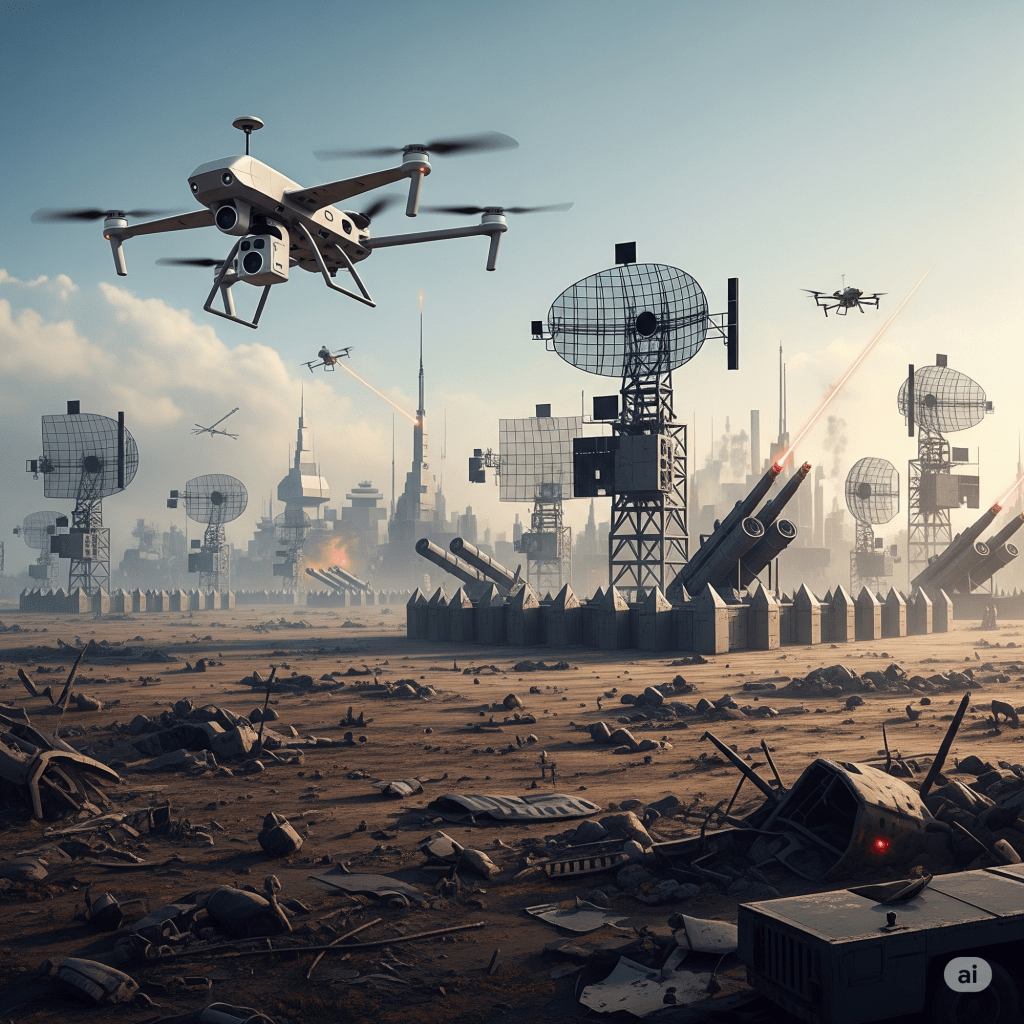
The Strategic Implications of Economic Warfare
NATO’s €5.6 Billion Gamble
The European Sky Shield Initiative represents the West’s largest attempt to address drone defense economics through collective procurement:
- Economies of Scale: Joint acquisition by 19 nations to reduce procurement costs through higher unit numbers
- Layered Integration: Three-tier system combining short-range (IRIS-T), medium-range (Patriot), and long-range (Arrow-3) capabilities
- Industrial Base Development: Balancing immediate capability needs with long-term European defense autonomy
However, the initiative’s reliance on limited production capacity means it addresses only part of the economic challenge. Even with joint procurement, missile shortages require encouraging NATO allies to donate from existing stockpiles.
China’s Rapid Response Model
China’s counter-drone market features over 3,000 manufacturers, with government procurement notices jumping from 87 in 2022 to 205 in 2024. This industrial mobilization approach demonstrates how economic pressure drives rapid technological development:
- Distributed Production: Massive industrial base reduces single-point failures
- Rapid Innovation Cycles: AI-driven decision-making and multi-sensor fusion for fully autonomous drone neutralization
- Layered Defense Integration: Unified command and control systems synchronizing radar, electro-optical, and electronic warfare capabilities
Ukraine’s Dual Challenge: Production and Protection
Ukraine faces a unique dual challenge—rapidly scaling offensive drone production while defending against incoming attacks. Ukraine is manufacturing 2.5-3 million military drones annually at approximately $2.47 billion (roughly $800-1,000 per unit), primarily FPV kamikaze drones. This represents 96.2% domestic production of Ukraine’s offensive UAV requirements.
Simultaneously, Ukraine must defend against Russian drone attacks using expensive Western-supplied interceptors, creating the economic asymmetry that epitomizes the broader challenge facing all air defense operators.
Emerging Technologies: Tomorrow’s Solutions
Quantum Detection and AI Optimization
2025 may see quantum physics-based detection and AI-enhanced targeting systems that anticipate drone movements in real-time. These technologies promise to improve engagement efficiency, reducing the number of interceptors required per successful engagement.
Swarm vs. Swarm Combat
The development of autonomous killer drones capable of defeating electronic warfare represents the next phase of drone evolution. Counter-swarm technologies are emerging:
- Defensive Drone Swarms: Interceptor drones designed for persistent area coverage
- Coordinated EW Systems: Fiber-optic communication lines providing unjammable connection for counter-drone operations
- Adaptive AI Systems: Learning algorithms that evolve with threat characteristics
Operational Recommendations: Sustainable Defense Architecture
Immediate Actions (2025-2027)
- Prioritize Directed Energy Development: National defense budgets should increase DEW research investment to field operational systems capable of $13-per-shot engagement costs
- Expand Kinetic Alternatives: Increase conventional ammunition production (35mm, 30mm) for cost-effective point defense systems that cannot be electronically jammed
- Implement AI Integration: Deploy AI-enabled sensor fusion across existing air defense networks for improved target discrimination and reduced false engagement rates
Medium-Term Strategy (2027-2030)
- Scale DEW Production: Target deployment of 50-100+ operational laser systems across critical national infrastructure and military installations
- Develop Counter-Swarm Doctrine: Integrate multiple engagement systems (kinetic, electronic, directed energy) for coordinated defense against mass drone attacks
- Industrial Base Expansion: Leverage counter-drone market growth projections ($6.44 billion by 2031) through strategic public-private partnerships and procurement reforms
Long-Term Vision (2030-2035)
- Autonomous Defense Networks: Deploy fully integrated AI-driven systems requiring minimal human intervention for rapid response to swarm attacks
- Multinational Coordination: Establish shared early warning networks and coordinated response protocols among allied nations
- Economic Parity: Achieve sustainable cost-per-engagement ratios below 10:1 through technological advancement and production scale economies
Conclusion: Redefining Air Defense Economics
The drone defense crisis represents more than a technological challenge—it embodies a fundamental shift in warfare economics that renders traditional air defense models obsolete. With drones causing 70% of Ukrainian combat casualties and production scales reaching millions of units annually, the old paradigm of expensive interceptors engaging expensive targets has collapsed.
Success requires embracing the economic reality that sustainable drone defense must achieve cost parity with threats. Directed energy weapons offering $13 per engagement costs represent the most promising path forward, but implementation requires massive industrial mobilization similar to historical wartime production efforts.
The nations that master this economic transition—balancing immediate capability needs with sustainable long-term costs—will possess decisive advantages in future conflicts. Those that cling to traditional cost structures will find themselves economically overwhelmed by adversaries willing to embrace the new mathematics of modern warfare.
The question is no longer whether traditional air defense can evolve, but whether it can do so quickly enough to remain relevant in an era where the cost of defense must match the economics of the threat.
AI-assisted article.

