
European nations are making significant strides in the development of laser-directed energy weapons (LDEWs) as part of their broader efforts to modernize defense capabilities. These systems, designed to counter emerging threats such as drones, missiles, and artillery, are being prioritized due to their cost-effectiveness, operational flexibility, and potential to complement traditional kinetic weapons. With numerous projects underway and multinational collaborations gaining momentum, Europe aims to achieve operational deployment of advanced LDEWs by 2030. This article provides a comprehensive overview of key European initiatives, prototypes, and strategic plans in this domain.
Major European Laser Weapon Projects
TALOS-TWO (Tactical Advanced Laser Optical Systems-TWO)
The TALOS-TWO project is one of Europe’s most ambitious efforts to develop sovereign high-energy laser systems. Funded by the European Defence Fund (EDF) with €25 million, TALOS-TWO involves a consortium of 21 partners across 8 EU nations, including major defense companies like CILAS (France), Leonardo (Italy), Rheinmetall (Germany), and leading research institutions such as DLR and Fraunhofer.
Objective: Develop 100 kW-class laser weapons for deployment on air, ground, and maritime platforms.
Technological Focus:
- Two types of laser sources: a 1µm wavelength source for precision targeting and a 2µm wavelength sourcefor atmospheric penetration and eye-safe operations.
- Advanced beam control systems for dynamic 3D visualization of threats.
Timeline:
- Development and testing: 2023–2027.
- Operational readiness: Achieve Technology Readiness Level 8 (TRL-8) by 2030, enabling deployment in realistic operational environments.
TALOS-TWO underscores Europe’s commitment to technological sovereignty by establishing a fully European supply chain for laser components. This reduces reliance on non-EU suppliers while fostering innovation within the continent’s defense industry.
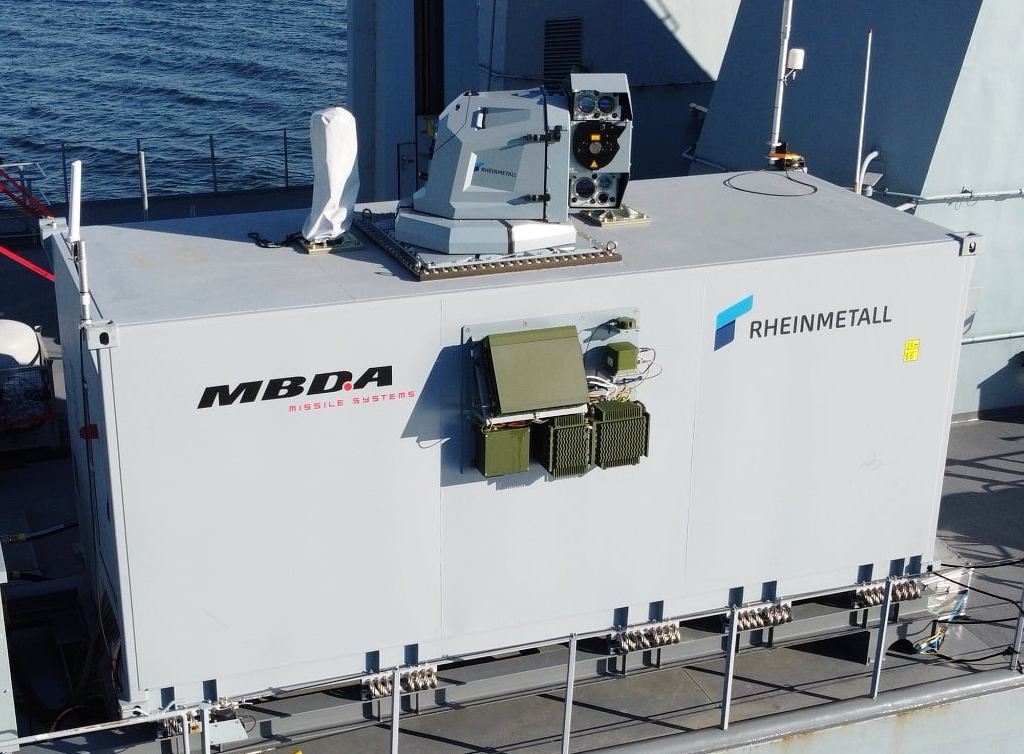
Rheinmetall-MBDA Maritime Laser Collaboration
Rheinmetall and MBDA are collaborating on ship-based laser systems designed to counter drones and missiles in naval environments. This project has already achieved significant milestones:
Testing Milestones: Over 100 successful test shots were conducted aboard the German Navy’s Sachsen-class frigate in 2024.
Capabilities:
- Integration with existing sensors, command systems, and effectors for seamless operation.
- Cost-effectiveness: Rheinmetall estimates a cost of approximately €12 per shot compared to millions for traditional missile interceptors.
- Deployment Goal: Operational ship-based lasers by 2030.
This collaboration aligns with NATO’s broader maritime defense strategy and highlights the growing importance of directed energy weapons in protecting naval assets from asymmetric threats.
Thales Group’s Counter-Drone Systems
Thales is focusing on compact laser systems tailored for urban defense and naval platforms. These systems integrate with Thales’ existing air defense radars and missile systems, providing a layered approach to countering drones and other low-altitude threats. While specific timelines remain undisclosed, Thales aims to deploy these systems by the late 2020s.
Prototypes and Testing
Iron Beam Influence
Although not a European project, Israel’s Iron Beam—a 100 kW ground-based laser system developed by Rafael Advanced Defense Systems—is influencing European LDEW developments through shared NATO strategies. Expected to be operational by late 2025, Iron Beam offers near-zero cost per interception against rockets, drones, and mortars. Its success has underscored the viability of high-energy lasers as a cost-effective alternative to traditional interceptors.
German Research Contributions
German research institutions like the German Aerospace Center (DLR) and Fraunhofer Institute are playing pivotal roles in advancing LDEW technologies:
- DLR focuses on beam stability and power sustainability.
- Fraunhofer is refining adaptive optics for enhanced precision targeting.
These advancements are critical for addressing challenges such as atmospheric interference and maintaining beam coherence over long distances.
Technical Advancements Driving LDEWs
Sovereignty and Supply Chain Development
European projects like TALOS-TWO emphasize reducing dependency on external suppliers by establishing a fully sovereign supply chain for critical components such as laser diodes, optics, and cooling systems. This approach ensures that Europe retains control over its defense technologies while fostering industrial competitiveness.
Cost Efficiency
One of the primary advantages of LDEWs is their low operational cost compared to traditional interceptors. For example:
- A single laser shot costs approximately €12.
- In contrast, interceptor missiles can cost upwards of €1 million per engagement.
This cost efficiency makes LDEWs particularly attractive for countering high-volume threats like drone swarms or artillery barrages.
Versatility
LDEWs can be deployed across multiple platforms—land-based vehicles, naval ships, or even aircraft—making them highly versatile tools for modern warfare. Their ability to neutralize diverse threats such as drones, rockets, mortars, and even hypersonic missiles positions them as essential components of future defense architectures.
Challenges Facing European LDEWs
Despite significant progress, several challenges remain:
Technical Hurdles:
- Maintaining beam stability over long distances.
- Overcoming atmospheric interference (e.g., fog or dust).
Operational Readiness:
- Ensuring that prototypes can perform reliably in real-world combat scenarios.
Funding Constraints:
- While projects like TALOS-TWO benefit from EDF funding, broader adoption will require sustained financial commitments from national governments.
Additionally, some military leaders have cautioned against overpromising capabilities before the technology is fully matured. For example, U.S. Navy Rear Adm. Fred Pyle has warned that directed energy weapons should not be seen as immediate replacements for traditional missile defense systems but rather as complementary tools.
Future Outlook
Europe’s investment in LDEWs reflects a strategic shift toward integrating advanced technologies into its defense architecture. By focusing on projects like TALOS-TWO and Rheinmetall-MBDA’s maritime lasers, European nations aim to establish themselves as leaders in directed energy weaponry while enhancing NATO’s collective capabilities.
By 2030:
- High-energy lasers will likely complement existing missile systems across land, sea, and air domains.
- Cost-effective solutions will enable countries to counter high-volume aerial threats without depleting expensive missile stockpiles.
- Sovereign supply chains will ensure Europe’s technological independence in this critical area.
As these projects mature, Europe’s ability to defend against evolving threats will significantly improve, solidifying its position as a global leader in advanced military technologies.
References
- European Commission. (2023). TALOS-TWO: Tactical Advanced Laser Optical Systems. European Defence Fund.
https://ec.europa.eu/defence-industry-space/talos-two-laser-weapons_en - Rheinmetall AG. (2024). Rheinmetall Tests Naval Laser Weapon on German Frigate.
https://www.rheinmetall.com/en/media/news-watch/news/2024/march/naval-laser-test - Janes Defence Weekly. (2024). Europe’s TALOS-TWO Aims for Sovereign Laser Weapons by 2030.
https://www.janes.com/defence-news/talos-two-laser - Defense News. (2024). Cost Efficiency Drives Rheinmetall Laser Adoption.
https://www.defensenews.com/global/europe/2024/04/rheinmetall-laser-cost - Fraunhofer Institute for Laser Technology. (2023). Beam Control Systems for Directed Energy Weapons.
https://www.fraunhofer.de/en/research/beam-control.html - Naval Technology. (2023). Iron Beam’s Impact on NATO Defense Strategies.
https://www.naval-technology.com/news/iron-beam-laser-nato
Image: MBDA/Rheinmetall
AI-assisted article

