
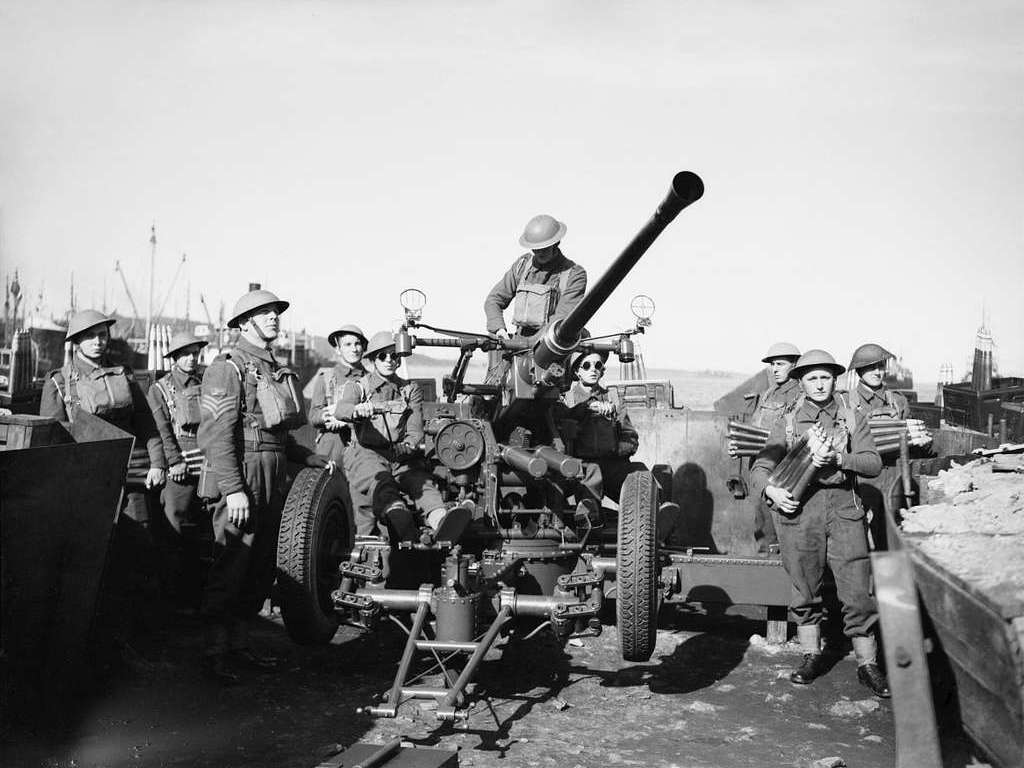
The work of building up air defense in Norway after the war began in October 1945, with Lieutenant Colonel Leif Husjord as the newly appointed Inspector General and Chief of Air Defense Artillery. Just over eight years later, in 1953, the Air Defense Artillery had established itself as the second largest branch of the Armed Forces. And the plan for mobilization was for a period of over 20,000 officers and soldiers, to man 45 heavy and 39 light batteries distributed over 21 battalions. The equipment was a mixture of American and British materiel, as well as German materiel taken over after the war. In addition, the Home Guard Air Defense and the Army could set up an additional 29 gun batteries. In 1955, the Boyesen Committee recommended that the air defense, which had been subordinated to the Army in 1952, should be returned to the Air Force. This transfer took place gradually until 1960, with a downsizing of the air defense structure, in which the remaining battalions were transferred to military airfields. The Air Force then changed its name back to the Air Force. At the same time, the Storting accepted an offer from the United States in 1957 to receive the NIKE air defense missile system. With coverage at all altitudes and a range of over 150 km from four locations around Oslo, the country had for the first time an area air defense for Eastern Norway. NIKE was operational from 1960 until its official decommissioning on January 9, 1991.

The following text is based on Storting reports from the 1980s and 1990s, and deals with some of the aspects that characterized the air defense artillery during these years and the first years after the turn of the millennium.
The war structure for air defense, as planned in the early 1990s, after the decommissioning of NIKE, consisted of ten gun batteries, ten batteries with portable short-range missiles and six missile batteries with medium range. In order to man the units in the event of mobilization, there was active force production at six air stations; these were Bardufoss, Andøya, Evenes, Bodø, Ørland and Rygge.
The gun batteries consisted of L70 40-mm cannons controlled by radar central sights and electro-optical sights, first acquired from 1966 and then upgraded, most recently in 1989-1990. A battery consisted of four gun troops each with radar sight and several guns. The short-range missiles RB70 were acquired by the Air Force in the late 1980s, as a replacement for the then aging L60 cannons. In 1992-1993, it was planned to acquire 112 portable units of the system.
In 1983, the Storting decided that missile air defense should be acquired for airfields. This was initially NOAH, a Norwegian-adapted variant of the American HAWK system with medium range. NOAH consisted of a modified American artillery location radar and a completely new control system, which together replaced four different radar types in the basic version of HAWK. And which thus both improved and simplified the operation and maintenance of the system. In 1986, it was decided to establish NOAH departments. As a result of the introduction of the new system, several of the existing gun batteries were to be closed down and the remaining ones were to be reorganized. All with effect from January 1, 1987. In September 1990, Storting Report No. 1 was adopted, and it was here decided that the first version of NASAMS should be developed, and the system should be based on existing systems.
NOAH: Norwegian Adapted HAWK.
HAWK: Homing All the Way Killer.
NASAMS: Norwegian Advanced SAM System.
Although the Defense Study of 1991, which was published in 1992, called for a significantly improved air defense of the air stations, the 1990s was also a period of downsizing of the air defense. The backdrop was an order to downsize for savings. But this was also the period with the dissolution of the Soviet Union and the de-escalation of the Cold War, with a shift from an invasion defense based on the ability to mobilize, to an expeditionary defense with a larger proportion of standing forces.
A series of political decisions this decade, and in the period after the turn of the millennium, clearly influenced the air defense in the Air Force.
Already in 1993, the year after the Defense Study was published, it was decided to halve the force production at air stations, from six to three; and Bardufoss in Troms, Bodø in Nordland and Ørland in Trøndelag remained. After about five years of operating three systems at three stations, the responsibility for all force production within RB70 in the Armed Forces was transferred to the Army. And in 1999, the education on L70 was stopped, with the subsequent phasing out of the cannon system in 2001. Furthermore, the force production of the remaining NASAMS at Bardufoss air station was discontinued in 2000, and four years later the RB70 was out of the structure, with the closure of air defense in the Army in 2004. Thus, two of the three air defense systems in the Air Force were out, and without any plans for replacements, the Norwegian air defense solution had in practice become part of history.
The Norwegian air defense solution was a concept with a system of systems, which was largely manned by conscripts, but also with increasingly active personnel in leadership and key roles on weapon systems and communications. In 1998, the air defense solution was validated through a comprehensive live-fire scenario with all three weapon systems at a firing range in the USA.
A film from the Armed Forces Recruitment and Media Center (FRM) gives a short presentation of the Air Force’s ground-based air defense systems, as it was in 1997. The film shows how they were planned to be used, and a brief description of the three weapon systems that were part of the air defense solution is given.

