
The Deutsche Marine’s most ambitious surface combatant program extends Zeitenwende to sea
While Germany’s December 2025 deployment of the Arrow 3 system at Holzdorf has dominated headlines about German missile defense, an equally significant transformation is underway at sea. The Type F127 frigate program represents Berlin’s commitment to establishing comprehensive sea-based air and missile defense capability for the first time in German naval history. With Aegis combat systems, SPY-6 radar, and Standard Missile inventories now approved, Germany is positioning itself as a central node in NATO’s evolving maritime defensive architecture.
The program’s scale is remarkable by German standards: up to eight frigates displacing 10,000 tonnes each, armed with 64 vertical launch cells, equipped with the same Aegis combat management system that forms the backbone of U.S. Navy surface combatants. The first vessels are expected to enter service around 2034, replacing the aging F124 Sachsen class while dramatically expanding German naval capability against the full spectrum of aerial threats, from low-altitude cruise missiles to ballistic missiles in their terminal phase.
From F124 to F127: Addressing Two Decades of Capability Gap
The F124 Sachsen class frigates, commissioned between 2004 and 2006, represented the pinnacle of German naval air defense when they entered service. The three vessels, FGS Sachsen, Hamburg, and Hessen, incorporated the Thales APAR multifunction radar and SMART-L long-range surveillance radar, systems that were genuinely advanced for their era. Armed with 32 Mk 41 vertical launch cells carrying SM-2 Block IIIA and Evolved Sea Sparrow Missiles, plus Rolling Airframe Missiles for point defense, the F124 class was among the most capable air defense platforms outside the U.S. Navy at the time of commissioning.
The Sachsen class emerged from successful German-Dutch-Spanish cooperation under the Trilateral Frigate Cooperation framework. While the three nations developed different hull designs, they shared the APAR/SMART-L sensor combination and the SM-2/ESSM missile pairing, ensuring interoperability and cost efficiencies through common development. The Dutch De Zeven Provinciën class and Spanish Álvaro de Bazán class (which chose the American Aegis system with SPY-1 radar instead) paralleled Germany’s effort.
However, two decades have exposed the F124 class’s limitations. The 32-cell vertical launch system, while adequate for its original mission, cannot accommodate the missile volumes required for sustained operations against modern saturation attacks. More critically, the F124 class was never designed for ballistic missile defense. A 2013 German Navy study examined the feasibility of upgrading the ships for Theater Ballistic Missile Defense by integrating SM-3 interceptors, but the approximately $1 billion cost per ship made the modification economically impractical.
The ships themselves are showing their age. Rather than proceed with extensive modernization of the long-range sensor and air defense capabilities, the German Navy inspector prioritized maintaining operational availability until replacement. The F124 class will be operated “as trouble-free as possible” until the F127 class arrives in the mid-2030s.
The German Navy recognized that replacement, not modification, was the appropriate response. The F127 program would not merely replicate F124 capabilities but establish an entirely new category of German naval power: sea-based integrated air and missile defense, including ballistic missile defense in the terminal phase.
The Failed Partnership: Future Air Defender
The F127 program’s path was not straightforward. Germany and the Netherlands initially intended to continue their successful F124/LCF cooperation into the next generation through the Future Air Defender (FuAD) program. A letter of intent signed on 17 December 2020 committed both nations to developing common ship designs, radars, command systems, and deployment systems for vessels to replace both the German F124 and Dutch De Zeven Provinciën classes.
The collaboration made strategic sense. Both navies faced similar timelines for frigate replacement, both sought enhanced air and missile defense capability, and both benefited from the economies of scale and interoperability that joint development could provide. With requirements for four Dutch and six German vessels, the program would have produced a ten-ship class, spreading development costs across a substantial production run.
However, divergent national requirements proved insurmountable. Germany increasingly emphasized integration with American Aegis combat management and Raytheon SPY-6 radar systems. This direction effectively excluded Thales Nederland, which had been central to the F124/LCF sensor suite and expected a major role in FuAD. The Netherlands, conversely, sought to preserve its domestic naval electronics industry and favored continued development of Thales L/S/X-band radars and indigenous systems.
By July 2023, the FuAD cooperation was suspended. Germany’s Federal Office of Bundeswehr Equipment (BAAINBw) confirmed in February 2024 that the partnership had collapsed due to “unresolved technical and operational mismatches.” The two nations would proceed separately: Germany with the F127 program oriented toward American technology, the Netherlands with its own replacement effort emphasizing Thales systems and Damen Naval construction.
The dissolution highlighted persistent tensions in European defense cooperation. Despite decades of rhetoric about European strategic autonomy and defense industrial consolidation, fundamental disagreements over technology sourcing, industrial workshare, and operational requirements repeatedly fracture multinational programs. Germany’s choice to prioritize Aegis integration over European technology preservation echoed in French criticism of the European Sky Shield Initiative’s reliance on Israeli and American systems.
The F127 Design: MEKO Heritage Meets Aegis Future
The F127 program formally received Bundestag approval in December 2024 as part of a broader €21 billion defense procurement authorization. The approval released initial funding for preparatory studies and confirmed thyssenkrupp Marine Systems (TKMS) as program lead, with NVL Group (Naval Vessels Lürssen) as joint venture partner. Construction could begin as early as 2025, with the first vessel expected to enter service around 2034.
The ship design draws on TKMS’s MEKO A-400 AMD (Air and Missile Defense) concept, adapting proven MEKO modular construction principles to a substantially larger hull. Published specifications indicate a length of 160 meters, a beam of 21 meters, a draft of 5.5 meters, and a displacement approaching 10,000 tonnes. These dimensions represent a dramatic increase over the F124 class (143 meters, 5,800 tonnes) and approach the scale of American Arleigh Burke-class destroyers.
Current planning calls for five vessels with an option for a sixth, though reporting suggests Germany may ultimately expand the class to eight ships to adequately address expanding mission requirements. This would represent a significant increase from the three F124 vessels being replaced, reflecting both the expanded mission set and recognition that three air defense frigates proved insufficient for Germany’s NATO commitments.
The design incorporates several innovations visible in TKMS concept models presented at Euronaval 2024. The two-island superstructure arrangement, characteristic of MEKO designs, enhances damage resilience and redundancy. An inverted bow similar to the American Zumwalt class improves seakeeping. Perhaps most notably, concept illustrations show laser weapon turrets forward and aft, suggesting integration of Rheinmetall’s directed energy weapons for close-range air defense.
The ships will accommodate two NH-90 helicopters and provisions for mission-specific ISO containers, maintaining flexibility for various operational requirements beyond the primary air and missile defense mission.
The Aegis Decision: Transatlantic Integration Over European Autonomy
Germany’s selection of the Lockheed Martin Aegis combat management system represents a fundamental strategic choice. Aegis, originally developed for the U.S. Navy and now deployed on vessels from Japan, Spain, Australia, South Korea, and Norway among others, is the world’s most combat-proven integrated air and missile defense system. Its selection ensures maximum interoperability with American carrier strike groups and NATO’s broader maritime defensive architecture.
However, the decision came with industrial implications. The original F124 class employed the German SEWACO FD combat management system, integrated with Dutch-developed APAR radar. By choosing Aegis, Germany effectively excluded domestic and European combat management system providers from the program’s most critical element.
The November 2025 agreement with Canada partially addressed this concern through an innovative arrangement. Under a government-to-government contract exceeding $1 billion, Germany will acquire Lockheed Martin Canada’s CMS 330 combat management system for its entire surface fleet, including the F127 frigates. CMS 330, developed for the Royal Canadian Navy’s Halifax-class frigates, will be integrated with Aegis rather than replacing it, creating a layered architecture where CMS 330 handles certain combat management functions while Aegis provides the fire control backbone for air and missile defense.
The CMS 330 selection creates unexpected strategic alignment between the German and Canadian navies. Both will operate the same combat management system, facilitating interoperability that extends beyond simple data link compatibility to shared tactics, procedures, and training. Combined with the July 2024 Canada-Germany-Norway trilateral partnership on maritime security cooperation in the North Atlantic (joined by Denmark in June 2025), the arrangement suggests an emerging network of likeminded navies operating common systems in the Atlantic and Baltic theaters.
German industry maintains significant involvement despite the American combat system. Hensoldt will serve as prime subcontractor for CMS 330 integration. The ship construction itself remains entirely German through the TKMS-NVL joint venture, preserving an estimated 90% of program value within Germany and supporting approximately 1,500 jobs at TKMS facilities in Wismar.
SPY-6 Radar: The Eyes of the F127
In October 2025, Germany selected Raytheon’s AN/SPY-6(V)1 radar for the F127 frigates, becoming the first non-U.S. customer for the system. The choice represented a victory for Raytheon over Lockheed Martin’s SPY-7 radar, which had been selected for the Spanish S-80 Plus submarines and Canadian Surface Combatant program.
SPY-6 represents a generational advancement over the SPY-1 radar that has equipped Aegis vessels since the 1980s. The system employs Gallium Nitride-based transmit/receive modules in an Active Electronically Scanned Array (AESA) configuration, providing substantially greater sensitivity and flexibility than the older passive arrays. Each F127 will carry four planar arrays, each containing 37 Radar Modular Assemblies (RMAs), providing continuous 360-degree situational awareness.
The SPY-6’s capabilities include simultaneous air and ballistic missile defense tracking, surface target surveillance, and enhanced resilience against electronic warfare. The modular design enables scaling across different platform sizes, from the smaller SPY-6(V)4 configuration on the U.S. Navy’s Constellation-class frigates to the larger SPY-6(V)1 on Flight III Arleigh Burke-class destroyers. Germany’s selection of the (V)1 variant indicates intention to maximize the system’s capability for the F127 mission set.
For ballistic missile defense specifically, SPY-6 provides the tracking precision required to guide SM-6 interceptors against ballistic missiles in their terminal phase. This capability is central to the F127’s expanded mission set compared to the F124 class.
Standard Missiles: The Firepower Behind the Radar
In November 2025, the U.S. State Department approved a potential $3.5 billion Foreign Military Sale to Germany comprising 173 SM-6 Block I missiles and 577 SM-2 Block IIIC missiles, along with associated launchers, equipment, and support. The approval marked the final major element required to complete the F127’s offensive and defensive armament.
The SM-6 (RIM-174 Standard Extended Range Active Missile) represents RTX’s most advanced Standard Missile variant. Uniquely capable of anti-air warfare, anti-surface warfare, and ballistic missile defense in a single airframe, SM-6 provides engagement ranges exceeding 200 kilometers at speeds around Mach 3.5. The active terminal guidance mode reduces reliance on continuous target illumination, enabling engagements beyond the radar horizon when supported by off-board targeting.
For the F127’s missile defense mission, SM-6 provides sea-based terminal defense against ballistic missiles, complementing Germany’s ground-based Arrow 3 system. While Arrow 3 engages threats in the exoatmosphere during their midcourse phase, SM-6 can engage ballistic missiles during atmospheric reentry in the terminal phase. This layered approach ensures that threats escaping exoatmospheric interception face additional engagement opportunities before impact.
The SM-2 Block IIIC, comprising the bulk of the approved sale at 577 missiles, represents the latest evolution of the Standard Missile 2 family. The upgrade introduces an active radio frequency seeker derived from SM-6 technology, replacing the semi-active guidance of earlier variants. This provides engagement envelopes of 100-160 kilometers depending on firing profile, offering area defense for naval task groups against cruise missiles and aircraft. The active seeker reduces electronic warfare vulnerability and enables more flexible emission control management.
The 64-cell Mk 41 Vertical Launch System planned for F127 provides substantial magazine depth. With strike-length cells capable of accommodating both Standard Missiles and Tomahawk land-attack cruise missiles, the VLS configuration offers flexibility across the engagement spectrum. Quad-packed ESSM (Evolved Sea Sparrow Missiles) can provide medium-range defense against closer threats, while Naval Strike Missiles and the German-developed 3SM Tyrfing will provide anti-surface capability.
Integration with Arrow 3: A Layered National Shield
The F127 program gains strategic context when viewed alongside Germany’s ground-based Arrow 3 deployment. Together, these systems will provide Germany with comprehensive missile defense across multiple engagement layers for the first time.
Arrow 3, now operational at Holzdorf with additional batteries planned for Schleswig-Holstein and Bavaria, provides exoatmospheric interception of ballistic missiles during their space-flight trajectory. With an interception ceiling exceeding 100 kilometers and a range of approximately 2,400 kilometers, Arrow 3 can engage incoming threats while they remain in space, far from their intended targets.
The F127 frigates will add sea-based terminal defense. SM-6 interceptors can engage ballistic missiles during atmospheric reentry, providing an additional layer should threats penetrate the Arrow 3 engagement envelope. This layered approach mirrors the Israeli model, where Arrow operates alongside David’s Sling and Iron Dome to provide defense in depth.
The integration extends to surveillance and tracking. The F127’s SPY-6 radar can contribute to the broader missile defense sensor network, providing early warning and tracking data that enhances the performance of shore-based systems. Operating in the Baltic Sea or North Sea, F127 frigates could detect threats that ground-based radars might not see due to terrain masking or horizon limitations.
For NATO, the combination positions Germany as a critical node in integrated air and missile defense. The Aegis-equipped F127s will interoperate seamlessly with American, Spanish, Norwegian, and other allied Aegis vessels. Their radar data can flow into NATO’s BMD network alongside inputs from the Aegis Ashore sites in Romania and Poland, the command center at Ramstein, and the forward-deployed radar in Turkey.
The Baltic Mission: Defending NATO’s Eastern Flank
The F127 class will deploy into a Baltic security environment fundamentally transformed by Russia’s invasion of Ukraine. With Sweden and Finland now NATO members, the Baltic has become an internal NATO sea, surrounded entirely by alliance territory. Yet this same geographic enclosure increases vulnerability. Russian military assets in Kaliningrad, including Iskander-M short-range ballistic missiles and anti-ship systems, can threaten much of the Baltic littoral.
The F127’s air and missile defense capability addresses this threat directly. Operating in the central or southern Baltic, an F127 frigate could provide wide-area defense for allied forces and populations against Iskander missiles launched from Kaliningrad. The SPY-6 radar’s long-range surveillance capabilities would provide early warning of launches, while SM-6 interceptors could engage incoming missiles during their terminal phase.
This maritime dimension complements the ground-based Arrow 3 batteries. While Arrow 3 at Holzdorf covers the Berlin region and central Germany, sea-based defenses can extend protection over water and littoral areas that fixed sites cannot optimally cover. A task group built around F127 frigates could provide mobile missile defense across the theater, positioning to address specific threats or protect high-value units.
The precision strike capability planned for F127, likely including Tomahawk Block V cruise missiles, adds an offensive dimension. German surface combatants have not previously possessed such capability. Armed with land-attack cruise missiles, F127 frigates could hold targets at risk hundreds of kilometers inland, contributing to NATO’s deterrence posture and providing escalation options short of employing more provocative assets.
Industrial and Program Challenges
The F127 program’s ambition carries execution risks. German defense procurement has repeatedly struggled with complex programs, and the F127 represents the most sophisticated surface combatant Germany has ever attempted to build.
The software integration challenge looms particularly large. Marrying the Canadian CMS 330 combat management system with American Aegis fire control, SPY-6 radar, and German-sourced subsystems will require extensive engineering. Problems with combat management system integration have delayed the F126 frigate program already under construction. Similar challenges could affect F127 timelines.
Schedule pressure is significant. The F124 class requires replacement by the mid-2030s, but no steel has yet been cut for F127. Even with construction beginning in 2025, achieving initial operational capability by 2034 represents an aggressive timeline for a 10,000-tonne warship incorporating novel systems. Any significant delays could create a capability gap as F124 vessels reach end of service life.
Cost growth represents another traditional risk. The program’s total value likely exceeds €15 billion for ships alone, before accounting for lifetime sustainment, munitions, and training costs. German defense budgets, while elevated following Zeitenwende, remain constrained. The €100 billion Sondervermögen special fund will be exhausted by 2027, requiring defense spending to compete with other priorities in regular budgets thereafter.
Personnel presents a chronic German military challenge. The Bundeswehr consistently misses recruitment targets, and the Navy is not exempt. Operating eight F127 frigates (if the class expands to that size) alongside existing fleet commitments will require crews that may prove difficult to man. A 2025 report by the Parliamentary Commissioner for the Armed Forces noted that “the Bundeswehr still has too little of everything,” including trained personnel.
European Context: The ESSI Connection
The F127 program aligns with Germany’s leadership of the European Sky Shield Initiative, extending ESSI’s collaborative defense concept into the maritime domain. While ESSI focuses primarily on ground-based systems, the operating principle of layered, interoperable air and missile defense applies equally at sea.
Several ESSI member states operate or plan to acquire Aegis-equipped vessels. Spain’s F100 class and the forthcoming F110 class carry Aegis. Norway’s Fridtjof Nansen class employs Aegis with SPY-1F radar, though replacements are under consideration. The Netherlands, while proceeding separately from Germany, will likely seek some degree of interoperability with Aegis-equipped neighbors.
A network of Aegis-equipped European vessels operating common systems and datalinks could provide maritime air defense coverage across NATO’s northern and eastern flanks. German F127s in the Baltic, Spanish vessels in the Atlantic and Mediterranean, and Norwegian frigates in the High North could share tracking data and potentially coordinate engagements, creating a maritime dimension to ESSI’s shield concept.
France, which has criticized ESSI’s reliance on non-European technology, operates its own FREMM frigates with SAAM-ESD air defense systems and Aster missiles. While not Aegis-compatible at the command system level, these vessels can exchange data via Link 16 and contribute to NATO’s integrated air picture. The ongoing tension between transatlantic interoperability (exemplified by Aegis selection) and European strategic autonomy (exemplified by French preferences) will continue to shape European naval air defense development.
Conclusion: A Navy Transformed
The F127 program represents more than incremental improvement over the F124 class. It marks a fundamental transformation in German naval capability, extending Zeitenwende’s defense modernization into the maritime domain with systems and missions previously beyond the Deutsche Marine’s reach.
For the first time, Germany will operate surface combatants capable of ballistic missile defense. For the first time, German frigates will carry land-attack cruise missiles enabling deep precision strike. For the first time, the German Navy will operate Aegis, the world’s most combat-proven integrated air and missile defense system.
Combined with the Arrow 3 deployment, F127 establishes Germany as a comprehensive air and missile defense provider within NATO, able to contribute meaningfully to alliance defensive operations from both shore and sea. The Baltic Shield concept that has emerged from post-Ukraine German strategic thinking finds concrete expression in these programs.
Challenges remain substantial. Program execution, budgetary sustainability, personnel availability, and the inherent complexity of integrating multinational systems will test German defense procurement capabilities. The dissolution of the German-Dutch Future Air Defender partnership demonstrates that even long-established cooperative relationships can fracture under technical and industrial pressures.
Yet the direction is clear. The F127 frigates, when they enter service in the mid-2030s, will provide capabilities that seemed unimaginable for the German Navy just a decade ago. The Zeitenwende extends to sea.
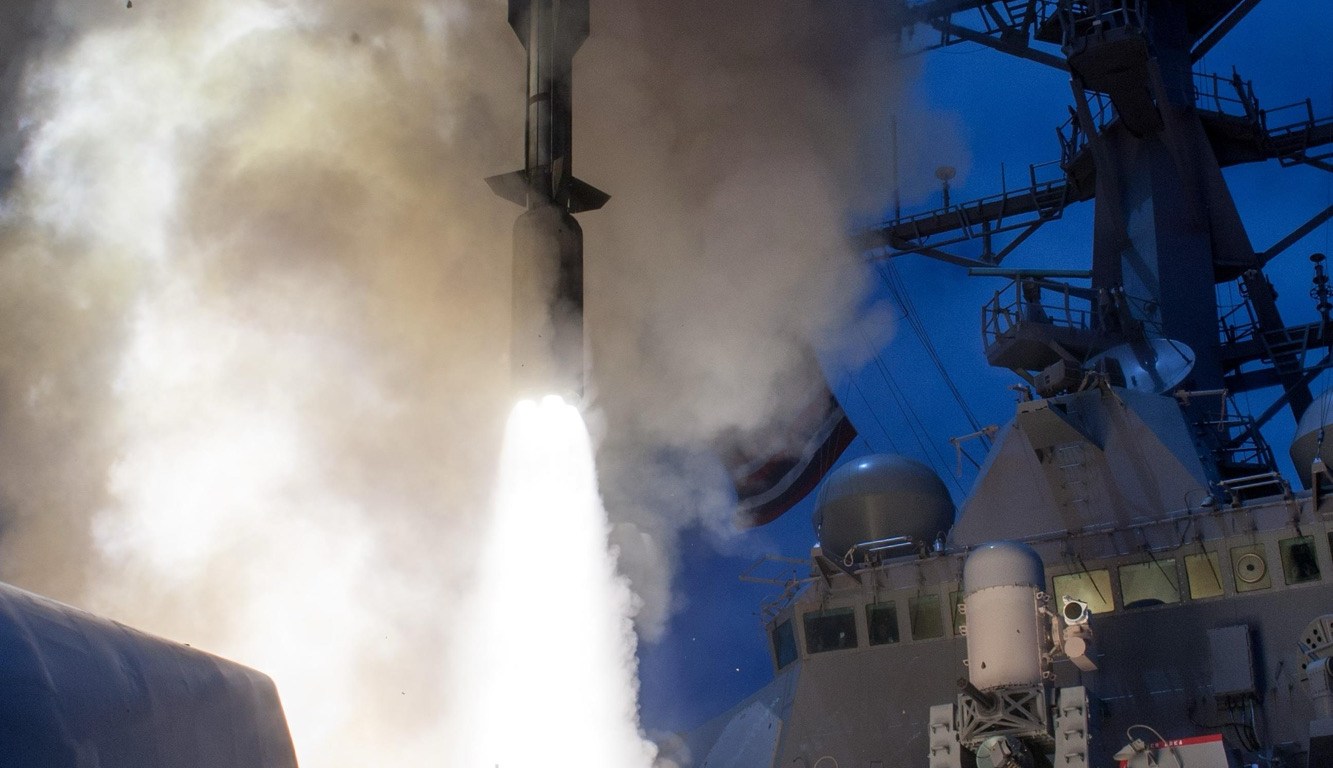
Image: US Navy successfully executed four flight tests of the surface-to-air Standard Missile-6 Block I (SM-6 Blk I) off the Hawaiian coast April 6-13 2017.
AI-assisted article.

